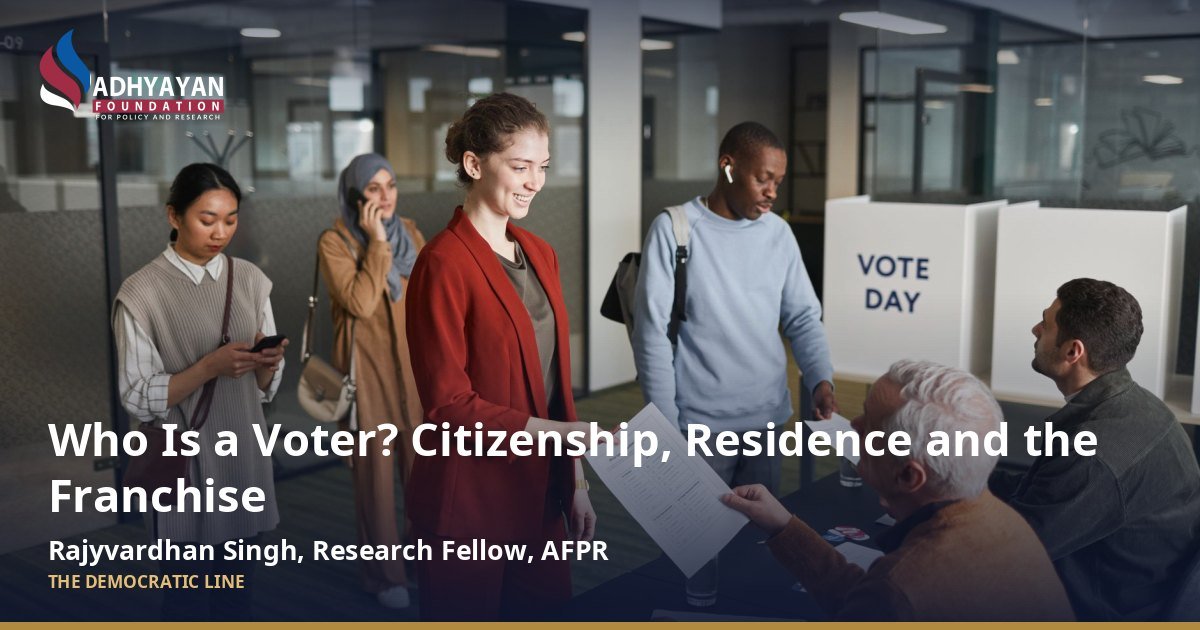
Every republic that grants the vote to its citizens must answer a prior question: who, exactly, is a citizen, and who among them lives where the roll says they live? No later stage of an election can restore a voter who was never listed or remove a name that should never have been there. The roll deserves the same constitutional seriousness as the vote itself, and the dispute over the Election Commission of India’s Special Intensive Revision (SIR) is more than a quarrel between a regulator and its critics.
The argument is simple. A democracy is entitled, indeed obliged, to confine its roll to citizens resident in the constituency, and to verify voter eligibility in India actively and not on faith. But the legitimacy of verification depends on how it is done. It must be led by the state’s own records and effort, not by a demand that the citizen reconstruct his paper trail. It must give notice, a hearing and an appeal before a name is removed. And it must leave the final word on citizenship with the authority the law designates. Where these conditions hold, clean rolls strengthen the franchise; where they fail, the cleaning becomes the injury. Democracies verify eligibility without excluding the eligible by making the state carry most of the burden of verification, and by making every adverse decision visible, reasoned and appealable.
The constitutional and statutory frame for voter eligibility in India
The Constitution fixes the outer boundary of the franchise in Article 326. Elections to the House of the People and to State Legislative Assemblies are to be held on the basis of adult suffrage. Every person who is a citizen of India, and who has reached the minimum age (now eighteen), is entitled to be registered, unless disqualified under the Constitution or a law made by the appropriate legislature on stated grounds, which include non-residence, unsoundness of mind, crime and corrupt or illegal practice.[1] Citizenship is thus a constitutional precondition, not an administrative preference, and the Constitution itself contemplates residence as a statutory ground of disqualification. The phrase “ordinarily resident” does not appear in Article 326; it enters through the statute.
The Representation of the People Act, 1950 supplies the working rules. Section 16 provides that a person who is not a citizen of India cannot be registered, and that a registered person who becomes disqualified must have his name removed.[2] Section 19 sets the two positive conditions of entitlement: that the person be at least eighteen on the qualifying date and that he be ordinarily resident in the constituency.[3] Section 20 explains the phrase: owning a dwelling does not by itself make a person ordinarily resident, temporary absence does not end residence, special rules cover service voters, and a disputed question is decided on all the facts.[4] The test is factual, not documentary, which matters when proof of residence is later demanded in paper.
Section 21 governs revision. Rolls are revised before each general election and bye-election, and section 21(3) adds that the Commission may order a special revision of the roll of any constituency or part of it, at any time and in the manner it thinks fit, provided it records reasons.[5] Section 22 empowers the Electoral Registration Officer to correct, transpose or delete an entry, including where a person has ceased to be ordinarily resident; the proviso requires a reasonable opportunity of being heard before he acts, save in the case of death.[6] Section 24 supplies the appellate layer, which the judgment discussed below records as an appeal to the District Magistrate and then to the Chief Electoral Officer.[7]
The law of citizenship sits elsewhere. Articles 5 to 11 of the Constitution deal with citizenship at its commencement; Article 5, for instance, extended citizenship to those domiciled in India who were born there, had a parent born there, or had been ordinarily resident for five years.[8] The Citizenship Act, 1955 then regulates acquisition and loss. Section 3, in the 1986 form reproduced on the page I consulted, makes birth in India a ground of citizenship where a parent is a citizen at the birth.[9] Section 9 provides that a citizen who voluntarily acquires another country’s citizenship ceases to be an Indian citizen, and section 9(2) says that disputes on that question are decided by a prescribed authority under prescribed rules of evidence.[10] The statute thus gives the roll-maker no general power to adjudicate citizenship, yet section 16 forbids him to register a non-citizen. How these two propositions sit together is the central difficulty of the subject.
What Lal Babu Hussein settled
The Supreme Court addressed this difficulty in Lal Babu Hussein v. Electoral Registration Officer, decided on 6 February 1995 by a bench headed by Chief Justice A. M. Ahmadi, and reported at (1995) 3 SCC 100 and AIR 1995 SC 1189.[11] The case arose from notices to persons already on the roll, asking them to show that they were citizens. The Court drew a line. Where a person seeks to be added, the officer may require evidence of citizenship. Where a name is already on the roll, the officer must presume that the necessary steps were followed when the entry was made. The Court also held that a person whose status is doubted must be told why the suspicion has arisen, that the material relied on must be disclosed, and that deletion requires a reasoned order. Proceedings in all three cases were quashed, with liberty to start afresh on proper notice.[11]
The Special Intensive Revision and the Court’s judgment
The Commission announced an SIR of the Bihar roll on 24 June 2025, with 1 July 2025 as the qualifying date, ahead of the Assembly elections. Challenges under Article 32 followed.[12] The Bihar pre-revision roll stood at 7.89 crore electors. The draft roll, published on 1 August 2025, listed 7.24 crore, so some 65 lakh names were not carried forward, for reasons the Commission classed as death, migration and duplication. Claims and objections then added 21.53 lakh electors and a further 3.66 lakh were removed as ineligible, leaving a final roll of 7.42 crore published on 30 September 2025.[13] These are the Commission’s figures as reported by All India Radio and the Tribune.
The litigation produced interim orders that shaped the exercise. The Commission’s enumeration form listed eleven documents, and petitioners complained that officials were not accepting Aadhaar on its own. On 8 September 2025 a bench of Justices Surya Kant and Joymalya Bagchi directed that Aadhaar be treated as the twelfth document, as proof of identity only, noting that under the Aadhaar Act it is not proof of citizenship.[14] The Court also directed publication of the list of about 65 lakh excluded names with reasons, and enabled claims with Aadhaar or any listed document, as the judgment itself records.[15]
On 27 May 2026 the same bench, now headed by Chief Justice Surya Kant, delivered judgment in Association for Democratic Reforms v. Election Commission of India, W.P.(C) 640 of 2025, reported as 2026 INSC 564.[15] The Court’s conclusions are set out in paragraph 186 of the judgment.[15]
On the power of the Commission, the Court upheld the SIR as an exercise traceable to section 21(3) of the 1950 Act read with Article 324. It read section 21(3) as a flexible power, and held that a State-wide revision was therefore permissible where inaccuracies are systemic, as migration and urbanisation can make them.[16][17] The exercise satisfied proportionality, since the measures could not be said to be disproportionate to the object, and notice, a claims window and appellate remedies preserved fairness in substance.[15][16] The substance of Rule 21A of the Registration of Electors Rules, 1960, namely notice, enquiry, hearing and a reasoned decision, applied within the SIR.[16][17]
On citizenship, the Court adopted a middle course. Citizenship is a statutory condition of registration under section 16, so the Commission cannot maintain an accurate roll without being satisfied on it. But the Commission’s inquiry is “limited” and is made for the purpose of electoral representation. It is not a determination of citizenship under the 1955 Act, which remains with the competent authority; an adverse finding by the Commission has electoral consequences only and does not amount to a declaration that the person is not a citizen. Where the Commission is not satisfied, it must refer the matter to the competent authority. According to the Supreme Court Observer and Verdictum summaries, the Court did not accept the petitioners’ reliance on section 9(2) of the Citizenship Act as ousting the Commission’s incidental power.[16][17]
On documents, the Court treated the Commission’s list as a structured scheme within its discretion, noting that it had grown during the exercise. The Court held that the EPIC is “a derivative document, issued on the basis of inclusion in the electoral roll”, and that a ration card “is certainly not a conclusive proof of citizenship” (paras 158-159).[15] Aadhaar was accepted for identity under section 23(4) of the 1950 Act but, the Court recorded, is not proof of citizenship.[14][15]
On the burden of proof, the Court held that the presumption in favour of names already on the roll is real but rebuttable. Asking electors for supporting material did not by itself displace it, because an intensive revision is a verification exercise that confirms or corrects existing entries. The Court confined Lal Babu Hussein to individual adjudicatory proceedings and held that it does not bar a systemic intensive revision, treating the 2003 roll as a more reliable reference point than later summary revisions (paras 114, 124-125).[15] That is a significant narrowing; the Commission’s submission, recorded in the judgment, was that no “absolute or irrebuttable” presumption attaches to a name merely because it is on the roll.[15] On Form 6, the judgment records that a new voter had to file it with a declaration annexed to the Commission’s order.[15] I found no holding on that declaration as such and attribute none to the Court; the Supreme Court Observer summary says only that the Commission could set a separate documentation regime for an intensive revision.[16]
The directions, in paragraph 186(h), are as follows. The Commission must refer, within four weeks, those deleted from the 2003 Bihar roll on citizenship grounds to the competent authority under the Citizenship Act, which is to decide after notice and a hearing, preferably before the next Parliamentary, Assembly or local body elections, whichever is earlier. Those found to be citizens are to be restored. And those wrongly removed for reasons such as absence may seek judicial review.[15]
The comparative picture
In Great Britain, the annual canvass is a statutory duty. Since the Electoral Registration and Administration Act 2013 inserted section 9D into the Representation of the People Act 1983, every registration officer must each year seek out people entitled to be registered who are not, and registered people who are no longer entitled, and may make house-to-house enquiries where a form is not returned.[18] The burden of finding the gaps is expressly the officer’s.
Germany relies on its population registers. German citizens registered with the registration office on the forty-second day before the election are entered in the voters’ register automatically. Each should receive a notification by the twenty-first day, and between the twentieth and sixteenth day may inspect the entry and lodge an objection (Einspruch).[19] Eligibility checking there is a by-product of compulsory civil registration, which India lacks in comparable form.
Australia is the clearest example of state-run verification. The Australian Electoral Commission’s direct enrolment programme draws on driver’s licence authorities, Services Australia, the Tax Office and the Department of Home Affairs; the AEC writes to the person before adding or changing details and allows twenty-eight days to correct them before any action.[20] Direct enrolment accounted for about 47 per cent of enrolment transactions in July 2023 (my calculation from a parliamentary table), and a witness told a committee that roll accuracy was in the high nineties; I record that as testimony, not audited statistic.[21] The AEC’s page does not address how citizenship is verified, but the programme shows how far an administration can go in finding eligible persons itself.
The United States offers the other pole. In Crawford v. Marion County Election Board (decided 28 April 2008) the Supreme Court upheld Indiana’s photo-identification law against a facial challenge, accepting the State’s interests in deterring fraud and protecting confidence in elections.[22] In Arizona v. Inter Tribal Council of Arizona, 570 U.S. 1 (17 June 2013), it held that a State could not reject federal-form applicants for want of documentary proof of citizenship, though States may refuse registration on information in their possession showing ineligibility.[23] The American debate is largely about a documentary hurdle placed on the citizen, and about who may impose it, which is the feature of the Indian exercise that critics find hardest to accept. In the German and Australian examples reviewed here, by contrast, notice and a window to respond come before the register is altered, and the effort begins with the state’s own records. None is directly transferable to India, whose civil registration is incomplete and whose population is mobile, but they show what reform should aim at.
Two kinds of error, and the strongest objection
Every roll makes two kinds of mistake. An inclusion error places on the roll a person who is not entitled to be there: a non-citizen, a deceased elector, a duplicate, a person who has moved. An exclusion error leaves off or removes a person who is entitled. The two are not equally visible: a suspected phantom voter attracts attention, while an eligible citizen quietly left out rarely has a voice and may not know until polling day. Nor are they equally reversible: a wrongly included name can be struck off before polling, whereas a wrongly excluded voter who learns of it on polling day has lost the franchise for that election.
For this reason an honest system cannot aim at zero of both. Tightening verification reduces inclusion errors and raises the risk of exclusion errors, unless the state compensates with effort and appeal. The case for clean rolls is a case about the legitimacy of the count: an inflated roll carrying the dead, the departed and the duplicated distorts turnout figures, invites impersonation and erodes confidence. The 2025-26 revisions have produced large numbers. The first two phases were reported to have covered nearly 59 crore electors.[24] In the second phase, the rolls of twelve States and Union Territories fell from over 50.99 crore to 45.81 crore, a net reduction of over 5.18 crore or 10.2 per cent, according to a PTI report of 11 April 2026.[25] The third phase, announced on 14 May 2026 for sixteen States and three Union Territories and about 36.73 crore electors,[24] was reported on 10 August 2026 to have removed about 1.5 crore names in twelve States and Union Territories, though that report gave no breakdown or clear statement that these were draft-stage removals.[26] I could not reconcile the press reports into one authoritative national total, and readers should not add them. The totals say nothing of how many removed were eligible citizens.
That last point is the strongest objection to the Commission’s course, and it should be stated in its strongest form. The objection runs as follows. A reduction in the roll tells us nothing about whether the roll became more accurate. It may fall because the dead and the duplicate have been removed. It may also fall because the poor, the mobile, the elderly, married women who have moved, and migrant workers cannot produce the right document at the right address. Where many citizens hold few formal records, a document test in practice tests the ability to produce documents, which is not the same as citizenship. If the burden shifts to those already enrolled, the objection concludes, exclusion errors become far likelier than inclusion errors, and the presumption in Lal Babu Hussein is hollowed out.
This objection deserves a serious reply. First, the Court examined the point and held the exercise proportionate, and institutions should be respected when they reach that conclusion. Second, the presumption was narrowed, not reversed: it was kept as rebuttable, and what was rejected was the proposition that an entry carried forward for decades without verification is beyond re-examination. A roll no one may re-examine accumulates errors without limit. Third, the Court did not leave exclusion unremedied. It widened the documents accepted, required disclosure of those removed with reasons, enabled claims through party agents and legal-services volunteers, and left the final decision on citizenship with the competent authority.[14][16][17] The objection is answered to the extent the safeguards work in practice, which is an empirical question on which the public record is still incomplete. How many of those removed were later restored on claim or appeal, and how fast, is what a conscientious reader should ask for.
Safeguards, technology and a reform proposal
Four safeguards matter most, and each has a statutory basis. The first is notice: a person whose entry is proposed to be removed for non-residence or non-entitlement must be given a reasonable opportunity of being heard under the proviso to section 22.[6] The second is a reasoned order; Lal Babu Hussein required it and the SIR judgment held that the substance of Rule 21A applies.[11][16] The third is the claims and objections period, which in Bihar produced a net addition of electors between draft and final rolls.[13] The fourth is appeal under section 24.[7] An appeal assumes an aggrieved person who knows an order has been made and can find the forum; no data I could find shows how often it is used, which is itself a gap.
Technology can help or harm. Deduplication, matching against death registers and seeding of Aadhaar to roll entries can identify inclusion errors at scale with less intrusion than a house visit. But a software match is a lead, not a finding: a name flagged as a likely duplicate or a “logical discrepancy” should trigger a human inquiry and a notice, not automatic removal. According to the Supreme Court Observer’s case page, in October 2026 the Court noted that the legality of the “logical discrepancy” concept was still undecided.[12] Aadhaar is useful for what it is: proof of identity, not of citizenship.[14]
On this basis the following reform is proposed, to strengthen the Commission and not displace it. First, the state should shoulder the first stage of verification: before any elector is asked for a document, the Registration Officer should match the roll against the state’s own records of births, deaths, pensions and similar datasets, and confirm matches by notice, as the Australian model does, so that document demands fall only on the residual cases. Second, a flagged entry should carry a written, specific reason served on the elector, with a fixed period to respond. Third, a deletion on the ground of doubtful citizenship should not take effect until the competent authority under the Citizenship Act has decided, within a statutory time limit; the Court has required referral, and the Registration of Electors Rules should make the sequence explicit so that the burden of delay does not fall on the elector. Fourth, officers should be obliged to tell a person of his right of appeal under section 24, and the Commission should publish, State by State, the numbers of notices issued, hearings held, claims allowed and appeals decided, so that the exclusion rate can be measured. Fifth, a short list of documents, with an alternative of a sworn declaration supported by a local verifier, should be notified well before any revision. A rule that the voter must prove everything, and a rule that nothing may be questioned, are equally unfit for a republic whose elections must be believed by the losers as well as the winners.
Conclusion
Who is a voter? In law, a citizen of India who is eighteen or older, ordinarily resident in the constituency, and not disqualified. In practice, a person the state has found, or who has persuaded it, to enter on a list. The judgment of 27 May 2026 settles the Commission’s authority to conduct an intensive revision, to make a limited inquiry into citizenship for electoral purposes and to ask for supporting material, while holding that the Commission does not decide citizenship and that its adverse findings are subject to referral and hearing. That is a conservative and institutionally sound settlement: it protects the integrity of the franchise and keeps the final word on nationality where Parliament put it.
The answer to the question this essay was set is that democracies verify eligibility without excluding the eligible by assigning the effort to the state, notifying before acting, reasoning every adverse decision, giving a real appeal, and measuring the errors in both directions. India has the framework and judicial confirmation of the Commission’s powers. What remains is administrative discipline and public transparency, so that the large numbers now being struck from the rolls can be shown to be the dead, the departed and the duplicated, and not the poor, the mobile and the unrecorded. A roll that is honest about its errors, and corrects them in public, will earn the trust on which every count depends.
Frequently asked questions
Who is eligible to be registered as a voter in India?
A citizen of India aged eighteen or older, ordinarily resident in the constituency and not disqualified. Article 326 fixes citizenship and adult suffrage, and sections 16 and 19 of the Representation of the People Act, 1950 supply the working rules.
Can the Election Commission decide whether a voter is a citizen?
The article reports that in the Court’s judgment of 27 May 2026 the Commission’s inquiry is limited and for electoral purposes only. It is not a determination of citizenship under the 1955 Act, and where the Commission is not satisfied it must refer the matter to the competent authority.
What did Lal Babu Hussein decide?
In Lal Babu Hussein v. Electoral Registration Officer ((1995) 3 SCC 100) the Court held that a person already on the roll is presumed to have been properly entered, must be told why suspicion has arisen, and can be removed only by a reasoned order.
What does the article propose to make roll verification fair?
The state should do the first stage of verification from its own records, serve written reasons with a fixed time to respond, delay deletions for doubtful citizenship until the competent authority decides, tell electors of their appeal right, and publish State-wise data on notices, hearings, claims and appeals.
Further reading from AFPR: Counting the Counters: SIR Across the States, Phase by Phase · Petition, Not Placard: Why the Street Cannot Stand In for the Supreme Court, the Election Commission and the Constitution
Notes and References
[1] Constitution of India, Article 326, text as published at constitutionofindia.net (Constitution Society of India resource), “Article 326: Elections to the House of the People and to the Legislative Assemblies of States to be on the basis of adult suffrage”. Undated. https://www.constitutionofindia.net/articles/article-326-elections-to-the-house-of-the-people-and-to-the-legislative-assemblies-of-states-to-be-on-the-basis-of-adult-suffrage/ . Opened.
[2] Representation of the People Act, 1950, section 16, bare-act text at advocatekhoj.com. Undated. https://www.advocatekhoj.com/library/bareacts/representation/16.php . Opened. (Secondary reproduction of the statute, not India Code.)
[3] Representation of the People Act, 1950, section 19, advocatekhoj.com. Undated. https://www.advocatekhoj.com/library/bareacts/representation/19.php . Opened.
[4] Representation of the People Act, 1950, section 20, advocatekhoj.com. Undated. https://www.advocatekhoj.com/library/bareacts/representation/20.php . Opened.
[5] Representation of the People Act, 1950, section 21, advocatekhoj.com. Undated. https://www.advocatekhoj.com/library/bareacts/representation/21.php . Opened.
[6] Representation of the People Act, 1950, section 22, advocatekhoj.com. Undated. https://www.advocatekhoj.com/library/bareacts/representation/22.php . Section 23(4)-(6) were inserted by the Election Laws (Amendment) Act, 2021 (Act 49 of 2021).
[7] Representation of the People Act, 1950, section 24, advocatekhoj.com. Undated. https://www.advocatekhoj.com/library/bareacts/representation/24.php . Section 24 provides an appeal to the District Magistrate, Additional District Magistrate or equivalent officer against an order under section 22 or 23, and a further appeal to the Chief Electoral Officer.
[8] Constitution of India, Article 5, constitutionofindia.net. Undated. https://www.constitutionofindia.net/articles/article-5-citizenship-at-the-commencement-of-the-constitution/ . Opened. Articles 6 to 11 were not opened; the statement that Articles 5 to 11 form the citizenship provisions of Part II reflects the instruction brief and general knowledge and was not confirmed on a page.
[9] Citizenship Act, 1955, section 3, advocatekhoj.com. Undated. https://www.advocatekhoj.com/library/bareacts/citizenship/3.php . Opened. The page reproduces the 1986 text and does not include the later 2003 amendment.
[10] Citizenship Act, 1955, section 9, advocatekhoj.com. Undated. https://www.advocatekhoj.com/library/bareacts/citizenship/9.php . Opened.
[11] Supreme Court of India, Lal Babu Hussein and others v. Electoral Registration Officer and others, decided 6 February 1995, (1995) 3 SCC 100; AIR 1995 SC 1189. Judgment text at the Supreme Court’s judis archive. https://api.sci.gov.in/jonew/judis/10904.pdf . Opened.
[12] Supreme Court Observer, “Challenge to the ECI’s Revision of Electoral Rolls in Bihar”, case page with timeline, accessed 29 October 2026. https://www.scobserver.in/cases/challenge-to-the-ecis-revision-of-electoral-rolls-in-bihar-sir-association-for-democratic-reforms-v-election-commission-of-india/ . Opened. The statement about the October 2026 “logical discrepancy” observation is from this page, which concerns a later phase and not the Bihar judgment itself.
[13] The Tribune (India), “Bihar voter count drops to 7.42 cr, 65 lakh deleted, 21 lakh added during SIR”, around 30 September 2025. https://www.tribuneindia.com/news/india/bihar-voter-count-drops-to-7-42-cr-65-lakh-deleted-21-lakh-added-during-sir/amp ; All India Radio, “EC releases final voter list for Bihar Assembly elections”, https://www.newsonair.gov.in/ec-releases-final-voter-list-for-bihar-assembly-elections . Press reports of Election Commission figures.
[14] LiveLaw, “Supreme Court Directs ECI To Accept Aadhaar Card As ’12th Document’ In Bihar SIR As Proof Of Identity”, 8 September 2025. https://www.livelaw.in/top-stories/supreme-court-directs-eci-to-accept-aadhaar-card-as-12th-document-in-bihar-sir-as-proof-of-identity-303182 . Opened. Also corroborated by the judgment’s recital at para 10.13 (see [15]).
[15] Supreme Court of India, Association for Democratic Reforms v. Election Commission of India, W.P.(C) 640 of 2025, judgment of 27 May 2026, 2026 INSC 564 (CJI Surya Kant and Justice Joymalya Bagchi). https://api.sci.gov.in/supremecourt/2025/35785/35785_2025_1_1501_71617_Judgement_27-May-2026.pdf . Conclusions at para 186. No SCC or AIR citation has yet been reported.
[16] Supreme Court Observer, “Challenge to the ECI’s Revision of Electoral Rolls in Bihar: Judgement Summary”, 2026. https://www.scobserver.in/reports/challenge-to-the-ecis-revision-of-electoral-rolls-in-bihar-judgement-summary/ . Opened. Secondary summary, used for the reading of section 21(3), Rule 21A and section 9(2); the holdings on EPIC, ration cards, Lal Babu Hussein and the directions are cited to the judgment itself [15].
[17] Verdictum, “ECI Can Conduct ‘Limited Enquiry’ On Citizenship For Voter List Verifications; It Will Not Amount To Determination Of Citizenship: Supreme Court” (2026 INSC 564), May 2026. https://www.verdictum.in/supreme-court/2026-insc-564-association-for-democratic-reforms-v-election-commission-of-india-1614782 . Opened. Secondary report; quoted phrases are from this report’s extracts of the judgment.
[18] legislation.gov.uk, Electoral Registration and Administration Act 2013, section 4 (inserting section 9D into the Representation of the People Act 1983). https://www.legislation.gov.uk/ukpga/2013/6/section/4 . Opened.
[19] Die Bundeswahlleiterin, glossary entry “Wählerverzeichnis”. https://bundeswahlleiterin.de/service/glossar/w/waehlerverzeichnis.html . Opened. Read in German; summarised in English by the author.
[20] Australian Electoral Commission, “Direct Enrolment and Direct Update” (Federal Direct Enrolment and Update). https://aec.gov.au/Enrolling_to_vote/About_Electoral_Roll/direct.htm . Opened. Undated.
[21] Parliament of Australia, Joint Standing Committee on Electoral Matters, “Chapter 3: Single national electoral roll”, Report on the 2022 federal election. https://www.aph.gov.au/Parliamentary_Business/Committees/Joint/Electoral_Matters/2022federalelection/Conduct_of_the_2022_federal_election_and_other_matters/Chapter_3_-_Single_national_electoral_roll . Opened. The 47 per cent figure is calculated from a table in the chapter (98,856 of 208,442 transactions in July 2023); the accuracy range is a witness’s testimony.
[22] Crawford v. Marion County Election Board, No. 07-21, Supreme Court of the United States, decided 28 April 2008; syllabus at Cornell Legal Information Institute. https://www.law.cornell.edu/supct/html/07-21.ZS.html . Opened. The U.S. Reports citation was not given on the page and is omitted.
[23] Arizona v. Inter Tribal Council of Arizona, Inc., 570 U.S. 1 (2013), decided 17 June 2013, Justia. https://supreme.justia.com/cases/federal/us/570/1 . Opened (first 100,000 characters).
[24] Press Information Bureau, Government of India, Election Commission of India press release on Phase III of the Special Intensive Revision, 14 May 2026. https://www.pib.gov.in/PressReleasePage.aspx?PRID=2260955®=48&lang=2 . Opened.
[25] The Federal (PTI), “SIR trims voter rolls by 10pc in 12 states, UTs; over 5.18 cr names scrapped”, 11 April 2026. https://thefederal.com/elections-2026/ec-sir-12-states-ut-reduces-voter-rolls-by-10pc-over-5-crore-names-scrapped-elections-2026-238635 . Opened. The article does not explain all of the reduction.
[26] The Wire, “Another 1.5 crore voters deleted in 12 states and 3 union territories during SIR Phase 3”, 10 August 2026. https://thewire.in/politics/another-1-5-crore-voters-deleted-in-12-states-and-3-union-territories-during-sir-phase-3 . Opened (headline-level detail only; the figure is approximate and the page did not state whether it referred to draft rolls).