
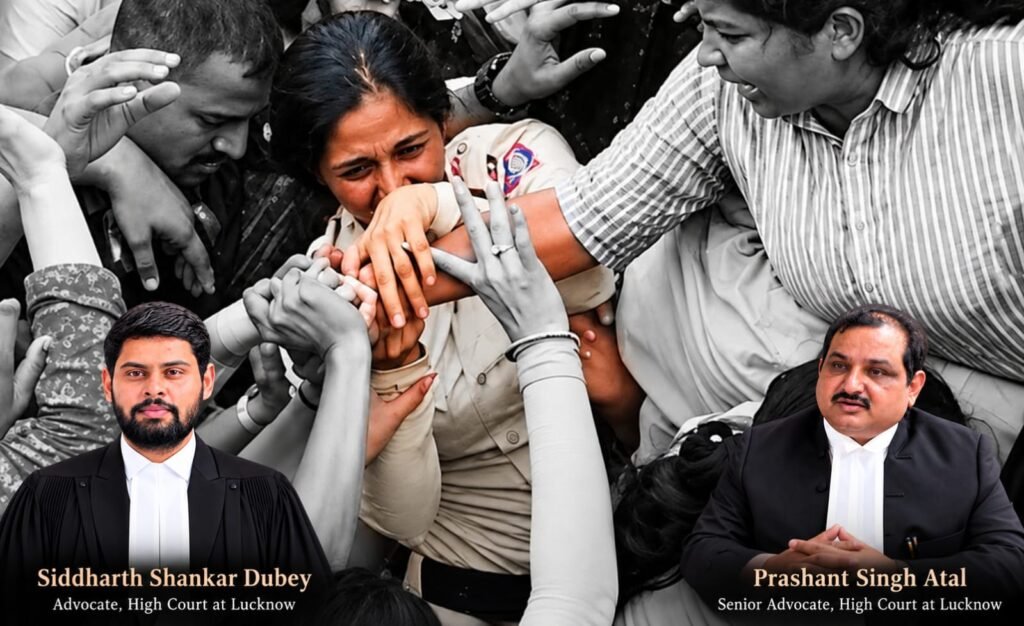
By Prashant Singh Atal, Designated Senior Advocate, High Court at Lucknow, and Siddharth Shankar Dubey, Advocate, High Court at Lucknow
In the second week of October 2026, the national capital was witness to a convergence that ought to give pause to anyone who believes that a republic is held together by its institutions rather than by its loudest voices. A youth movement that calls itself the Cockroach Janta Party, the principal parties of the INDIA bloc, and a cluster of student organisations including AISA, SFI, AISF and the student wing of the Aam Aadmi Party gathered behind a single demand, namely that the Chief Election Commissioner, Gyanesh Kumar, resign over the Special Intensive Revision of electoral rolls. Reuters, citing a Home Ministry official, placed the number detained in Delhi on 10 October at about two thousand, while The Hindu, citing police sources, placed it at nearly two thousand five hundred, and some six hundred more were arrested in Mumbai. Among those detained were functionaries of the Congress, the Trinamool Congress, the Aam Aadmi Party, the CPI(M) and the CPI(ML) Liberation, and a member of the Cockroach Janta Party, Ratna Singh, later stated that its leaders had been released on the condition of “no breach of peace for one year”. Within forty eight hours the agitation had travelled from the gates of Nirvachan Sadan to the doors of the Supreme Court, where a memorandum was sought to be handed to the Chief Justice of India, and when the Chief Justice declined to receive it, the Kerala unit of the Congress publicly asked him, too, to resign.
There is a telling irony in the very name of the movement. On 15 May 2026, during the hearing of a contempt matter concerning the conferment of senior designations in the Delhi High Court, a remark of Chief Justice Surya Kant was reported as having likened unemployed youngsters to cockroaches. On the very next day the Chief Justice clarified that his criticism had been directed at those who had entered noble professions such as the Bar on the strength of fake degrees, and that it was entirely baseless to suggest that he had spoken against the youth of the nation. The clarification did not travel as far as the misquote. Within forty eight hours a former social media strategist of the Aam Aadmi Party had launched an online “party” that gathered millions of followers on the strength of a sentence the Chief Justice had never meant. A movement that began by misreading a courtroom has, in the months since, continued by misreading the Constitution.
The argument of this article is a simple one, though its implications are not. The street, whatever its passion and whatever its numbers, cannot replace the institutional credibility of the Supreme Court, the Election Commission of India or Parliament, because these bodies derive their authority not from popularity but from the Constitution, and because the questions now being shouted in the streets are questions that the Constitution has already assigned to a forum, a procedure and a remedy. Nobody disputes the right to protest, which Article 19(1)(b) guarantees to every citizen who assembles peaceably and without arms. What is in dispute is whether a crowd may decide what a court is already hearing, and whether a demand for resignation may substitute for the procedure of removal that the Constitution prescribes. To answer that, four distinct but connected questions must be examined: first, whether the Special Intensive Revision is a lawful exercise or a partisan contrivance; second, whether the Election Commission, as it is now constituted, deserves more suspicion than its predecessors; third, how the Supreme Court may legitimately be approached, and why a memorandum and a resignation demand are no substitute for a petition; and fourth, what follows when mobilisation displaces adjudication, when outrage becomes selective, and when an open and leaderless movement becomes vulnerable to influences that have no stake in India’s constitutional health.
When sovereignty passed into Indian hands in August 1947, the framers of the Constitution were acutely conscious that a people who had won their freedom through mass movements would be tempted to continue governing themselves through mass movements. The Constitution that came into force on 26 January 1950 answered that temptation by locating the sovereignty of the people not in the crowd but in institutions that the people themselves created: a Parliament elected on adult franchise, an Election Commission vested by Article 324 with the superintendence, direction and control of electoral rolls and elections, and a Supreme Court established by Article 124 and charged by Article 32 with enforcing the fundamental rights of every citizen. Dr B.R. Ambedkar, closing the debates of the Constituent Assembly on 25 November 1949, put the matter with a clarity that has not dated: “But where constitutional methods are open, there can be no justification for these unconstitutional methods. These methods are nothing but the Grammar of Anarchy and the sooner they are abandoned, the better for us.”
The same architecture is reflected in the doctrine of separation of powers, which the Supreme Court has treated as part of the basic structure of the Constitution. In Ram Jawaya Kapur v. State of Punjab (1955) the Court observed that “our Constitution does not contemplate assumption, by one organ or part of the State, of functions that essentially belong to another”, and in Kesavananda Bharati v. State of Kerala (1973) Chief Justice Sikri counted among the essential features of the Constitution the “Separation of powers between the Legislature, the executive and the judiciary.” If no organ of the State may usurp the function of another, it follows with greater force that no crowd may usurp the function of all three. The Indic tradition anticipated this long before the Constituent Assembly did, for the Upanishadic teaching that Dharma is the power above power, the authority that binds even the king, is precisely the idea that the modern Constitution translated into the language of institutions. It is no accident that Article 51A(a) makes it the first fundamental duty of every citizen “to abide by the Constitution and respect its ideals and institutions”.
The Special Intensive Revision has been described in the streets as an invention of the present Commission. It is nothing of the kind. Article 324(1) vests in the Election Commission the superintendence, direction and control of the preparation of electoral rolls, and Article 326 confines the franchise to citizens of India who are not less than eighteen years of age. Section 16 of the Representation of the People Act, 1950 disqualifies a person who is not a citizen from registration, Section 19 requires ordinary residence in the constituency, and while Section 21(2) provides for the routine revision of rolls before each election, Section 21(3) expressly empowers the Commission, at any time and for reasons to be recorded, to direct a special revision of the roll for any constituency or part of it in such manner as it thinks fit. Rule 25 of the Registration of Electors Rules, 1960 in turn contemplates that rolls may be revised intensively, summarily, or partly in one manner and partly in the other. Far from being novel, intensive revisions were carried out repeatedly between Independence and 2004, the last being the staged special revision of 2002 to 2004, under which Bihar’s roll was revised between May 2002 and January 2003. The present exercise, ordered for Bihar on 24 June 2025 and extended on 27 October 2025 to a second phase covering twelve States and Union Territories including Kerala, Tamil Nadu and West Bengal, is the ninth such exercise in the life of the Republic.
The constitutional reach of Article 324 has never been in doubt. In Mohinder Singh Gill v. Chief Election Commissioner (1978), a Constitution Bench held that “Article 324, in our view, operates in areas left unoccupied by legislation”, recognising the Commission as the repository of plenary power where statute is silent. In Lal Babu Hussein v. Electoral Registration Officer (1995) the Court accepted that electoral authorities may inquire into the citizenship of a person whose inclusion in the roll is questioned, provided they act fairly and give the person concerned a hearing. And on 27 May 2026, in Association for Democratic Reforms v. Election Commission of India, a Bench presided over by Chief Justice Surya Kant upheld the Special Intensive Revision as traceable to Section 21(3) read with Article 324, holding that the exercise “breathes life into the constitutional mandate of Article 324” and that its object, the “restoration of accuracy, completeness, and integrity of the electoral roll”, is a legitimate one. The judgment did not hand the Commission an unbounded power. It held that the Commission may conduct only a limited inquiry into citizenship for electoral purposes and cannot finally determine citizenship, that an elector already on the roll enjoys a presumption in his favour, and that persons about whom the Commission is not satisfied must be referred to the competent authority under the Citizenship Act, 1955. In other words, the very Court whose Chief Justice is now asked to resign has already examined the exercise, upheld its legality and built safeguards into its operation.
What remains to be decided is already before that Court. On 15 October 2026, a Bench of the Chief Justice and Justice Joymalya Bagchi issued notice on the petition filed by the Leader of the Opposition and other INDIA bloc leaders, tagged connected matters relating to the revision, and observed that as many as forty six matters were already pending. The issues raised in the memorandum that the Chief Justice declined to receive are therefore sub judice in the most literal sense, and the demand that the revision be suspended by public pressure while the Court is seized of it is a demand that the Court abdicate its own jurisdiction. Equally, the call to annul recently concluded Assembly elections ignores Article 329(b), which provides that no election to Parliament or to a State Legislature shall be called in question except by an election petition presented in the manner provided by law, a petition which the Representation of the People Act, 1951 requires to be filed within forty five days of the declaration of results. The Constitution has foreseen the grievance and provided the remedy; what it has not provided, and could never provide, is a remedy by procession.
Those who today accuse the Election Commission of having become an instrument of the government would do well to recall the conditions under which the Commission functioned for most of its history. From 1950 until 2023, Parliament never enacted the law contemplated by Article 324(2), and the Chief Election Commissioner and the Election Commissioners were appointed by the President on the advice of the Union Council of Ministers alone, without any statutory process, without any role for the Leader of the Opposition and without any public scrutiny. For the greater part of those seven decades the Council of Ministers was a Congress one, and the record of that period is instructive. R.K. Trivedi demitted office as Chief Election Commissioner on 31 December 1985 and was appointed Governor of Gujarat on 26 February 1986. On 7 October 1989, on the eve of a general election, the Congress government of the day created two posts of Election Commissioner and filled them on 16 October, only for the posts to be abolished on 1 January 1990 after a change of government. In S.S. Dhanoa v. Union of India (1991) the Supreme Court recorded, with evident disapproval, that “In the first instance, the petitioner and the other Election Commissioners were appointed when the work of the Commission did not warrant their appointment.”
The pattern did not end there. T.N. Seshan, rightly remembered as the Chief Election Commissioner who gave the Commission its teeth, contested the 1999 Lok Sabha election from Gandhinagar as the candidate of the Congress. M.S. Gill, Chief Election Commissioner from December 1996 to June 2001, entered the Rajya Sabha as a Congress member in April 2004 and was made a Union Minister in 2008. Most strikingly, in January 2009 the then Chief Election Commissioner, N. Gopalaswami, invoked the proviso to Article 324(5) and recommended the removal of Election Commissioner Navin Chawla, citing a series of instances of partisan conduct. The Congress led government rejected the recommendation, and Mr Chawla was elevated as Chief Election Commissioner in April 2009 and presided over that year’s general election. One need not impute motives to any individual to recognise what the record demonstrates: an appointment process controlled entirely by the executive of the day, operated for decades by the very party that now protests most loudly, produced a sequence of post retirement rewards and partisan controversies that no subsequent Commission has matched.
It was the judiciary, not the street, that corrected this. In Anoop Baranwal v. Union of India (2023), a Constitution Bench directed that until Parliament made a law, appointments be made on the advice of a committee comprising the Prime Minister, the Leader of the Opposition and the Chief Justice of India. Parliament then exercised the power that Article 324(2) had always reserved to it and enacted the Chief Election Commissioner and Other Election Commissioners (Appointment, Conditions of Service and Term of Office) Act, 2023. Under that Act a Search Committee prepares a panel of five names, and the Selection Committee comprises the Prime Minister, a Union Cabinet Minister nominated by him, and the Leader of the Opposition in the Lok Sabha, with the leader of the single largest opposition party deemed to be the Leader of Opposition where none is recognised. For the first time in seventy five years, therefore, the opposition sits by right at the table where Election Commissioners are chosen, and its voice is a matter of record: when the present Chief Election Commissioner was selected in February 2025, the Leader of the Opposition placed a dissent note before the committee. The same Act requires that the business of the Commission be transacted unanimously as far as possible, and that where the Commissioners differ the opinion of the majority shall prevail. Much has been made of a press report that two Election Commissioners had formally objected to aspects of the revision; the Commission has maintained that its decisions were unanimous, and Senior Advocate Harish Salve has pointed out that a Commissioner who disagrees records a dissent, and that a dissent cannot be dressed up as a unanimous decision or a unanimous decision as a dissent. Whichever account is correct, the question of collective decision making is now before the Supreme Court in the opposition’s own petition.
The validity of the 2023 Act is itself under challenge, and on 23 September 2026 a two Judge Bench, having differed on whether the challenge warranted a reference, directed that the matter be placed before the Chief Justice for the constitution of a Constitution Bench. That is precisely how a constitutional democracy resolves a contested question about its institutions. The Constitution, moreover, has deliberately insulated the Chief Election Commissioner by providing in Article 324(5) that he shall not be removed except in like manner and on like grounds as a Judge of the Supreme Court. A demand that he resign because a movement disapproves of his decisions is therefore not a demand for accountability; it is an attempt to achieve by public pressure what the Constitution permits only through an address of both Houses of Parliament on the ground of proved misbehaviour or incapacity.
If the Election Commission has been targeted for discharging its mandate, the Supreme Court has been targeted for insisting on its procedure. Article 32 guarantees the right to move the Supreme Court “by appropriate proceedings”, and the phrase is not ornamental. Article 136 provides for special leave petitions, Article 131 for disputes between the Union and the States, and Article 143 for references by the President, while Article 145 empowers the Court to make rules regulating its own practice and procedure. The Supreme Court Rules, 2013 made under that power are unambiguous. Order XXXVIII provides that “Every petition under Article 32 of the Constitution shall be in writing”, and Order IV reserves to an Advocate on Record the right to file an appearance or act for a party. Even the epistolary jurisdiction that the Court developed in S.P. Gupta v. Union of India (1981) and Bandhua Mukti Morcha v. Union of India (1984) for the benefit of those too poor or too oppressed to approach it formally has, since the Full Court guidelines of 1 December 1988, been confined to defined categories and permitted to proceed only on the direction of the Judge nominated for the purpose.
The distinction between a petition and a memorandum is therefore not one of form but of substance. A petition invokes a defined jurisdiction; it discloses a cause of action, is verified on affidavit, sets out specific prayers, is served upon the opposite party, and culminates in an adjudication on law and evidence that binds those before the Court. A memorandum, the familiar gyapan of our public life, is a representation addressed to the discretion of an executive authority; it invokes no jurisdiction, calls for no hearing, binds nobody and may be acted upon or ignored at will. The executive can properly receive a gyapan because it governs by discretion. A court cannot, because it decides only between parties who have been heard, and a judge who received a memorandum from one side of a pending dispute would be compromising the very neutrality that gives his judgment its authority. When the Chief Justice declined the memorandum and advised that the Court be approached through a petition, he was not shutting the door of the Court; he was pointing to it. The proof lies in what followed, for the petition was filed on 12 October, registered on 13 October and taken up on 15 October, when notice was issued. The constitutional door had been open throughout; it merely required that those who wished to pass through it do so as litigants rather than as a procession.
The response of the Kerala unit of the Congress, which on 12 October posted that the Chief Justice should resign if law and order was not his domain and that a replacement would be found who could handle it, before deleting the post, was condemned the same day by both the Supreme Court Bar Association and the Supreme Court Advocates on Record Association. The condemnation was well founded in law. Under Article 124(4), a Judge of the Supreme Court may be removed only by an order of the President passed after an address by each House of Parliament, supported by a special majority, on the ground of proved misbehaviour or incapacity, and Article 121 forbids even Parliament from discussing the conduct of a Judge in the discharge of his duties except upon a motion for such removal. What the Constitution forbids Parliament to discuss, a political party may not presume to demand on social media. It is a settled convention of the Bench that judges speak only through their judgments and do not descend into the arena to answer their critics, and it is that very restraint which a resignation demand exploits, because the person attacked is the one person who will not reply. As Senior Advocate Harish Salve observed in an interview on 7 October 2026, “constitutional institutions should not be made targets of political attacks”; the present campaign, in his assessment, risks dragging a constitutional institution into the mud. The law has always drawn the line between fair criticism and the scandalising of courts, and Section 5 of the Contempt of Courts Act, 1971 protects the former even as Section 2(c) penalises the latter. In E.M.S. Namboodiripad v. T. Narayanan Nambiar (1970), the Supreme Court upheld the conviction of a sitting Chief Minister for contempt, observing that “in a democracy such as ours to weaken the judiciary is to weaken democracy itself.” On 15 October 2026 the present Chief Justice put the same principle more briefly when he remarked from the Bench that nobody can browbeat the judiciary.
The party whose unit issued that demand might have been expected to approach the subject with greater humility, for it was a Congress government that on 25 April 1973, a day after the judgment in Kesavananda Bharati, appointed Justice A.N. Ray as Chief Justice in supersession of Justices J.M. Shelat, K.S. Hegde and A.N. Grover, all of whom had ruled against an unlimited power of amendment; that on 29 January 1977 preferred Justice M.H. Beg over Justice H.R. Khanna, whose solitary dissent in ADM Jabalpur v. Shivkant Shukla (1976) had defended the right to life during the Emergency; and that in 1976 transferred sixteen High Court Judges. Justice Baharul Islam, a former Congress member of the Rajya Sabha, was elevated to the Supreme Court in December 1980 and resigned in January 1983 to contest as a Congress candidate. Once again it was the judiciary, through law and not slogans, that restored the balance, when in Supreme Court Advocates on Record Association v. Union of India (1993) it held that “The opinion of the Chief Justice of India, for the purpose of Articles 124(2) and 217(1), so given has primacy in the matter of all appointments.”
The right of assembly guaranteed by Article 19(1)(b) is subject, under Article 19(3), to reasonable restrictions in the interests of the sovereignty and integrity of India and of public order, and the Supreme Court has been clear about where the balance lies. In Amit Sahni v. Commissioner of Police (2020), arising out of the prolonged occupation of a public road at Shaheen Bagh, the Court held that “Democracy and dissent go hand in hand, but then the demonstrations expressing dissent have to be in designated places alone.” In the present agitation prohibitory orders were defied, and on 13 October, after the designation of Jantar Mantar as a protest site had been withdrawn, members of the movement crossed police barricades there. The difference between democracy and mobocracy, however, does not lie only in the conduct of a protest; it lies in the nature of its demands. The Cockroach Janta Party has demanded not merely the pausing of the revision but the restoration of the voter list of January 2025, a halt to forthcoming elections, criminal proceedings against the Chief Election Commissioner and the repeal of the 2023 Act, and a member of the movement has declared that it will not bow down even if the Chief Election Commissioner resigns. A movement whose demands outlive their own fulfilment is not seeking a remedy; it is seeking a stage. That is the essence of mob justice, in which the verdict precedes the hearing and the sentence is pronounced by whoever shouts last.
The selectivity of the outrage is equally revealing. The Special Intensive Revision was carried out in Kerala as part of the second phase, and the final roll published in February 2026 reflected the deletion of nearly nine lakh names. The Congress led United Democratic Front went on to win the Assembly election in May 2026 on that very roll; the new Chief Minister publicly rejected the claim that the revision had cost the rival front the election, and appointed as Secretary to the Chief Minister the officer who had served as Kerala’s Chief Electoral Officer. Yet in October the Kerala Assembly passed a resolution seeking the removal of the Chief Election Commissioner, and on 3 October the Congress president called for the dissolution of State Assemblies and fresh elections by ballot paper, a call that has not been extended to the Assembly in Thiruvananthapuram. The same exercise that was accepted in Kerala, where the verdict was favourable, is denounced in Bihar, where the opposition lost in November 2025, and in West Bengal, where the outcome of May 2026 went against the incumbent. A process cannot be constitutional where one wins and unconstitutional where one loses. If the rolls were tainted, they were tainted everywhere, and the remedy under Article 329(b) was available everywhere within the time the law allows; if they were not, the agitation is not about the rolls at all.
There is a final and graver dimension. A movement that was born on social media, that counts its followers in millions and its registered members in lakhs, and that has no organisational means of knowing who marches under its banner, is by its very structure open to those whose interest lies not in a cleaner electoral roll but in a weaker Indian State. The Solicitor General informed the Supreme Court on 15 October that a video relied upon in one of the complaints had been examined and found to be generated by artificial intelligence, and the Court directed all law enforcement agencies to preserve CCTV footage and digital material. Allegations have also been aired abroad that the movement draws support from overseas donors hostile to the present government. Those allegations remain unproven, and they should be tested by the agencies empowered to do so under the Foreign Contribution (Regulation) Act, 2010, which forbids foreign contribution to political parties and to organisations of a political nature, rather than traded on social media in the manner of the very movement they concern. But the larger point does not depend on their truth. Institutions verify before they act; crowds do not. A court will not proceed on an unverified video, and an Election Commission must record reasons before it acts; a street mobilisation has neither the means nor the inclination to distinguish the citizen from the agent provocateur, or genuine grievance from manufactured outrage. That is why those who have never wished India’s constitutional order well have always found more opportunity in its streets than in its courtrooms, and why the sovereignty and integrity of India, which Article 19 itself places among the grounds for restricting assembly, are not abstractions to be invoked only in times of war.
The four questions with which this article began admit of a single answer. The Special Intensive Revision rests on Articles 324 and 326, on Section 21(3) of the Representation of the People Act, 1950 and on a practice as old as the Republic, and it has been examined and upheld by the Supreme Court, which is even now hearing the questions that remain. The Election Commission is today appointed through a statutory process in which the Leader of the Opposition sits by right, which is more than could be said of the decades in which the present protesters’ predecessors appointed Commissioners who later became Governors, Congress candidates and Congress Ministers, and whatever doubts remain about that process are before a Constitution Bench. The Supreme Court can be approached by any citizen, including the Leader of the Opposition, through a petition, which is exactly what happened within a day of the memorandum being declined, and its Judges and the Chief Election Commissioner can be removed only in the manner that Articles 124(4) and 324(5) prescribe. Against all of this, the street offers demands that the Constitution does not permit, outrage that depends upon the result, and a mobilisation porous enough to admit those who wish the Republic ill.
None of this diminishes the right of any citizen to disagree with the Election Commission or to criticise a judgment of the Supreme Court. It is precisely because that right is so valuable that it must be exercised through the channels that make disagreement productive rather than destructive. The Indian tradition has always placed Dharma above the ruler and reasoned inquiry above acclamation, and the motto inscribed on the emblem of the Supreme Court, Yato Dharmastato Jayah, where there is Dharma there is victory, is a reminder that in a constitutional republic victory belongs to the side that has law on its side, not to the side that has numbers on the road. Dr Ambedkar warned that where constitutional methods are open, unconstitutional methods are nothing but the grammar of anarchy. In October 2026 those methods were, and remain, wide open. The course they offer is neither slow nor obscure: draft the petition, verify it, serve it, argue it, and abide by the result. That is how a sovereign people speaks to its institutions, and it is the only way in which those institutions, and the Republic they sustain, can continue to speak for the people.