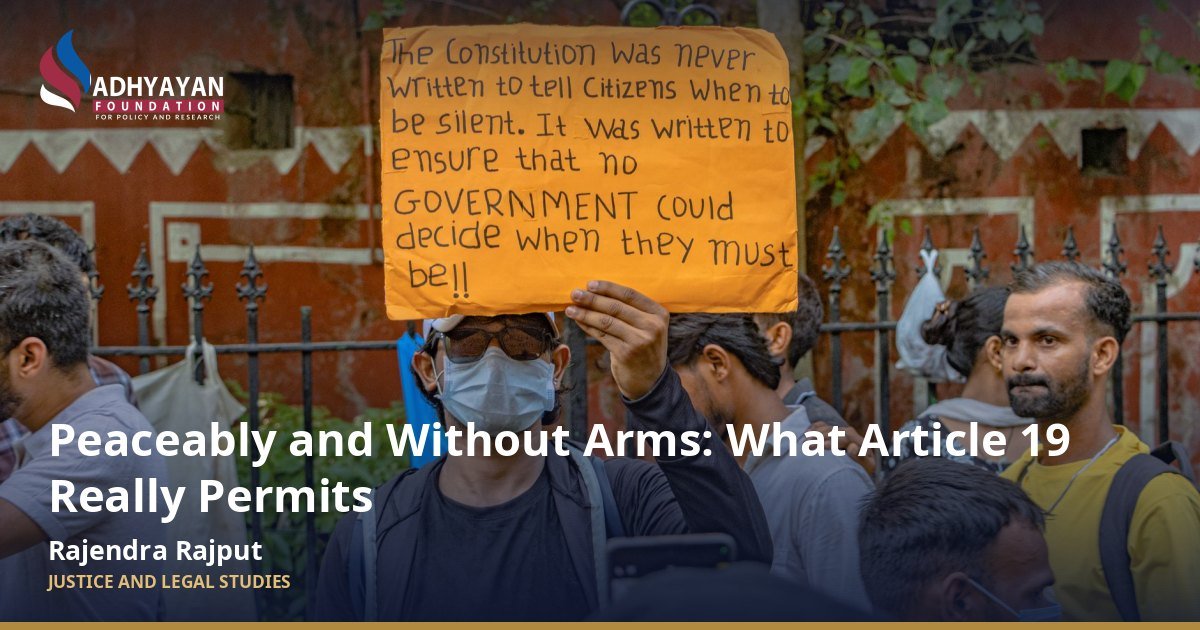
The protest sits at the centre of a familiar constitutional argument. One side says that a peaceful dissent is a right. The other says that blocked roads and disorder cannot be accepted in its name. Both claims find support in the Article 19 right to assemble. The Constitution protects the freedom of citizens “to assemble peaceably and without arms”, yet it also allows the State to restrict that freedom in the interests of “the sovereignty and integrity of India or public order”.1 This blog asks what the Supreme Court has made of that tension. What counts as an assembly? What do “peaceably” and “without arms” require? How far are marches, sit-ins and blockades protected, and what limits may the State impose? My argument is that the right is real, but conditional, and that the conditions must themselves be lawful, clear, and reasonable.
Text and Purpose of the Article 19 Right to Assemble
Article 19(1)(b) gives “all citizens” the right “to assemble peaceably and without arms”.2 The right belongs to citizens and protects physical gatherings. It is limited by the words “peaceably” and “without arms”, and from outside by Article 19(3). An assembly is a collective gathering of citizens for a common purpose, usually to express a view, make a demand or demonstrate. The Constitution fixes no minimum number of participants, and it does not formally distinguish a protest from a dharna, a rally or a procession. In practice, the useful question is whether the gathering is peaceful, unarmed, and regulated consistently with Article 19(3). The leading authority is Kameshwar Prasad v State of Bihar (1962). The Court examined a Bihar rule that barred government servants from taking part in “any demonstration”. It held that a peaceful demonstration is covered by Articles 19(1)(a) and 19(1)(b), and it struck the rule down because it prohibited even innocent, non-violent demonstrations.3
“Peaceably” and “Without Arms”
The two qualifying words do real work. “Without arms” excludes weapons. “Peaceably” is wider: it excludes violence, coercion, intimidation, destruction of property, and conduct that itself creates a serious and immediate threat to public order. Together, the words protect unarmed, non-violent collective action. The Court has not given one exhaustive definition of “peaceably”. In Kameshwar Prasad, it separated orderly, peaceful demonstrations from violent and disorderly conduct such as stone-throwing, and only the first kind falls within Articles 19(1)(a) and 19(1)(b). 4 The assessment is therefore fact-specific. Courts may look at the organisers’ intent, the conduct of the crowd, any earlier violence, and the immediate risk the gathering creates.
Assembly, Speech, Association and Movement
Assembly seldom stands alone. A protest usually carries a message, so the freedom of speech and expression in Article 19(1)(a) is engaged along with Article 19(1)(b). Article 19(1)(c), the freedom to form associations or unions, is a neighbouring right because it also concerns collective action.5 Movement supplies the main counterclaim. Article 19(1)(d) protects the freedom of citizens to move freely across India.6 When a march or sit-in occupies a road, the protesters’ right of assembly meets the commuters’ freedom of movement, and access for emergency services and the flow of traffic also enter the analysis. The cases below show courts balancing these interests through the restrictions that Article 19(3) allows, rather than ranking one right above the other in advance.
Reasonable Restrictions Under Article 19(3)
Article 19(3) is the source of the State’s power. It allows existing and new laws that impose reasonable restrictions on the right of assembly in the interests of “the sovereignty and integrity of India or public order”.7 Three requirements follow:
- Legal source: the restriction must come from a law.
- Permitted objective: it must serve the sovereignty and integrity of India, or public order. These are the only grounds in the clause.
- Reasonableness: modern analysis treats this as including proportionality, meaning a legitimate aim, a rational connection with that aim, necessity, and a fair balance between the right and the public interest. Anuradha Bhasin v Union of India (2020) is a useful guide, although it concerned internet shutdowns and prohibitory orders, not a protest site. The Court applied proportionality and held that indefinite suspension is impermissible; that orders should be published, and that Section 144-type powers cannot be used to suppress legitimate expression. 8 These safeguards are a sound benchmark for testing restrictions on assemblies.
Supreme Court Decisions
Five decisions shape the law. The table summarises what each decision is and why it matters.
Kameshwar Prasad v State of Bihar (1962) [3]: Struck down a rule barring government servants from "any demonstration". Peaceful demonstrations are protected; violent conduct is not. Why it matters: peaceful demonstrations are protected.
Himmat Lal K Shah v Commissioner of Police, Ahmedabad (1973) [10]: Prior permission for street meetings is not invalid in itself, as there is no right to assemble at any place and time. The rule failed because it gave unguided, arbitrary discretion. Why it matters: permission systems need clear standards.
Ramlila Maidan Incident, In re (2012) [11]: A Section 144 CrPC order needs material facts, an imminent threat and immediate preventive necessity. The overnight eviction of sleeping protesters was unjustified. Why it matters: emergency powers need real justification.
Mazdoor Kisan Shakti Sangathan v Union of India (2018) [12]: Peaceful demonstrations of grievances are protected. A blanket displacement of protests from Jantar Mantar was set aside, and authorities were directed to create a regulated mechanism for limited use of protest sites. Why it matters: regulation is allowed, but protest must not become invisible or ineffective.
Amit Sahni v Commissioner of Police (2020) [13]: The right to peaceful protest was affirmed, but public ways cannot be occupied indefinitely. A complete road blockade causing grave inconvenience to commuters was unacceptable, and dissent should be held in designated places. Why it matters: indefinite occupation of a public way has limits.
Source: Author’s summary of the judgments cited.
Amit Sahni needs careful reading. Its core holding concerned an indefinite occupation that completely blocked a public way. It does not hold that every protest outside a designated site is unlawful. The wider idea that dissent must stay in designated places should be read with Mazdoor Kisan Shakti Sangathan, which warned against making protests invisible or ineffective.14
Public Spaces, Permission and Policing
Can citizens assemble anywhere and at any time? Himmat Lal K Shah says no. Article 19(1)(b) is not a right to hold a meeting at any place and time, so a prior-permission rule is not unconstitutional by itself.15 The State may therefore regulate the time, place, route, size, noise and conduct of assemblies. Ramlila Maidan also accepted that prior permission can be a reasonable restriction, provided the system does not become arbitrary. 16 Regulation needs clear legal standards and must not work as an effective veto on dissent. Police and executive powers sit inside this frame. The Bharatiya Nagarik Suraksha Sanhita, 2023 (BNSS) has replaced the Code of Criminal Procedure, 1973. Section 163 BNSS, the successor to Section 144 of the old Code, allows orders in urgent cases of nuisance or apprehended danger. Section 148 BNSS deals with dispersing unlawful assemblies and assemblies likely to disturb the public peace. 17 Authorities may use these powers where there is a real, immediate and proportionate need to prevent disorder, and they may regulate traffic and police processions. But emergency powers are not a general licence to prevent peaceful dissent. In Ramlila Maidan, the Court found both the restrictions and their execution unjustified.18
Digital Mobilisation
Mobilisation can also happen online, and governments may respond by restricting internet access. Article 19(1)(b) protects physical gatherings, so Article 19(1)(a) is more directly engaged here. Anuradha Bhasin held that restrictions on expression through the internet must satisfy Article 19(2) and proportionality, that indefinite suspension is impermissible, and that orders should be published.19 That case was about expression, not assembly. Still, its tests of lawful basis, proportionality, publication and limited duration are a sensible benchmark for any order that affects online organisation of protests.
A Practical Framework
Four questions help in judging whether a protest, or a restriction on it, is lawful:
- Is the gathering peaceful and unarmed?
- Is any restriction based on law, with clear standards that limit official discretion?
- Does it serve the sovereignty and integrity of India or public order, and is it proportionate?
- Do the protest and its regulation keep public ways usable while giving protesters a meaningful, visible place to be heard?
Conclusion
Article 19(1)(b) protects meaningful collective dissent. Citizens may gather, march, demonstrate and protest peacefully and without arms. But there is no unlimited right to assemble at every place, at every time and in every manner. The State may regulate assemblies to protect public order, traffic, safety and the rights of others, if the restriction rests on law, pursues an Article 19(3) purpose, and is reasonable and proportionate. A permission system is valid only when it helps assemblies happen through clear, non-arbitrary criteria. When it becomes an unguided power to suppress dissent, it is unconstitutional.
Frequently asked questions
What does Article 19(1)(b) protect?
It gives all citizens the right to assemble peaceably and without arms. It protects physical gatherings, and the Constitution fixes no minimum number of participants.
What restrictions can the State place on the right to assemble?
Article 19(3) allows reasonable restrictions made by law in the interests of the sovereignty and integrity of India or public order. The article adds that modern analysis treats reasonableness as including proportionality.
Can citizens protest at any place and time?
No. Himmat Lal K Shah held that Article 19(1)(b) is not a right to hold a meeting at any place and time, so a prior-permission rule is not unconstitutional by itself. The State may regulate time, place, route, size, noise and conduct, provided the standards are clear and not arbitrary.
What did the Supreme Court say in Amit Sahni v Commissioner of Police?
The Court affirmed the right to peaceful protest but held that public ways cannot be occupied indefinitely. The article stresses that the core holding concerned an indefinite, complete blockade, and that it should be read with Mazdoor Kisan Shakti Sangathan, which warned against making protests invisible or ineffective.
Further reading from AFPR: The Grammar of Dissent: Why the Constitution Sends Protest to Institutions, Not the Street · Petition, Not Placard: Why the Street Cannot Stand In for the Supreme Court, the Election Commission and the Constitution
Notes
1 Constitution of India 1950, art 19(1)(b) and art 19(3).
2 Constitution (n 1) art 19(1)(b).
3 Kameshwar Prasad v State of Bihar AIR 1962 SC 1166.
4 Kameshwar Prasad (n 3).
5 Constitution (n 1) art 19(1)(a) and (c).
6 Constitution (n 1) art 19(1)(d).
7 Constitution (n 1) art 19(3).
8 Anuradha Bhasin v Union of India (2020) 3 SCC 637.
9 Kameshwar Prasad (n 3).
10 Himmat Lal K Shah v Commissioner of Police, Ahmedabad (1973) 1 SCC 227.
11 Ramlila Maidan Incident, In re (2012) 5 SCC 1.
12 Mazdoor Kisan Shakti Sangathan v Union of India (2018) 17 SCC 324.
13 Amit Sahni v Commissioner of Police (2020) 10 SCC 439.
14 Amit Sahni (n 13); Mazdoor Kisan Shakti Sangathan (n 12).
15 Himmat Lal K Shah (n 10).
16 Ramlila Maidan (n 11).
17 Bharatiya Nagarik Suraksha Sanhita 2023, ss 148 and 163. Code of Criminal Procedure
1973, s 144 (repealed).
18 Ramlila Maidan (n 11).
19 Anuradha Bhasin (n 8).
List of References
Cases
Amit Sahni v Commissioner of Police (2020) 10 SCC 439
Anuradha Bhasin v Union of India (2020) 3 SCC 637
Himmat Lal K Shah v Commissioner of Police, Ahmedabad (1973) 1 SCC 227
Kameshwar Prasad v State of Bihar AIR 1962 SC 1166
Mazdoor Kisan Shakti Sangathan v Union of India (2018) 17 SCC 324
Ramlila Maidan Incident, In re (2012) 5 SCC 1
Constitutional and Statutory Provisions
Bharatiya Nagarik Suraksha Sanhita 2023 (Act 46 of 2023), ss 148, 163
Code of Criminal Procedure 1973 (Act 2 of 1974) (repealed), s 144
Constitution of India 1950, art 19(1)(a)–(d), art 19(3)