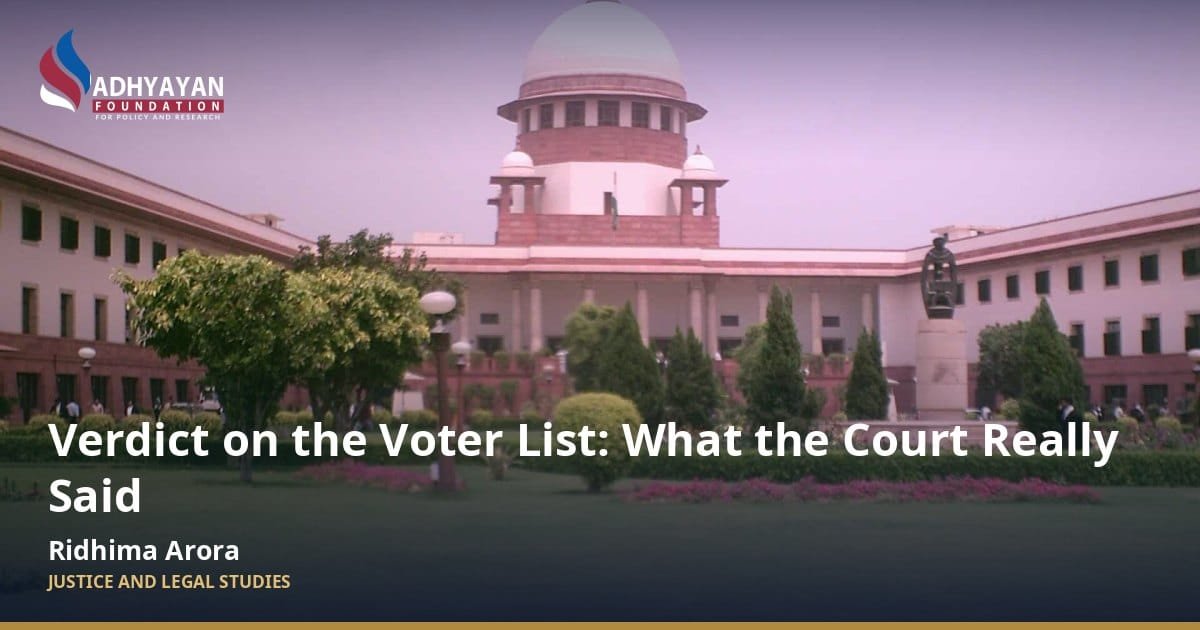
Before a single vote is counted, it must be decided whose votes may be counted. That is the work of the electoral roll, which is why a dispute about a voter list is never just paperwork. On 27 May 2026, a two-judge Bench of the Supreme Court, with Chief Justice Surya Kant writing, unanimously upheld the Election Commission of India’s (ECI) Special Intensive Revision (SIR) of Bihar’s electoral rolls. The Bihar SIR judgment begins by calling the roll the legal record of the political community; a fight over it therefore goes to the foundation of representative government. In brief, the Court held that the Commission had the power, that it acted for a legitimate purpose and in a proportionate way, and that it may inquire into citizenship for voter-list purposes without finally deciding who is a citizen. At the centre of that answer sits Article 324, read with Parliament’s law. The ruling also closes with directions meant to protect those who are wrongly excluded.
The Facts
On 24 June 2025, the ECI ordered an SIR of the rolls in every Assembly constituency of Bihar, acting under Article 324 and Section 21(3) of the Representation of the People Act, 1950. Bihar’s last intensive revision was in 2003, and the Commission said two decades of urbanisation and migration had changed the rolls. It treated the 2003 roll as evidence of eligibility unless rebutted. Anyone not on it had to produce one of the listed government documents. Every voter was to return a pre-filled enumeration form by 25 July 2025, or be left out of the draft roll. Doubtful cases were to get a show-cause notice, a reasoned order and two appeals.
After the deadline, the Commission reported that 7 lakh electors were registered in more than one place, 22 lakh were dead, and 36 lakh had shifted or could not be found. The roll had a total of about 7.89 crore, and the draft roll of 1 August 2025 had about 7.24 crore. Thus, nearly 65 lakh names were left out. The petitions reached the Supreme Court, which let the process continue but issued certain directions: publication of the excluded list with reasons, help for voters from party agents and legal-services volunteers, and, on 8 September 2025, acceptance of Aadhaar as a twelfth identity document. The final roll of 30 September 2025 had 7.42 crore electors, after 3.66 lakh deletions and 21.53 lakh additions. The Bihar election followed in November 2025.
The Issues Before the Court
The Court framed four questions:
1. Does the ECI have the power to conduct this SIR?
2. Is the SIR founded on a legitimate purpose, and are its measures proportionate?
3. Does its procedure violate the Representation of the People Act, 1950 or the Registration of Electors Rules, 1960?
4. Can the ECI examine the citizenship of those seeking to join or stay on the roll?
Behind these questions lies a balancing act that the Court named at the outset. First, no eligible citizen should be excluded from the electorate. Second, the roll must keep reflecting the true composition of the political community. The petitioners feared that lakhs of voters would be arbitrarily disenfranchised, while a few other petitioners wanted such exercises held regularly to keep ineligible names out.
The Arguments
The petitioners, led by the Association for Democratic Reforms and joined by activists and MPs, called the SIR unconstitutional, arbitrary and disproportionate. First, Article 324 is not a free-standing power, as it operates only where Parliament’s law under Article 327 is silent, so the Commission cannot bypass the Act and the Rules. Second, Section 21(3) speaks of “any constituency or part of a constituency”, and so suits targeted, exceptional revisions, not a statewide one. Third, enrolled voters were made to prove eligibility again, which inverts the presumption of citizenship recognised in Lal Babu Hussein. They also called the 2003 cut-off arbitrary, said names could drop out without the notice required by Rule 21A of the 1960 Rules, objected to unchecked powers for booth-level officers, and argued that citizenship belongs to the Home Ministry.
The Election Commission replied that Article 324 gives it wide power over the preparation of rolls, and that Article 327 is itself subject to the Constitution, so Parliament cannot take that power away. It argued that Mohinder Singh Gill does not leave the Commission powerless once a law exists, and that A.C. Jose involved a direct clash with express rules, unlike here. Section 21(3), it said, was written to give wide power, and “any” can cover all constituencies. It pointed to migration, urbanisation and duplicate entries as common reasons. It also defended the 2003 roll as a baseline because that roll came from an intensive revision, and said its eleven documents were more than in 2003. It further noted that affected voters got notice, a reasoned order, and two appeals. Finally, it called the SIR an electoral verification exercise, not a citizenship adjudication.
What the Bihar SIR Judgment Held, and Why
The petitioners said Article 324 is only a residual power that fades once Parliament legislates. The Court rejected this. Article 324 gives the ECI the superintendence, direction and control of the preparation of the electoral rolls, while Article 327 lets Parliament legislate on rolls only subject to the Constitution. The two are complementary, not rivals: Parliament cannot empty the Commission’s constitutional role, and the Commission cannot defy an express statutory command. Reading Mohinder Singh Gill, the Court said each side had relied on only half of it, and it confined A.C. Jose to its facts, where the rules required ballot papers and the Commission tried to introduce voting machines.
Here Parliament had itself provided the route. Section 21(3) lets the Commission direct a special revision at any time, for recorded reasons, in a manner it thinks fit. The Court treated the opening “notwithstanding” clause as freeing a special revision from the ordinary rules of Section 21(2), and the duty to record reasons as a real safeguard open to judicial review. It read “any constituency” to mean many or all, since otherwise each constituency would need a separate order. The absence of separate rules did not matter because the Commission does not act as Parliament’s delegate. In the Court’s words, the SIR “breathes life into” Article 324 through Section 21(3).
Purpose and proportionality
The Court found a legitimate purpose: an accurate roll. Articles 325 and 326 require one common roll and universal adult suffrage, and Article 326 entitles every citizen of eighteen or older who is not disqualified to be registered. Accuracy is therefore a foundation of free and fair elections. Twenty years of summary revisions, duplicate entries, unreported deaths and migration had eroded it, and these problems form sufficient grounds for deletion in Rule 21A.
The Court then applied four tests: purpose, rational link, necessity and balance.
On necessity, it did not ask whether the method was the best, but whether it was manifestly excessive, because a statewide problem could not be fixed piecemeal. On balance, the right to vote is constitutional but not absolute, and verification protects it. The Court admitted the process raised real concerns at first, but held that its own orders on Aadhaar, the excluded list and volunteer help corrected them. Proportionality, the Court said, is judged by how a measure is carried out.
Presumption, deletion and documents
Enrolment creates a presumption of validity, but it is rebuttable and does not bar verification. Lal Babu Hussein concerned adjudicatory proceedings, not a systemic revision. On Rule 21A, notice, inquiry and hearing were preserved in substance across the stages of enumeration, draft roll and claims. The document list rested on intelligible criteria and was widened during the exercise.
Citizenship
Because Section 16 bars non-citizens from registration, the Commission may examine questions bearing on citizenship when preparing rolls. The consequence is limited: it affects inclusion in the roll, not a person’s claim to citizenship. Where the Commission is not satisfied, it must refer the person to the competent authority under the Citizenship Act. Any deletion on this ground stays subject to that authority’s final decision.
The directions
The Court ordered the ECI to refer within four weeks the cases of people deleted from the 2003 roll as non-citizens. The authority must decide after notice and hearing, preferably before the next elections, and restore names if people are found to be citizens. Bihar residents wrongly deleted as absent, dead, shifted or duplicate may seek judicial review.
Conclusion
The judgment does not hand the Commission unlimited power. It builds a chain instead. Article 324 supplies constitutional authority, and Section 21(3) provides the route. Recorded reasons and proportionality give the limits, and fairness in execution gives legitimacy. The last word on citizenship stays with the competent authority. This matters beyond Bihar, since the SIR has been completed in several states and continues in others.
Reference List
Association for Democratic Reforms v. Election Commission of India, W.P. (C) No. 640 of 2025, 2026 INSC 564 (Supreme Court of India, May 27, 2026).
Bakshi, G. K. (2026a, May 27). Supreme Court upholds Election Commission’s power to conduct SIR of electoral rolls, says it advances free and fair elections. LiveLaw.
Bakshi, G. K. (2026b, May 27). SIR | Supreme Court asks ECI to send to Centre names of persons deleted from 2003 Bihar roll over doubtful citizenship. LiveLaw.
Banerjee, N. (2026, May 27). Supreme Court backs Bihar SIR exercise, upholds ECI’s powers to purify electoral rolls. Supreme Court Observer.
Centre for Law and Policy Research. (n.d.-a). Article 324: Superintendence, direction and control of elections to be vested in an Election Commission. Constitution of India.
Centre for Law and Policy Research. (n.d.-b). Article 326: Elections to the House of the People and to the Legislative Assemblies of States to be on the basis of adult suffrage. Constitution of India.
Kaushik, A. (2026, May 27). ECI can conduct “limited enquiry” on citizenship for voter list verifications; it will not amount to determination of citizenship: Supreme Court. Verdictum.
LiveLaw News Network. (2026, May 27). “SIR meets proportionality test”: Conclusions from Supreme Court judgment. LiveLaw.
Frequently asked questions
What did the Supreme Court decide on the Bihar SIR?
On 27 May 2026 a two-judge Bench upheld the Election Commission’s Special Intensive Revision of Bihar’s rolls. It held that the Commission had the power, acted for a legitimate purpose and in a proportionate way.
Can the Election Commission examine citizenship?
Yes, for voter-list purposes, because Section 16 bars non-citizens from registration. The Court said this affects inclusion in the roll, not a person’s claim to citizenship, and that the competent authority under the Citizenship Act decides finally.
Which provisions gave the Commission the power?
Article 324 of the Constitution, read with Section 21(3) of the Representation of the People Act, 1950, which lets the Commission direct a special revision for recorded reasons.
What happened to wrongly deleted voters?
The Court said Bihar residents wrongly deleted as absent, dead, shifted or duplicate may seek judicial review, and ordered cases of those deleted from the 2003 roll as non-citizens to be referred to the competent authority.
Further reading from AFPR: Counting the Counters: SIR Across the States, Phase by Phase