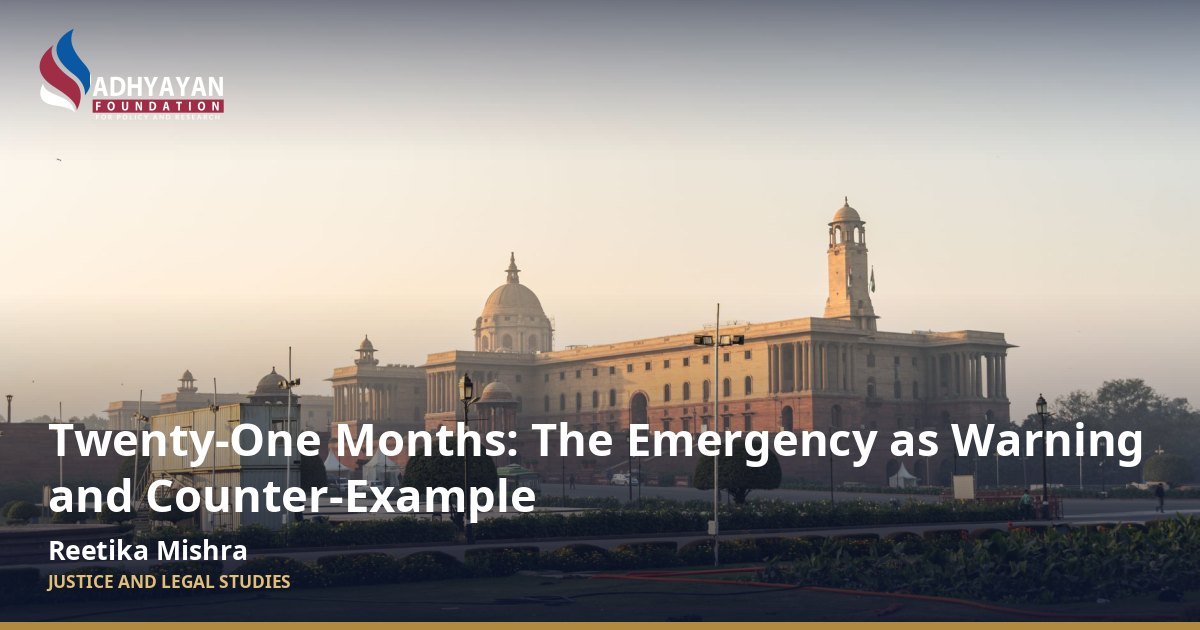
On 26 June 1975, as the clock struck eight in the morning [1], Indian democracy took a turn that betrayed every promise made at the “tryst with destiny” [2]. The President of India used Article 352 of the Constitution to declare the 1975 Emergency on the ground of “internal disturbance” [3]. The 21 months that followed are a warning of anarchy disguised as legal order. They also show how constitutional morality can be subverted when executive power goes unchecked.
The sequence matters. On 12 June 1975 the Allahabad High Court declared Indira Gandhi’s 1971 election void and barred her from contesting any election for six years [4]. The judgment fed the Nav Nirman student movement in Gujarat and Jayaprakash Narayan’s Sampoorna Kranti (Total Revolution) in Bihar. The Prime Minister appealed to the Supreme Court, and on 24 June 1975 Justice V. R. Krishna Iyer granted a conditional stay on the High Court’s decision [5]. The stay encouraged the protest movements, which called on the state machinery to refuse to obey unconstitutional orders. On the night of 25 June the President, on the advice of the Prime Minister, signed the Proclamation under Article 352. The decision was made public the following morning [1].
The Declaration of Emergency: Constitutional Provisions
Part XVIII of the Constitution contains three provisions for extraordinary circumstances: Article 352 (national emergency), Article 356 (President’s rule in a State) and Article 360 (financial emergency) [3]. In 1975 Article 352 allowed a national emergency on three grounds: war, external aggression or internal disturbance [3]. The declaration rested on internal disturbance and followed the sole recommendation of the Prime Minister [1]. Here came the first warning to constitutional principle: the subversion of the Cabinet.
Emergency Powers and the Curtailment of Civil Liberties
Constitutionalism stands on the foundation of limited government. It requires effective checks and balances between the organs of the state. The Emergency removed those checks.
First came the subversion of the Cabinet. The decision to advise the President was taken by the Prime Minister alone, without consulting the Council of Ministers [6]. This violated the principle of collective responsibility (Article 75(3)) and Article 74(1), which provides that a Council of Ministers shall aid and advise the President [3].
Next came the disruption of the legislature and of parliamentary politics. Thousands of opponents were detained, among them leaders such as Jayaprakash Narayan, Morarji Desai and George Fernandes, and Parliament was left without an opposition [7]. The tradition of debate and discussion was extinguished. The vacuum was then used to undermine the Constitution and judicial precedent. The 38th, 39th and 42nd Amendments showed how a constitution meant to check the government could be turned into an instrument of power without a brake [8].
With the enforcement of Article 352, the right to move the courts for habeas corpus, the basis of civil liberty, was in effect suspended. The Constitution remained in form, but its spirit had left it. Laws such as the Maintenance of Internal Security Act (MISA) were used to detain without trial [9]. Wider powers for the Executive, through amendments touching Articles 123 and 213 along with the emergency provisions of Articles 352, 356 and 360, narrowed judicial review [8]. The guardian of fundamental rights was confined within the text of the Constitution. Then came the ruling in ADM Jabalpur [10], the point at which constitutional morality collapsed, because the institution that should have protected liberty declined to do so.
Press censorship followed. The press was ordered to become the mouthpiece of the government of the day, the same government whose continuation had been put in doubt by a court of law. Newspapers were graded as friendly, neutral or hostile according to their views on the ruling party. The work of the Intelligence Bureau shifted from guarding India’s security to assessing the character of journalists reporting on the ground [11]. Censorship reached the arts: the songs of the singer and actor Kishore Kumar were banned on state broadcasters [12]. The right to dissent, the essence of democracy, was treated as a crime.
Ordinary life was the next target. Under the banner of population control, the autonomy and dignity of citizens were treated as the property of the state. A total of 26.42 lakh sterilisations were carried out in 1975-76 and another 81.32 lakh in 1976-77. Rations, jobs and housing were linked to sterilisation [13].
This record explains why the Emergency stands as a warning to the constitutional order. Without checks on executive power, the democracy promised by the founders will remain words on paper. A genuine democracy rests on dissent and on peaceful protest. When the right to question and to hold a regime accountable is treated as a crime, rights become, in the phrase, “writ in water”.
The 1975 Emergency as Counter-Example
The Emergency is also a counter-example. For 21 months everything seemed to be in order: dissent was curbed, protest was countered, and it seemed that the electorate was with the government. But the steps taken to protect the seat of power ended in the defeat of the government in the 1977 elections. The people gave their verdict. It did not happen overnight. The dissent of Justice H. R. Khanna [10], the courage of protesters who faced lathi charges and harsh jail conditions [14], and the defiance of publishers who printed blank editorial columns in the Indian Express and The Statesman [15] kept constitutional values alive. Cinema too answered, with films such as Kissa Kursi Ka [16]. The time had come for reflection.
When the dissenters came to power, one lesson was clear: the Constitution must be strong enough that no single organ of the state can bend it to its favour. The appointment of the Shah Commission and the 44th Amendment, which restored many of the judiciary’s powers, stand foremost. The emergency provisions of Part XVIII were reworked. The Cabinet’s written recommendation became a condition for declaring an Emergency, and “internal disturbance” was replaced by “armed rebellion”. Fundamental rights were given protection: the amendment of Articles 358 and 359 ensured that the right to life and liberty under Articles 20 and 21 could not be suspended in any emergency [17].
The Emergency thus served as a counter-example to the belief that law and order are the same as constitutionalism. A limited government is the foundation of constitutionalism, and under no circumstance can limited powers be turned into absolute power. “We, the People of India” adopted, enacted and gave to ourselves the Constitution on 26 November 1949 [18]. Twenty-five years later, when the executive tried to dismantle it, the people defended what was theirs. The darkest hour of Indian democracy carries a lesson for citizens and government alike. It tells citizens to speak against injustice, and it tells government to listen. If either duty is neglected, this chapter will serve again as a counter-example. Anarchy dressed as legal order does not last, and the will of the people prevails.
Frequently asked questions
When and how was the Emergency declared in 1975?
On the night of 25 June 1975 the President, on the Prime Minister’s advice, signed a Proclamation under Article 352 on the ground of internal disturbance. It was made public the following morning.
What happened to civil liberties during the Emergency?
Thousands of opponents were detained under laws such as MISA, the right to move the courts for habeas corpus was in effect suspended, and the press was censored. The Supreme Court’s ruling in ADM Jabalpur is described as the point at which constitutional morality collapsed.
How did the 44th Amendment change emergency powers?
It made the Cabinet’s written recommendation a condition for declaring an Emergency and replaced “internal disturbance” with “armed rebellion”. It also ensured that the right to life and liberty under Articles 20 and 21 could not be suspended.
Why is the Emergency called a counter-example?
For 21 months everything seemed in order, yet the steps taken to protect the seat of power ended in the government’s defeat in the 1977 elections. The article argues this shows that law and order is not the same as constitutionalism.
Further reading from AFPR: The Grammar of Dissent: Why the Constitution Sends Protest to Institutions, Not the Street · Petition, Not Placard: Why the Street Cannot Stand In for the Supreme Court, the Election Commission and the Constitution
References
[1] Government of India, Ministry of Home Affairs, Notification G.S.R. 353(E), publishing the President’s Proclamation of Emergency dated 25 June 1975, The Gazette of India, Extraordinary, Part II, Section 3(i), 26 June 1975.
[2] J. L. Nehru, “A Tryst with Destiny”, speech to the Constituent Assembly of India, 14-15 August 1947.
[3] Constitution of India, Ministry of Law and Justice, Legislative Department.
[4] Raj Narain v Indira Nehru Gandhi, Election Petition No. 4 of 1971, Allahabad High Court, 12 June 1975.
[5] Indira Nehru Gandhi v Raj Narain, Civil Appeal No. 887 of 1975 and Civil Miscellaneous Petition No. 3557 of 1975, Supreme Court of India, 24 June 1975.
[6] Shah Commission of Inquiry, Interim Report I, Chapter V, pp. 29-32, paras 5.68-5.71.
[7] Shah Commission of Inquiry, Interim Report II, Chapter XI, p. 32, para 11.1.
[8] Constitution (Thirty-eighth Amendment) Act 1975; Constitution (Thirty-ninth Amendment) Act 1975; Constitution (Forty-second Amendment) Act 1976.
[9] Maintenance of Internal Security Act 1971 (Act 26 of 1971).
[10] A.D.M. Jabalpur v Shivkant Shukla, AIR 1976 SC 1207.
[11] Ministry of Home Affairs, Order on Press Censorship, G.S.R. 361(E), The Gazette of India, Extraordinary, Part II, Section 3(i), 26 June 1975.
[12] Shah Commission of Inquiry, Interim Report II, Chapter VIII, pp. 1-9, “Misuse of Media”, 26 April 1978.
[13] Shah Commission of Inquiry, Third and Final Report, Chapter XXI, pp. 21.4-21.26, “Implementation of Family Planning Program During the Emergency”, 1978.
[14] Shah Commission of Inquiry, Interim Report I, Chapter VII, “Treatment of Detainees in Jail”.
[15] Shah Commission of Inquiry, Third and Final Report, Chapter XIII, “Censorship of News”.
[16] Ministry of Information and Broadcasting, order banning the feature film Kissa Kursi Ka, 1975; National Archives of India.
[17] Constitution (Forty-fourth Amendment) Act 1978.
[18] Preamble, Constitution of India, 1950.