
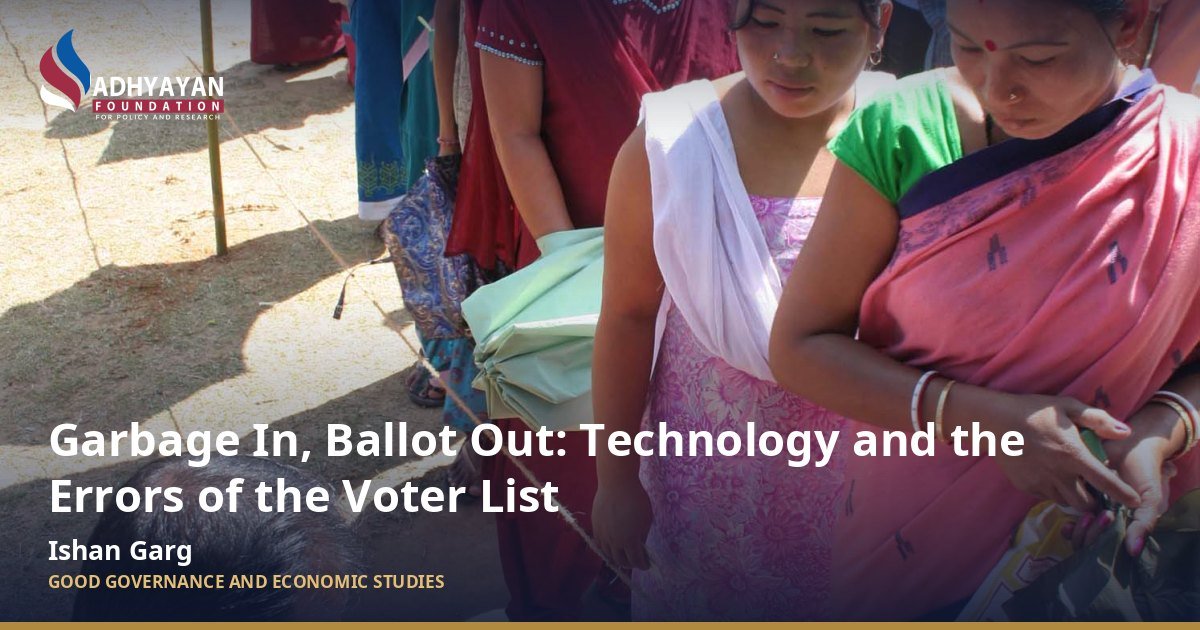
An eligible citizen arriving at a polling station only to discover their name is missing from the electoral roll represents a profound democratic failure. An accurate voter list is not a routine task; it is the foundation of the franchise. Under Article 324 of the Constitution, the Election Commission of India (ECI) holds the “superintendence, direction and control” of electoral rolls (Constitution of India, Art. 324). Article 326 lays down the principle of adult suffrage, with certain constitutional and statutory qualifications. These powers are put into action through the Representation of the People Act, 1950, which outlines the processes for registration and revision (Representation of the People Act, 1950, Sec. 21). With nearly a billion voters to manage, the ECI leans heavily on technology to keep the rolls current. That raises a question of accountability: who answers for voter list errors, and what proof must the state offer before a citizen is denied the vote?
The Mechanics of Technology-Assisted Verification
The ECI uses digitised electoral databases and software-assisted identification of demographic and photo-similar entries to detect potential duplicates. Its Manual on Electoral Rolls states that probable duplicate entries identified by the de-duplication software should be deleted only after verification by Booth Level Officers and in accordance with due process (ECI Manual on Electoral Rolls). The critical policy question is therefore not whether software can flag similar records, but whether verification and deletion procedures reliably separate genuine duplicates from distinct, eligible electors.
The risk of error stems from both algorithms and administration. Inconsistent data (variations in spelling, non-standard addresses, shared names in dense constituencies) can produce false matches: garbage in. But data quality is not the only variable. Matching thresholds, software design, verification procedures and, finally, human judgment all shape the outcome. When an automated match meets a deletion decision, citizens can find themselves navigating bureaucracy simply to prove they exist and to keep their legal rights.
The Evidence: Voter List Errors and the Bihar SIR
This challenge is evident in the Special Intensive Revision (SIR) in Bihar. According to the ECI’s press note of 30 September 2025, there were approximately 7.89 crore electors on 24 June 2025, before the revision. By the publication of the final roll on 30 September 2025, the number stood at 7.42 crore, an approximate net reduction of 47 lakh electors (ECI Press Note, 30 September 2025). During this process, approximately 65 lakh electors were excluded at the draft roll stage.
Further, the ECI’s release of 25 July 2025 reported that the field exercise had identified approximately 22 lakh deceased electors, 7 lakh duplicate registrations, and 35 lakh who had permanently migrated or could not be traced (ECI Press Note, 25 July 2025).
The difficulty is not only that no algorithmic error rate has been published; it is that the accuracy of the whole revision is hard to assess. The Commission’s categories explain why entries were flagged or removed, but they do not confirm that each classification was correct. Detailed data on verified deletions, disputed cases, successful appeals and restored entries would give citizens and researchers a clearer picture, and spare us from jumping to conclusions of either widespread error or flawless accuracy.
Judicial Review and the Demands of Due Process
The Supreme Court has addressed the tension between technological efficiency and administrative due process. In a judgment delivered on 27 May 2026 in Association for Democratic Reforms v. Election Commission of India (W.P. (C) No. 640/2025), the Court upheld the legality of Bihar’s SIR. It recognised the Commission’s authority under Article 324 read with Section 21(3) of the Representation of the People Act, 1950. According to the Court’s official summary, it accepted that addressing migration, unreported deaths and duplicate entries is a legitimate aim, while noting the statutory safeguards of notice, scrutiny and hearing (Supreme Court of India, 27 May 2026). The ruling is no licence for automated deletion; it stresses a statutory framework that protects eligible voters.
The Administrative Imperative (The Counterargument)
The case for thorough revision deserves its full weight. A roll with duplicate registrations, deceased electors and ineligible entries undermines election administration and planning. Duplicate entries do not automatically produce duplicate votes, but they create openings for fraud and impersonation. The Indian state has a strong interest in the integrity of its elections, and the risk of administrative error does not make the pursuit of a clean roll unconstitutional. Removing ineligible entries is as important to the principle of “one person, one vote” as protecting valid ones. To abandon technology-assisted revision would be to surrender the electoral system to the very inaccuracies and inefficiencies the Constitution empowers the ECI to prevent.
Safeguards for a Modern Franchise
A roll’s credibility rests on two things: removing ineligible entries and keeping eligible citizens on it. To balance digitisation with the constitutional requirements of the franchise, the ECI should adopt enforceable, measurable safeguards:
- Human verification before deletion: If software identifies a potential duplicate, it should prompt a thorough ground-level check by a Booth Level Officer rather than lead to automatic removal.
- Individual notice and reasoned decisions: Electors who are flagged must receive a clear explanation of their status and a fair, accessible chance to respond before any final deletion, in line with statutory guidelines.
- Fast restoration and appeal: The ECI should offer simple channels to resolve disputes quickly, especially before elections.
- Public accuracy reporting: The ECI should publish the number of duplicate flags reviewed, confirmed duplicates, disputed deletions, successful appeals and restored entries.
Technology is a vital tool for managing the vastness of Indian democracy, but it cannot replace the Commission’s constitutional responsibilities. By building strict, measurable due process into its systems, the ECI can ensure that the pursuit of a flawless roll does not cost legitimate voters their rights.
Frequently asked questions
What are voter list errors?
Wrong or inconsistent entries, such as spelling variations, non-standard addresses and shared names, can produce false matches, so that a distinct, eligible elector may be flagged as a duplicate.
Who controls the electoral rolls in India?
Under Article 324 of the Constitution the Election Commission of India holds the superintendence, direction and control of the electoral rolls. The Representation of the People Act, 1950 sets out the processes for registration and revision.
How many electors did the Bihar SIR remove?
The ECI reported about 7.89 crore electors before the revision and 7.42 crore in the final roll of 30 September 2025, a net reduction of about 47 lakh. About 65 lakh were excluded at the draft stage.
What safeguards does the article suggest?
Human verification by a Booth Level Officer before any deletion, individual notice and reasoned decisions, fast restoration and appeal, and public reporting of flags reviewed, confirmed duplicates, disputed deletions and restored entries.
Further reading from AFPR: Counting the Counters: SIR Across the States, Phase by Phase