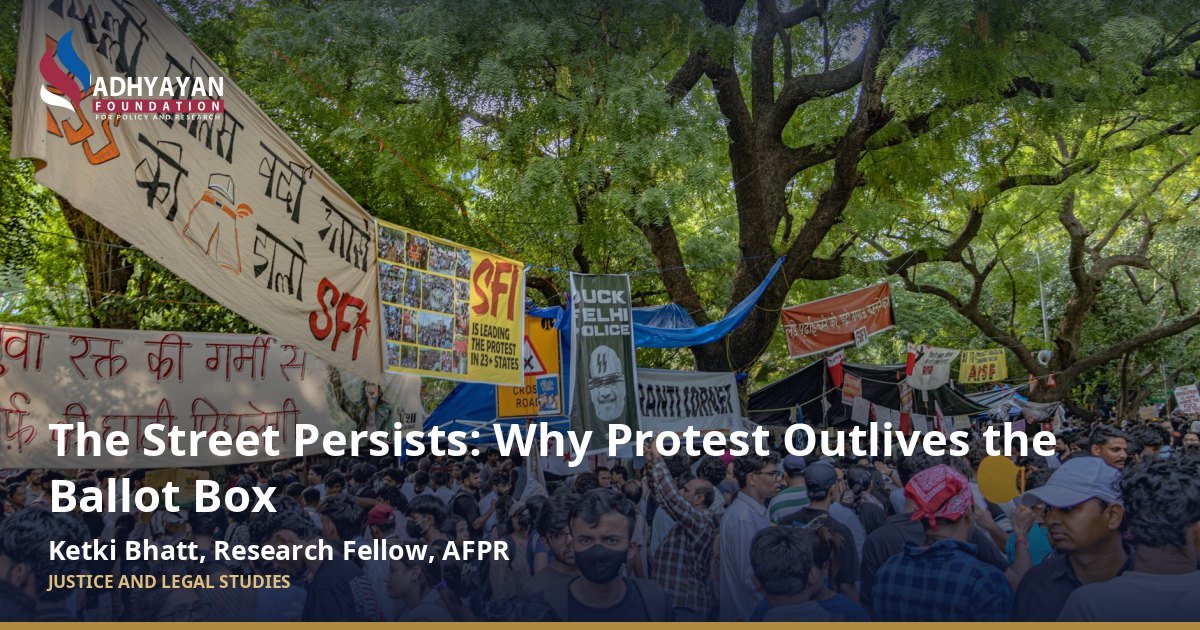
A general election gives every citizen a vote once in five years. Governing, meanwhile, goes on every day. Between one poll and the next, ministries draft rules, Parliament passes laws, courts rule on petitions, and ordinary people discover that a decision taken in a distant room has landed on their fields, their shops or their children. It should not surprise us that some of them then walk out into the street. This blog argues that protest outlives the ballot box because the ballot box speaks once while grievances arise continuously, and that a self-confident republic should answer by making its institutions listen better, while also holding protesters to the lawful limits the Supreme Court has drawn.
The ballot is periodic, the grievance is not
The ballot decides who governs. It does not tell the government what a particular law will do to a particular group of people, and it cannot be recalled when a policy misfires. Between elections, the formal channels are Parliament and its committees, the courts, the bureaucracy and the press. These are the channels through which the Constitution expects citizens to be heard, and a nationalist who values institutions over street politics should want them to work well precisely so that the street is rarely needed.
The question is whether they work as well as they should. Look first at Parliament. According to PRS Legislative Research, the 17th Lok Sabha, which sat from June 2019 to February 2024, held 274 sittings, and only four earlier Lok Sabhas sat fewer times, all of them dissolved before their five-year terms were over. Only 16 per cent of Bills in that House were referred to committees for detailed scrutiny, which PRS notes is lower than in the previous three Lok Sabhas, and 35 per cent of Bills were passed in the Lok Sabha with less than an hour of debate. Committees are where a Bill meets the people it will affect. A House that sends only one Bill in six to committee leaves many groups with little to do but write letters, and some with nothing but the road.
What the courts offer, and what they cannot
Next, the courts. The Lok Sabha was told on 13 February 2026, on National Judicial Data Grid figures as of 31 December 2025, that district and subordinate courts held 4,76,57,328 pending cases, the High Courts 63,66,023, and the Supreme Court 92,101, about 5.41 crore together by my addition. A litigant may be right and still be too late. A worker whose job is at stake, a farmer facing a new rule before the sowing season, a resident whose street is to be dug up next month cannot easily wait years for a judgment.
The courts also say frankly that they are not a substitute for government. In Amit Sahni v. Commissioner of Police, 2020 SCC OnLine SC 808, decided on 7 October 2020 by S.K. Kaul, Aniruddha Bose and Krishna Murari, JJ., the Court observed that authorities “should not hide behind the court orders”, and it noted that the administration had shown no negotiation or action for a considerable period. When the executive does nothing, the crowd stays.
An example that tells both ways
The farm laws are a revealing case, whatever one thinks of their merits. Both Houses passed the Farm Laws Repeal Bill on 29 November 2021, without discussion and by voice vote, the Lok Sabha acting within eight minutes of the Bill being introduced, as Bar and Bench reported. The repeal followed a long agitation outside Parliament. I do not draw a partisan lesson from this, and I make no claim here about how the original laws were enacted. The lesson is about process: when a major change of course is made with no debate at all, citizens may conclude that the loud route works and the quiet one is slow. Fuller scrutiny at either end, in the chamber or in a committee room, would have given the argument a proper place to be heard.
Where the law draws the line
Protest outliving the ballot box does not mean protest without limits. The Constitution protects the right of citizens to assemble peaceably and without arms, and the courts have said so. In the Ramlila Maidan matter, reported at (2012) 5 SCC 1, the Supreme Court treated the right of peaceful assembly as fundamental but not absolute, and subject to reasonable restrictions in the interest of public order. In Mazdoor Kisan Shakti Sangathan v. Union of India (2018), a bench of A.K. Sikri and Ashok Bhushan, JJ., refused a blanket ban on protests in Central Delhi and allowed limited, peaceful use of a part of Jantar Mantar, while observing that nobody can claim a right to demonstrate in one particular area only. In Amit Sahni, the Court held that democracy and dissent go together, but that dissent must be expressed in designated places, and that public ways and spaces cannot be occupied indefinitely.
This is a balanced position, and a sound one. It protects the dissenter without sacrificing the commuter, the patient in an ambulance or the shopkeeper whose road is shut. It also puts an obligation on the State: if protesters are to use designated places, those places must be reasonably accessible, and someone in government must be willing to hear them.
The strongest counter-argument
The best argument against my position runs as follows. A majority elected the Government, the Government acts on that mandate, and a minority that takes to the street is trying to overturn at the barricade what it could not win at the polls. If every unpopular decision can be met by a crowd, no government can govern, and the crowd with the best organisation wins, not the argument with the best case.
There is a good deal of truth in this, and it explains why the Court has insisted on limits. A mandate is real, and a minority has no right to veto a law by blocking a road. But the objection assumes that the only legitimate form of participation is the vote. Parliament’s own committees exist to take evidence from affected groups before a law is made; citizens are not a hostile force to be kept out of the process but a source of information the process should welcome. Protest is most dangerous to order when it is the only signal the system can read. A government that consults early finds that most grievances never reach the street.
What a confident republic would do
Four practical steps follow. First, make committee scrutiny the default for substantial legislation, not the exception, so that the 16 per cent figure becomes a figure to be ashamed of rather than to explain. Second, require a short, published consultation before major rules are notified, and a written reply to the main objections. Third, provide designated protest places that are accessible and visible, together with a named officer who is empowered to listen and to answer, in line with the Court’s reminder that administrators should not shelter behind its orders. Fourth, give the courts the capacity to hear urgent public-interest grievances faster, because a remedy that arrives after the harvest is no remedy at all.
Conclusion: why protest outlives the ballot box
The street will always be there, because the ballot box was never meant to carry every grievance between elections. The sensible response is neither to romanticise the protest nor to fear it. It is to build institutions strong and attentive enough that the street becomes a last resort, and to insist that where it is used, it is used peacefully, within the limits the courts have set. A nation that wants stability should invest first in listening.
Frequently asked questions
Why does protest continue after elections?
The ballot decides who governs but not what a particular law will do to a particular group, and it cannot be recalled when a policy misfires. Grievances arise between elections, and the formal channels may be slow.
How closely does Parliament scrutinise Bills?
According to PRS Legislative Research, the 17th Lok Sabha held 274 sittings, only about 16 per cent of its Bills went to committees, and 35 per cent were passed in the Lok Sabha with less than an hour of debate.
What limits has the Supreme Court set on protest?
In Ramlila Maidan the Court treated peaceful assembly as fundamental but not absolute. In Mazdoor Kisan Shakti Sangathan it refused a blanket ban at Jantar Mantar, and in Amit Sahni it held that public ways cannot be occupied indefinitely.
What does the article propose?
Committee scrutiny by default for substantial legislation, published consultation before major rules, accessible protest places with a named officer to listen, and faster hearing of urgent public-interest grievances.
Further reading from AFPR: The Grammar of Dissent: Why the Constitution Sends Protest to Institutions, Not the Street · Petition, Not Placard: Why the Street Cannot Stand In for the Supreme Court, the Election Commission and the Constitution
Notes and References
1. PRS Legislative Research, “Functioning of the 17th Lok Sabha” (Vital Stats), covering June 2019 to February 2024. https://prsindia.org/parliamenttrack/vital-stats/functioning-of-the-17th-lok-sabha
2. IANS, “Over 4.76 crore cases pending across Indian courts, govt tells Parliament”, 13 February 2026 (Minister of State for Law, written reply in the Lok Sabha, citing National Judicial Data Grid data as of 31 December 2025). https://ianslive.in/over-476-crore-cases-pending-across-indian-courts-govt-tells-parliament–20260213184542
3. Amit Sahni v. Commissioner of Police, 2020 SCC OnLine SC 808, Supreme Court, 7 October 2020. SCC Online Blog, “Shaheen Bagh protests: democracy and dissent go hand in hand but public spaces cannot be occupied indefinitely for expressing dissent: SC”, 7 October 2020. https://www.scconline.com/blog/post/2020/10/07/shaheen-bagh-protests-democracy-and-dissent-go-hand-in-hand-but-public-spaces-cannot-be-occupied-indefinitely-for-expressing-dissent-sc/
4. LiveLaw, “When Supreme Court Rejected Blanket Ban On Protests At Jantar Mantar In 2018” (Mazdoor Kisan Shakti Sangathan v. Union of India). https://www.livelaw.in/top-stories/supreme-court-2018-ruling-against-blanket-ban-of-jantar-mantar-protests-554361
5. Bar and Bench, “Farm Laws Repeal Act 2021 gets Presidential assent”, 2021. https://www.barandbench.com/news/farm-laws-repeal-act-2021-gets-presidential-assent
6. Ramlila Maidan Incident, In re, (2012) 5 SCC 1 (holdings as summarised in Lawfoyer, “Ramlila Maidan v. Home Secretary, Union of India”). https://lawfoyer.in/ramlila-maindan-union-of-india-case