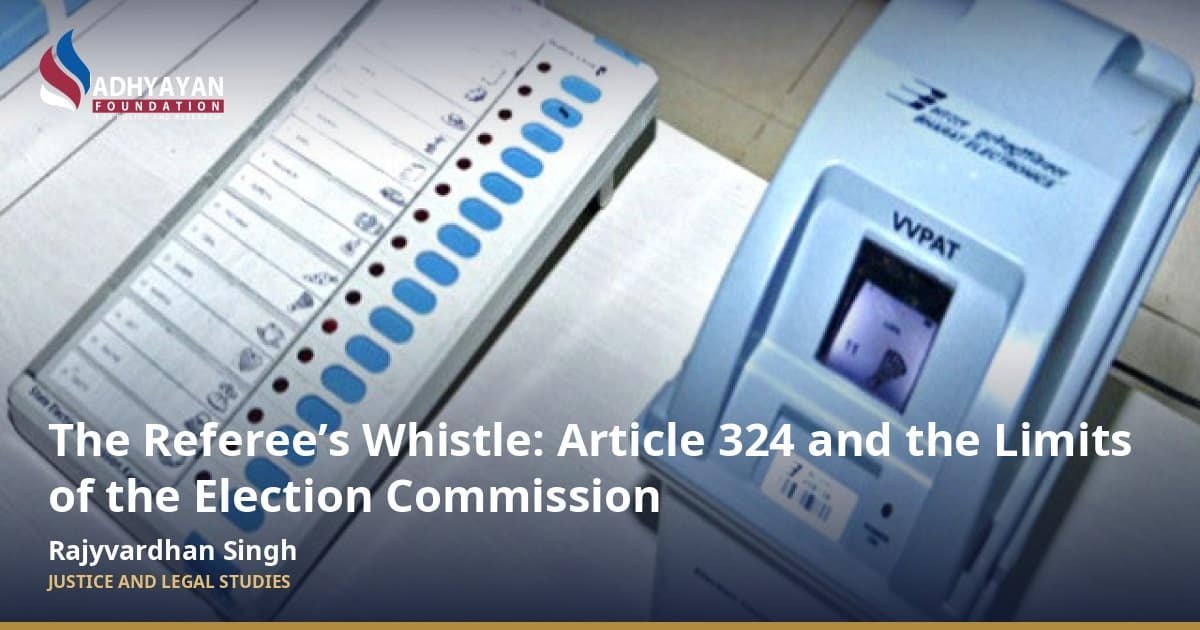
A good referee is noticed only when something goes wrong, and a bad one is noticed all the time. India’s Election Commission is the referee of the world’s largest democratic contest, and in 2026 it has been noticed a great deal. In May the Supreme Court upheld its Special Intensive Revision (SIR) of Bihar’s electoral rolls. In September a two-judge bench split over the law that decides who appoints the Commission’s members. Between those two events lies the question this article asks: how much power does Article 324 give the Election Commission, and what keeps that power within bounds?
What Article 324 says about the Election Commission
Article 324(1) vests the “superintendence, direction and control” of the preparation of the electoral rolls and the conduct of elections to Parliament, the State legislatures and the offices of President and Vice-President in an Election Commission. The Commission consists of a Chief Election Commissioner and such other Election Commissioners as the President may fix, appointed by the President “subject to the provisions of any law” made by Parliament. The Chief Election Commissioner can be removed only in the manner and on the grounds applicable to a Judge of the Supreme Court, and his conditions of service cannot be varied to his disadvantage after appointment. The other Commissioners cannot be removed except on the recommendation of the Chief Election Commissioner. Article 329(b) closes the other door: elections to Parliament and State legislatures may be questioned only by an election petition.
The structure is deliberate. The Constitution does not make the Commission a department of the executive, and it protects its head with the same tenure shield as a Supreme Court judge. The words “superintendence, direction and control” are broad, and the Supreme Court has read them broadly for decades.
A reservoir, with a wall around it
The leading case is Mohinder Singh Gill v. Chief Election Commissioner, (1978) 1 SCC 405. The 2026 judgment in Association for Democratic Reforms v. Election Commission of India (2026 INSC 564, decided on 27 May 2026 by Chief Justice Surya Kant and Justice Joymalya Bagchi) describes the ratio of Mohinder Singh Gill as twofold. The power under Article 324 is real and not confined to filling gaps that Parliament has left. But it cannot be used to defeat an express statutory mandate. The Court also read Articles 324 and 327 as complementary and not competing, quoting the earlier observation in Sadiq Ali, (1972) 4 SCC 664, that the Commission does not act as Parliament’s delegate. It relied on Kanhiya Lal Omar, (1985) 4 SCC 628, and Election Commission v. Ashok Kumar, (2000) 8 SCC 216, for a wide reading of “elections” and “superintendence”, and on Union of India v. Association for Democratic Reforms, (2002) 5 SCC 294. It distinguished A.C. Jose, (1984) 2 SCC 656, as a case in which the Act and Rules expressly contemplated ballot papers, so that the use of voting machines contradicted them.
The summary the judgment gives in its own words is balanced: the Commission’s power is expansive, but it must be exercised consistently with statutory prohibitions. This is the right balance for a constitutional body. A referee with no authority cannot keep the game fair, and a referee with unlimited authority is a player.
The SIR as a test of the power
In June 2025 the Commission ordered a Special Intensive Revision of the Bihar rolls under Article 324 and section 21(3) of the Representation of the People Act, 1950. Section 21(3) allows a special revision “at any time”, for reasons to be recorded, of “any constituency or part of a constituency” in such manner as the Commission thinks fit. The petitioners argued that Article 324 could not override the statutory scheme and that the provision was constituency-specific. The Court disagreed. It held that the SIR was traceable to section 21(3) read with Article 324 and not in conflict with the Act or the 1960 Rules, that Rule 25 governs only revisions under section 21(2), and that “any” can bear a wider meaning where the problem is systemic. It then applied a proportionality test (legitimate purpose, rational nexus, necessity and fair balance) and held the exercise proportionate, citing the notice, hearing and appeal safeguards. The numbers show the scale: about 7.89 crore electors before the revision, a draft roll of about 7.24 crore on 1 August 2025, and a final roll of about 7.42 crore on 30 September 2025.
Two features of the ruling deserve attention. First, the Court did not hand over a blank cheque on citizenship. As reported by the Supreme Court Observer, the Commission may make a limited inquiry into citizenship for the purpose of enrolment, but formal adjudication lies with the competent authority under the Citizenship Act, and persons the Commission is not satisfied about are to be referred there. Second, Aadhaar is accepted as identity proof but not as proof of citizenship. A referee is trusted when its authority is clearly marked, and these are the markings.
The harder question: who appoints the referee
Power of this width makes the manner of appointing the Commissioners more important, not less. In Anoop Baranwal v. Union of India (writ petition (civil) 104 of 2015, decided on 2 March 2023), a five-judge Constitution Bench held that, until Parliament made a law, a committee of the Prime Minister, the Leader of the Opposition and the Chief Justice of India would advise the President on appointments. Parliament then enacted the Chief Election Commissioner and Other Election Commissioners (Appointment, Conditions of Service and Term of Office) Act, 2023, which, on the account in the Supreme Court Observer, put a Cabinet Minister nominee in the place of the Chief Justice.
On 23 September 2026 the challenge to that Act, Dr. Jaya Thakur v. Union of India, writ petition (civil) no. 14 of 2024 (2026 INSC 1040), produced a split. Justice Dipankar Datta read the Anoop Baranwal committee as a stop-gap under Article 142 that lapsed when Parliament legislated, prima facie doubted that the Cabinet Minister could be a real counterweight to the Prime Minister, and said the Commission must “appear to be independent”. He declined to refer the matter to a larger bench. Justice Satish Chandra Sharma held that there is no authoritative decision on the Act’s validity and that a Constitution Bench of at least five judges must hear it. The matter now awaits the Chief Justice, and nothing in the reports reviewed records a stay of the Act. Justice Datta expressly confined his views to the question of reference and reached no final view on the merits.
The strongest objection
There is a serious case against giving the Commission wide residuary power. The petitioners in the SIR case argued that Article 324 cannot override the statutory scheme, and that the revision reversed the presumption in favour of those already on the roll. A body that frames a procedure and also applies it can err, and the people harmed by a mistaken exclusion are the least able to contest it. The same logic, applied to appointments, says that if the government of the day chooses the umpire, the umpire will be trusted less, whatever his or her personal integrity.
The answer is not to shrink the whistle but to build the walls. The Court’s own method is the model: the power is wide, but statute is higher; the Commission may act, but it must give reasons, notice and a hearing; and its decisions remain open to appeal and judicial review. On appointments, the right course is a settled, transparent selection law that commands wide confidence, which the larger bench or Parliament should supply promptly. Constitutionalism asks that institutions be strong and trusted, and trust does not come from strength alone.
Conclusion
Article 324 gives India a referee with authority, and the Supreme Court has confirmed that the authority is real. What remains is to make sure the referee is, and is seen to be, above the game. Parliament should settle the appointment question with the confidence of the whole House, the Commission should keep to reasoned, published and reviewable process, and the courts should keep the wall between the reservoir of power and the text of the statute. Those who care for institutions before street politics have a stake in all three.
Notes and References
1. Constitution of India, Articles 324 and 329, Legislative Department, Government of India, extracts from the Constitution, https://www.legislative.gov.in/static/uploads/2025/07/288b285129a41d9fbe4c7c9c517e1629.pdf
2. Association for Democratic Reforms v. Election Commission of India, W.P.(C) No. 640 of 2025 and connected matters, judgment of 27 May 2026, 2026 INSC 564, Supreme Court of India (paragraphs up to 108 read directly, including the discussion of Mohinder Singh Gill, (1978) 1 SCC 405; Sadiq Ali, (1972) 4 SCC 664; A.C. Jose, (1984) 2 SCC 656; Kanhiya Lal Omar, (1985) 4 SCC 628; Election Commission v. Ashok Kumar, (2000) 8 SCC 216; Union of India v. ADR, (2002) 5 SCC 294), https://api.sci.gov.in/supremecourt/2025/35785/35785_2025_1_1501_71617_Judgement_27-May-2026.pdf
3. “Revision of Electoral Rolls in Bihar”, judgment summary, Supreme Court Observer, 2026, https://www.scobserver.in/reports/challenge-to-the-ecis-revision-of-electoral-rolls-in-bihar-judgement-summary/
4. “Supreme Court Upholds Bihar Electoral Roll Revision, Sets Limits on Citizenship Inquiry”, Legal Republic, 2026, https://www.legalrepublic.in/supreme-court/adr-vs-eci-bihar-sir-electoral-rolls-2026/
5. Dr. Jaya Thakur v. Union of India, W.P.(C) No. 14 of 2024 and connected matters, opinions of Datta J. and Sharma J., 23 September 2026, 2026 INSC 1040, Supreme Court of India, https://www.sci.gov.in/sci-get-pdf/?diary_no=1462024&type=j&order_date=2026-09-23&from=latest_judgements_order
6. “SC delivers split verdict, sends ECI appointments law challenge to larger bench”, Supreme Court Observer, 23 September 2026, https://www.scobserver.in/reports/sc-delivers-split-verdict-sends-eci-appointments-law-challenge-to-larger-bench/
7. “Election Commission Appointments” (Anoop Baranwal v. Union of India, judgment of 2 March 2023), Supreme Court Observer, https://www.scobserver.in/cases/anoop-baranwal-v-union-of-india-election-commission-appointments-background/
Frequently asked questions
What does Article 324 of the Constitution provide?
It vests the superintendence, direction and control of the preparation of the electoral rolls and the conduct of elections in an Election Commission, with the Chief Election Commissioner removable only like a Supreme Court Judge.
How wide is the Election Commission’s power under Article 324?
The Supreme Court, relying on Mohinder Singh Gill, treats it as real and not limited to gaps in the law, but it cannot defeat an express statutory mandate.
What did the Court say about citizenship in the Bihar SIR?
The Commission may make a limited inquiry into citizenship for enrolment, but formal adjudication lies with the competent authority under the Citizenship Act.
What happened in the challenge to the 2023 appointments law?
On 23 September 2026 a two-judge bench split in Dr. Jaya Thakur v. Union of India. One judge sought a Constitution Bench; the other doubted the committee and declined to refer. The matter awaits the Chief Justice.
Further reading from AFPR: Counting the Counters: SIR Across the States, Phase by Phase · Petition, Not Placard: Why the Street Cannot Stand In for the Supreme Court, the Election Commission and the Constitution