Introduction and thesis
On the eve of Nigeria’s 2023 general election, the Independent National Electoral Commission (INEC) told political parties that there would be no turning back from using technology to verify voters and to publish results (Opinion Nigeria, n.d.). The promise was concrete. Voters would be accredited by the Bimodal Voter Accreditation System (BVAS), and the result sheet from each polling unit would be uploaded to the INEC Result Viewing portal (IReV) for the public to see. Biometric technology was offered as the answer to an old question in democracies: can citizens trust the list of who may vote, and therefore the count?
This article asks whether biometric registers raise public trust in the count, or only the cost of error. It argues that they narrow one avenue of fraud, the fake or duplicate registrant, but that trust is won or lost at later stages, where the technology either does not reach or fails without a fallback. Nigeria and Kenya show trust being lost at the count. Ghana shows trust being lost at polling-day verification, and also shows the technology earning real confidence. The evidence covers three African democracies and makes no claim about the continent as a whole.
The reader in mind is Indian. India’s current debate about the roll turns on the Special Intensive Revision (SIR) of electoral rolls, which the Supreme Court upheld on 27 May 2026. The SIR is a documentary exercise, not a fingerprint system, so the comparison is not about copying technology. It is about which stage of an election each safeguard protects and what is left unprotected. The final section sets out what India should adopt and what it should avoid, with India’s interests first.
Why biometric registers became a trust problem
The register is the foundation of the count, and disputes about it are old. Ghana’s 1992 transition election shows the pattern. Opposition parties alleged impersonation, double voting, under-age voting and a bloated register, boycotted the parliamentary poll, and demanded an entirely new register with identification cards (Debrah, Effah and Owusu-Mensah 2019). In the mid-1990s a computerised register was compiled, and by 2008 all eligible voters had photo identification cards. Yet suspicion of fraud persisted, and parties agreed through the Inter-Party Advisory Committee to adopt biometric technology for 2012, with multiple voting and impersonation as the targets (Debrah et al. 2019).
Nigeria’s problem was multiple registration. After the 2011 registration exercise, INEC ran fingerprint-matching software on the data and eliminated 870,000 multiple registrations ahead of the April 2011 elections, according to INEC’s own bulletin quoting its then chairman, Professor Attahiru Jega (INEC 2013). Jega’s interview with the ACE Electoral Knowledge Network gives a similar figure, close to one million (ACE, n.d.). Later, before the 2015 elections, Jega said that the system had allowed INEC to remove more than 4 million duplicate registrations (VOA, n.d.). The two figures belong to different periods and should not be confused.
Two ideas need separating. Trust in the count means that citizens and parties accept that the announced result reflects the votes cast. The cost of error is the harm done when a system gets an individual case wrong, for example by rejecting a genuine voter or removing a real name. A biometric register can improve the first by reducing duplicate entries, and can worsen the second if genuine voters are failed by the technology and have no way back. The case studies below show both effects.
The logic behind both reforms is simple: if the roll is clean, the count should be trusted. The rest of this article tests that claim stage by stage.
Nigeria, part one: the PVC and the register
Nigeria’s biometric register was built around the Permanent Voter Card (PVC). Each registered voter received a card carrying demographic and biometric information on a chip, and registration data were checked to remove people who had registered more than once (ACE, n.d.).
What the register fixed is therefore reasonably clear: it targeted the duplicate registrant, the person on the roll more than once. What it did not claim to fix is just as important. A Vanguard commentary published around the time of the reform argued that nothing suggested permanent cards could not be sold, and that irregular turnout figures would not disappear merely because the card was permanent (Vanguard, n.d.). That is a critic’s view, not a finding, but it identifies the gap this article examines: a clean register says who may vote, and says nothing about what happens to the votes afterwards.
This article was unable to establish how many duplicate or fictitious registrants remain after 2011. That would require an audit of the register, and any claim about it should come from INEC’s or an independent auditor’s own records.
The distinction matters for the argument. A register-level safeguard works at the entrance to the election. Whatever it achieves, it cannot vouch for the stages after it, and Nigeria’s later experience shows how much distance there is between a clean roll and a result that the public believes.
Nigeria, part two: BVAS, IReV and the count
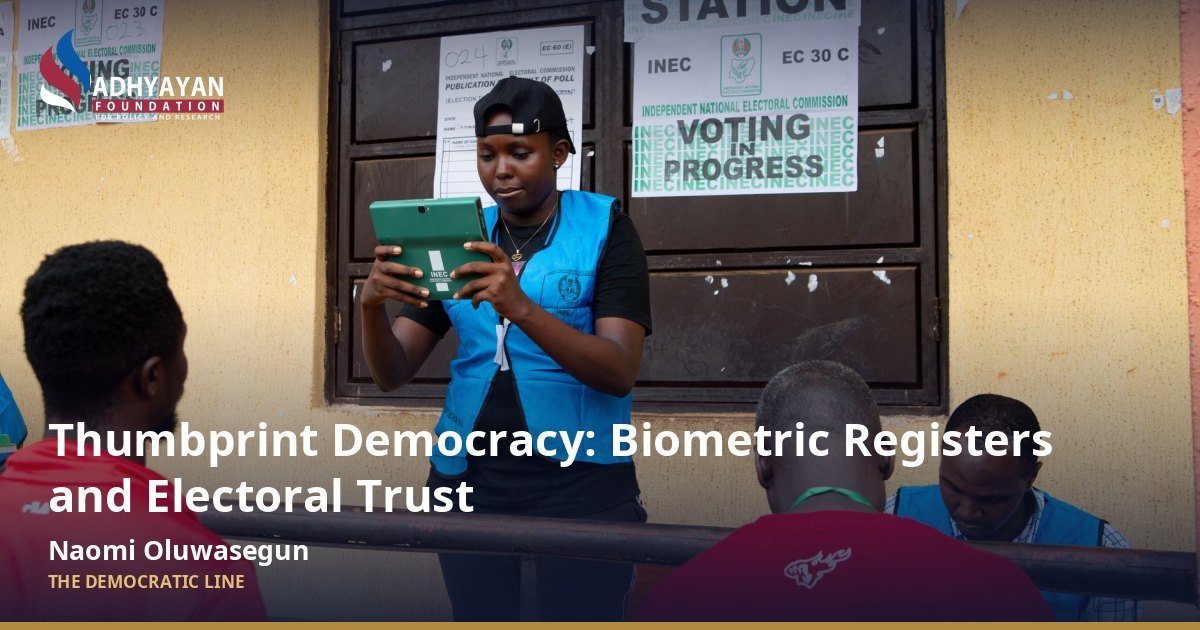
For 2023 INEC added two tools. BVAS verifies voters at the polling unit, and IReV publishes polling-unit result sheets online. Observers noted that both had been presented to Nigerians as game changers (Connected Development 2023).
Observers disagreed on how BVAS itself performed. The Nigeria Civil Society Situation Room (2023) found that it functioned satisfactorily in many polling units visited, while Connected Development (2023) reported that there were many polling units where it failed. The accreditation step, in other words, did not collapse, though it was not flawless either.
The more visible failure came with the results. On 25 February 2023, the House and Senate results were uploaded to IReV, but the presidential results returned a server error. INEC officers later told the Presidential Election Petition Court that only the presidential results failed to upload (Gazette NGR, n.d.). INEC’s post-election report, as reported by Channels TV, attributes the failure to a configuration problem in matching presidential results to polling units, and says the first presidential result sheet was uploaded at 8.55 pm (Channels TV, n.d.). Observers had recorded that none of the presidential results had reached the portal by 8 pm (Situation Room 2023).
INEC’s report admits that the failure to upload results in real time affected public perception of the election, but INEC maintains that the credibility of the election was not affected, because results were displayed at polling units and party agents held signed copies (Channels TV, n.d.). The Situation Room (2023) made a related point: collation has always been the weakest link in Nigeria’s electoral process.
Critics were not persuaded. Some alleged that the failure was deliberate, which INEC denies and describes as a technical glitch (Africa Check, n.d.). The Labour Party’s data analyst told the court that results from 18,088 polling units were blurred, and the court admitted the evidence (Opinion Nigeria, n.d.). A BudgIT analysis reported that some uploaded results were incomplete or contained photographs of polling-unit officials (BudgIT, n.d.). The Presidential Election Petition Court dismissed the petitions in September 2023 (Obi and Labour Party v INEC). These are allegations and contested evidence, and this article does not treat them as findings of rigging.
One point deserves emphasis. The paper copies on which INEC relied for its defence were also the oldest and least technological part of the system. The portal was meant to make those copies visible to everyone, and when it failed, the defence of the result fell back on documents posted at polling units and held by party agents, which most citizens had not seen for themselves. That does not show that the paper was unreliable. It shows that the technology had changed what the public expected to see, and the shortfall was measured against the promise.
What the Nigerian case shows is narrower and more defensible. The voter-verification step largely did its job, and the trust problem arose at transmission and collation, where INEC had promised public, real-time visibility and could not deliver it. When the portal failed, INEC’s defence retreated to paper. That is the pattern the thesis predicts.
Kenya, 2017: the identification worked, the result did not
Kenya’s 2017 election used the Kenya Integrated Elections Management System (KIEMS), a tablet-based system to identify voters and transmit results. The International Institute for Democracy and Electoral Assistance (IDEA 2017) reports that the identification side appeared to work and was not contested in the petition that followed.
On 1 September 2017, the Supreme Court annulled the presidential result and ordered a fresh poll within 60 days (Daily Maverick 2017). It cited irregularities and illegalities centred on the transmission of results (IDEA 2017). Legal commentary on the judgment focuses on the results forms, known as Forms 34A, 34B and 34C, that carry a result from the polling station to the national tally (Oxford Human Rights Hub, n.d.).
Kenya reinforces the Nigerian lesson in a different institutional setting. A voter-identification system that works well offers no protection to a result that cannot be traced from the polling station to the final declaration. The Court did not blame the machines that checked voters. It examined whether the chain of results documents could be trusted, and found that it could not.
There is a further point for comparison. In both countries the results were meant to move from polling stations to a central tally, and in both the dispute was about whether that movement could be trusted. Neither case turned on the question the biometric register was built to answer, namely whether a voter was who they said they were. The failure was in a different stage, which the register’s design had never promised to cover.
The counter-argument: Ghana, 2012
Ghana is the strongest evidence against a pessimistic reading, and it deserves a section of its own. The University of Ghana study of the 2012 election found that biometric registration and verification stimulated high voter participation and confidence, and acted as a forensic measure against fraud such as impersonation and multiple voting (Debrah et al. 2019). In the study’s survey of 500 voters, an absolute majority (92.4 per cent) said biometric registration convinced them that the election would be free and fair, and registration turnout rose from 69.5 per cent in 2008 to 79.43 per cent in 2012. These are survey and administrative figures reported by the authors, and they are real evidence that biometrics can build trust.
But the same study shows how the trust was lost. The Electoral Commission admitted that about 4,000 multiple registrations and other irregularities occurred, and some eligible voters could not find their names on the roll. On polling day, the verification machines malfunctioned in many places. Under the rule of ‘no verification, no vote’, voters whose fingerprints failed to match were in effect disenfranchised, because no alternative means of identification had been provided. On the evening of 7 December 2012, the Commission directed that polling continue the next day where verification could not be completed, and field officials applied the instruction unevenly. The opposition alleged manipulation and petitioned the Supreme Court, partly over voting without biometric verification, and the Court dismissed the petition (Akufo-Addo v Mahama 2013). The authors conclude that machine malfunction, human error and policy manipulation by polling officials neutralised the technology’s benefits (Debrah et al. 2019).
How far does this weaken the thesis? It weakens a blunt version, that biometrics do not raise trust, because in Ghana they plainly did. It also shows that the ‘later stage’ where trust is lost need not be the count. In Ghana it was polling-day verification itself, and the cause was a missing fallback and uneven official discretion, not the biometric concept. The refined thesis is therefore this: biometric systems raise confidence in the roll, but trust in the outcome depends on whether the stages after registration have fallbacks and open records. Ghana’s own reform points the same way. The Inter-Party Advisory Committee later amended the rule to add manual verification as a backup (Debrah et al. 2019).
Lessons for India
India’s current debate is about the roll. The SIR is a door-to-door enumeration and documentary revision that had last been run nationally in 2003, and during the Bihar hearings the Supreme Court pressed the Election Commission to include Aadhaar as the twelfth indicative document electors could file (The Hindu 2026). Reported figures show the scale: about 65 lakh names were removed from Bihar’s draft roll (The Hindu 2026).
On 27 May 2026, in Association for Democratic Reforms v Election Commission of India, the Supreme Court held that the Commission may conduct the SIR under Article 324 of the Constitution and the Representation of the People Act, 1950, and that free and fair elections depend on the integrity, accuracy and credibility of the rolls (Supreme Court of India 2026; All India Radio 2026). The Court noted safeguards of notice, hearing, objections and appeals, and directed that those deleted on citizenship grounds have their cases referred to the competent authority within four weeks (Supreme Court of India 2026; The Quint 2026). The implementation continues to be tested. In October 2026 opposition leaders petitioned the Court, stating that they challenge the manner of implementation and not the validity of the SIR (Asianet Newsable 2026). This article takes no position on those allegations.
What does the African evidence add for India? First, it speaks to cost of error. Ghana shows what happens when a verification step has no fallback: genuine voters were rejected and effectively excluded. India’s four-week referral requirement is a fallback of the same kind, and the Ghana experience suggests that the speed and reach of such a mechanism matter as much as the revision itself. India’s interests are best served when the cost of error, which falls on citizens wrongly removed, is made visible and reversible.
Second, it speaks to the count. Nigeria and Kenya show that a trusted roll does not produce a trusted result on its own. A fair objection is that India already requires polling-station results to be recorded and shared with candidates’ agents, and that VVPAT slips offer a paper check on the count. Nigeria’s experience suggests what that leaves open. INEC’s own defence rested on agents’ copies, yet public confidence fell, because most citizens are not agents. Where India’s existing safeguards already give agents these records, the question that remains is how quickly and how widely the same results are public, and whether anything promised publicly, in real time, can be delivered when systems fail.
Two things India should adopt follow. First, make polling-station results checkable by the public and not only by parties, in a form that allows the announced count to be compared with the paper record. Second, build and publish a manual fallback for every digital step, so that a machine failure does not become an exclusion or a dispute.
Two things India should avoid also follow. First, avoid promising real-time public verification before it has been tested at scale, since INEC’s own report says the failure to deliver hurt public perception. Second, avoid treating a clean roll as the end of the trust question. Kenya’s Supreme Court annulled a result because the chain of results forms could not be trusted, and not because the voter list was wrong.
Conclusion
Do biometric registers raise public trust in the count, or only the cost of error? The evidence from Nigeria, Kenya and Ghana suggests both, and that the balance depends on what surrounds the technology. Biometric registration raised confidence in the roll where it worked, as in Ghana. It did not, by itself, protect the count, as in Nigeria and Kenya, and where verification had no fallback, the cost of error fell on genuine voters, as in Ghana. For India, the lesson is not to copy any technology. It is to protect trust at every stage, give every digital step a manual fallback, and make results visible to those who were not in the room.
Frequently asked questions
Do biometric registers raise trust in elections?
They raise confidence in the roll where they work, as in Ghana, by narrowing fraud such as duplicate or fake registrants. They do not by themselves protect the count, as Nigeria and Kenya show.
What went wrong in Nigeria’s 2023 results system?
The presidential results returned a server error on the IReV portal on 25 February 2023, while House and Senate results uploaded. INEC’s report attributes it to a configuration problem and says its defence rested on results displayed at polling units.
Why did Kenya’s Supreme Court annul the 2017 result?
On 1 September 2017 it cited irregularities and illegalities centred on the transmission of results. It did not blame the machines that identified voters.
What should India adopt and avoid?
India should make polling-station results checkable by the public and publish a manual fallback for every digital step. It should avoid promising untested real-time verification and avoid treating a clean roll as the end of the trust question.
Further reading from AFPR: Garbage In, Ballot Out: Technology and the Errors of the Voter List · Verdict on the Voter List: What the Court Really Said
References
ACE Electoral Knowledge Network (n.d.) ‘Using Biometric Voter Registration for the 2015 Elections in Nigeria: An Interview with Professor Attahiru Jega’.
Africa Check (n.d.) ‘No, Nigeria’s electoral commision chair hasn’t said he regrets declaring president Bola Tinubu winner of Nigeria’s 2023 election’. https://africacheck.org/fact-checks/meta-programme-fact-checks/no-nigerias-electoral-commision-chair-hasnt-said-he-regrets
Akufo-Addo, N.A.D. and 2 others v Mahama, J.D. and 2 others, Writ No. J1/6/2013, Supreme Court of Ghana, judgment of August 2013.
All India Radio (2026) ‘Supreme Court upholds legality of ECI’s Special Intensive Revision of electoral rolls’, 27 May 2026.
Asianet Newsable (2026) report on the opposition petition against the implementation of the electoral roll revision, October 2026.
Association for Democratic Reforms v Election Commission of India, W.P.(C) No. 640/2025, Supreme Court of India, judgment of 27 May 2026 (Surya Kant CJI and Bagchi J), 2026 INSC 564. https://api.sci.gov.in/supremecourt/2025/35785/35785_2025_1_1501_71617_Judgement_27-May-2026.pdf
BudgIT (n.d.) ‘Nigeria Decides 2023: What Went Wrong in the Presidential Election?’.
Connected Development (2023) Interim statement on the process and conduct of Nigeria’s presidential and National Assembly elections 2023.
Daily Maverick (2017) ‘Kenya Supreme Court annuls election outcome, orders new poll within 60 days’, 1 September 2017. https://www.dailymaverick.co.za/article/2017-09-01-kenya-supreme-court-annuls-election-outcome-orders-new-poll-within-60-days
Debrah, E., Effah, J. and Owusu-Mensah, I. (2019) ‘Does the use of a biometric system guarantee an acceptable election’s outcome? Evidence from Ghana’s 2012 election’, African Studies, 78(3), pp. 347-369. https://doi.org/10.1080/00020184.2018.1519335
Gazette NGR (n.d.) ‘Only presidential election results failed to upload to portal, INEC officials tell tribunal’.
Channels TV (n.d.) report on INEC’s post-election report on the 2023 elections.
Independent National Electoral Commission (2013) Bulletin of 21 August 2013: remarks by Professor Attahiru Jega at the workshop on the Voters’ Register, Continuous Voter Registration and the Permanent Voter Card.
Voice of America (n.d.) ‘Nigeria electoral commission says 82 percent of voter cards collected’ (Reuters).
International IDEA (2017) ‘Kenya: the potential and limitations of electoral technology’.
Nigeria Civil Society Situation Room (2023) Second interim statement on the presidential and National Assembly elections, 26 February 2023.
Obi, P. and Labour Party v INEC and 2 others, Presidential Election Petition Court, judgment of 6 September 2023.
Odinga, R.A. and another v Independent Electoral and Boundaries Commission and 2 others, Presidential Election Petition No. 1 of 2017, Supreme Court of Kenya, determination of 1 September 2017.
Opinion Nigeria (n.d.) ‘Presidential election dispute: Court admits Peter Obi’s additional video evidence’.
Oxford Human Rights Hub (n.d.) ‘The Kenyan Supreme Court overturns presidential election results: of Forms 34As, Bs and Cs’.
The Hindu (2026) ‘Supreme Court to pronounce verdict on Bihar SIR on May 27’, 27 May 2026.
The Quint (2026) ‘Supreme Court upholds SIR of electoral rolls’, 27 May 2026.
Vanguard (n.d.) commentary on INEC’s permanent voter cards.