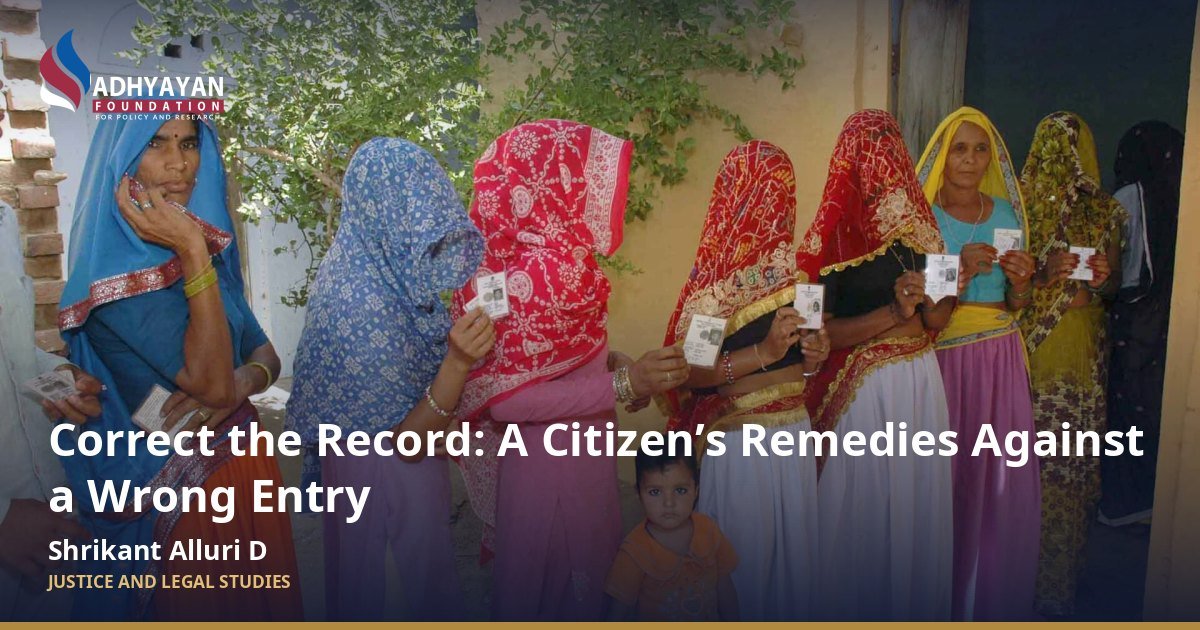
Every voter list is a promise made by the state to a citizen, and every promise needs a way to be enforced. India’s electoral roll is compiled by officials, house by house, for close to 97 crore electors, the figure the Election Commission gave in February 2024. Some entries will be wrong: a misspelt name, a wrong age, a person shown at an address she left years ago, or a name missing altogether. The law does not pretend otherwise. It gives the citizen a set of remedies. This article sets out the remedies for a wrong entry in the voter list, how they work in practice, and what the Supreme Court said about them in May 2026 when it upheld the Special Intensive Revision (SIR) of Bihar’s rolls.
The right is statutory, so the remedy must be statutory too
The right to vote is not an abstraction that floats free of paperwork. A person votes only if the name is on the roll. Section 23 of the Representation of the People Act, 1950 lets a person who is not on the roll of a constituency apply to the Electoral Registration Officer (ERO) for inclusion, and the ERO directs inclusion if satisfied that the applicant is entitled to be registered. The Registration of Electors Rules, 1960 turn this into forms. As the published text of the Rules shows, a claim for inclusion goes in Form 6, signed by the person who wants to be added. An objection to someone else’s inclusion goes in Form 7, and only a person whose own name is on that roll may file it. A correction to the particulars in an entry goes in Form 8, and only the person to whom the entry relates may file it. A request to move an entry to the right part of the roll goes in Form 8A.
These rules of standing matter. They mean that a stranger cannot “correct” your entry, and that you cannot be struck off by an anonymous complaint. Form 7, in particular, is not a general invitation to report a neighbour. The Goa Chief Electoral Officer’s bulletin of 9 January 2026, issued during that State’s SIR, shows the same discipline in practice: complaints that came without the prescribed form and declaration were not counted at all.
The clock and the hearing
The draft roll is the starting gun. Under Rule 12, claims and objections must be lodged within 30 days of publication of the draft, or within a shorter period of not less than 15 days fixed by the Election Commission, which may extend the time by notification. In Goa’s SIR the window ran from 16 December 2025 to 15 January 2026, a month. Late or ill-formed papers are liable to be rejected under Rule 17, so the practical advice is simple: file early, use the right form, and keep a copy.
What follows is more protective than many citizens realise. Under Rule 18 the officer may allow an uncontested claim without inquiry, but only after one week from its entry in the exhibited list, and if anyone demands an inquiry in writing, the claim “shall not be allowed without further inquiry”. Where the matter is contested, Rule 19 requires a date, time and place for a hearing, with notices to the claimant, the objector and the person objected to, served personally, by registered post, or by affixing at the residence. Rule 20 provides a summary inquiry in which each of them may appear and be heard, and the officer may take evidence on oath. For applications made on Forms 6, 7, 8 or 8A under Rule 26, a copy is posted with a notice inviting objections within seven days, and if the application is rejected the officer must record a brief written statement of reasons.
Deletion has its own safeguard. Rule 21A covers the names of dead persons, of people no longer ordinarily resident, and of persons otherwise not entitled to be on the roll. The officer must prepare a list, publish a notice, hear objections and then decide. Before deleting a person on grounds of residence or entitlement, the officer must make every effort to give that person a reasonable chance to show cause. In short, the law says that no one should lose a name without being told and heard.
If the officer says no: appeal
Section 24 of the 1950 Act supplies the appeal. An order of the ERO under section 22 or 23 can be taken to a District Magistrate or an officer of equivalent rank, and a further appeal against that officer’s order lies to the Chief Electoral Officer. The time and manner are “as may be prescribed”. The version of the Rules consulted prescribes a short period of days for the appeal, so a citizen who loses at the first stage should check the current Rules and the order itself for the deadline and act at once. The point is that two layers of administrative review sit above the registration officer before a citizen ever needs a court.
What the Supreme Court said
The remedies were tested in Association for Democratic Reforms v. Election Commission of India, writ petition (civil) no. 640 of 2025 and connected matters, decided on 27 May 2026 by a bench of Chief Justice Surya Kant and Justice Joymalya Bagchi (2026 INSC 564). The Court upheld the SIR and treated the safeguards as part of the reason. It noted the notice before proposed exclusion, the chance to respond, and the appellate remedies, and described the approach as one in which the right is “regulated, but not abrogated”. It also recorded the assistance it had ordered during the case: publication of the list of about 65 lakh persons left out of the draft with reasons (order of 14 August 2025), help from the Booth Level Agents of political parties in filing forms, and para-legal volunteers from the District Legal Services Authorities (order of 1 September 2025). On documents, it directed that Aadhaar be accepted as a twelfth document of identity (order of 8 September 2025), while making clear it is not proof of citizenship. According to reports of the judgment, the Court also held that omission from a draft roll is not final deletion, because the draft is provisional by design, and that persons erroneously deleted who are domiciled in the State can still seek judicial review.
The numbers are worth stating. The draft roll of 1 August 2025 carried about 7.24 crore electors; the final roll of 30 September 2025 carried about 7.42 crore, against 7.89 crore before the revision. The difference between draft and final is the claims-and-objections process at work.
The strongest objection
The critic’s case deserves a fair hearing. A remedy that exists on paper is only as good as the citizen’s ability to use it. A daily wage worker, a migrant, an elderly person or a woman who has moved after marriage may not know the form, the deadline or the office, and a procedure that places the burden of proof on the person erased puts the heaviest weight on those least equipped to carry it. The Court itself accepted that errors in a large exercise do not by themselves make it unconstitutional, which also means errors will occur.
That is a fair concern, but it points to administration, not to the absence of law. The design the Court examined contains the answer in its own terms: lists published with reasons, notice before deletion, hearings, two tiers of appeal, assisted filing and legal aid. What follows is a duty on the State to make those remedies reachable. Officers should publish the dates and the forms in plain language, and political parties that supply Booth Level Agents should use them for the people they were named to help.
What to do about a wrong entry in the voter list
Check the entry as soon as the draft is published. If the particulars are wrong, file Form 8; if the name is missing, file Form 6; if a name should not be there, Form 7 is available, but only to a person on that roll. Attach identity documents, remembering the Supreme Court’s distinction between identity and citizenship. Attend the hearing if called. If the order goes against you, read the reasons the officer was required to record, and appeal within the prescribed time. A correct roll is not only the State’s duty. It is a shared work, and the citizen who corrects the record protects the vote.
Notes and References
1. Representation of the People Act, 1950, sections 23 and 24, as reproduced in “Public information on Representation of People Act 1950 & Registration of Electors Rule 1960”, Morung Express, https://morungexpress.com/public-information-on-representation-of-people-act-1950-registration-of-electors-rule-1960
2. Registration of Electors Rules, 1960 (text, Rules 12 to 21A, 23, 26 and 27; Forms 6, 7, 8, 8A), Chief Electoral Officer, Assam, handbook, https://ceoassam.nic.in/handbook/the-registration-electors-rules-1960.pdf
3. Association for Democratic Reforms v. Election Commission of India, W.P.(C) No. 640 of 2025 and connected matters, judgment of 27 May 2026, 2026 INSC 564, Supreme Court of India, https://api.sci.gov.in/supremecourt/2025/35785/35785_2025_1_1501_71617_Judgement_27-May-2026.pdf (paragraphs up to 108 read directly)
4. “Revision of Electoral Rolls in Bihar”, judgment summary, Supreme Court Observer, 2026, https://www.scobserver.in/reports/challenge-to-the-ecis-revision-of-electoral-rolls-in-bihar-judgement-summary/
5. “Supreme Court Upholds Bihar Electoral Roll Revision, Sets Limits on Citizenship Inquiry”, Legal Republic, 2026, https://www.legalrepublic.in/supreme-court/adr-vs-eci-bihar-sir-electoral-rolls-2026/
6. Chief Electoral Officer, Goa, SIR daily bulletin dated 9 January 2026, https://ceogoa.nic.in/PDF/SIR2026/SIR_DB24.pdf
7. “Lok Sabha elections 2024: 97 crore registered to vote, 2 crore young electors added, says EC”, Business Today, 9 February 2024, https://www.businesstoday.in/amp/india/story/lok-sabha-elections-2024-97-crore-registered-to-vote-2-crore-young-electors-added-says-ec-416904-2024-02-09
Frequently asked questions
Which form do I use if my name is missing from the voter list?
Form 6, signed by the person who wants to be added, goes to the Electoral Registration Officer under Section 23 of the Representation of the People Act, 1950.
How do I correct a wrong detail in my voter entry?
File Form 8. Only the person to whom the entry relates may file it.
Who can object to a name on the roll?
Form 7 is for objections to someone else’s inclusion, and only a person whose own name is on that roll may file it.
Can I appeal if the officer rejects my application?
Yes. Section 24 provides an appeal to a District Magistrate or an equivalent officer, and a further appeal to the Chief Electoral Officer, within the prescribed time.
Further reading from AFPR: Counting the Counters: SIR Across the States, Phase by Phase