A Reform That Would Not Stay Settled
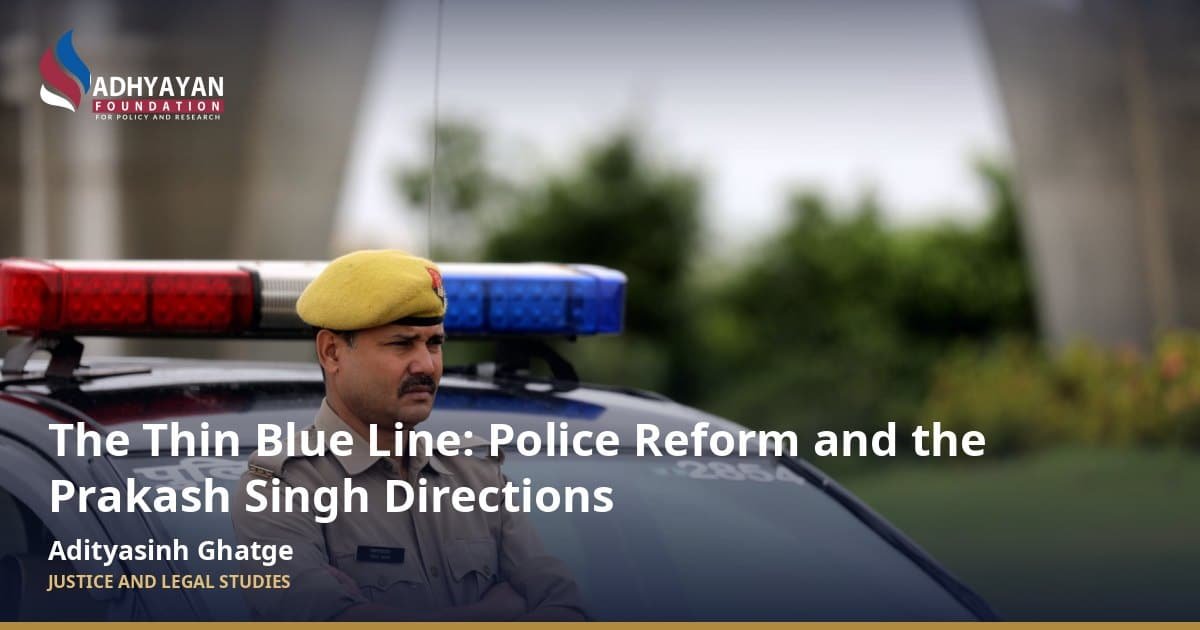
On 8 October 2026, the Supreme Court was again examining how a State appoints its police chief. It questioned, on a preliminary basis, Jharkhand’s rule allowing retrospective service credit to make an officer eligible despite having less than six months before retirement. No final ruling on the rule or appointment had yet been made. The dispute nevertheless raises an uncomfortable question: why is the appointment of a Director General of Police still contested twenty years after the Court issued nationwide reform directions?
The answer lies partly in the difference between creating a legal mechanism and allowing it to function as intended. A police force needs stable leadership and sufficient resources to manage crime and disorder. Equally, it needs safeguards against improper influence and meaningful scrutiny of misconduct. The Prakash Singh directions sought to bring these requirements together, rather than treating efficiency and accountability as alternatives.
What the Prakash Singh Directions Actually Required
In Prakash Singh v Union of India, the Supreme Court responded to decades of unrealised recommendations on policing. Its seven directions were intended to operate until appropriate legislation was framed. They did not ask the police to operate beyond democratic control. They sought to distinguish lawful supervision from interference in professional decisions.
The directions created three interconnected safeguards. State Security Commissions were to set broad policy and assess performance, while selection procedures and minimum tenures were intended to protect police leadership from arbitrary disruption. Police Establishment Boards would address specified personnel decisions, and separating criminal investigation from routine law-and-order duties would improve investigative attention and expertise.
Accountability formed the other half of the design. State and district Police Complaints Authorities were envisaged to examine serious misconduct with independent participation and consequential recommendations. A National Security Commission would address leadership in central police organisations. Independence without oversight could shield abuse and oversight without autonomy could leave police susceptible to political pressure. The value of the judgment was in recognising both risks together. Its success, however, depended on how governments translated these principles into appointments, laws and functioning institutions.
Twenty Years on: The Court Returns
The litigation did not end in 2006. In July 2018, the Court required states to forward DGP vacancy proposals to the Union Public Service Commission at least three months in advance and discouraged acting appointments. In March 2019, it clarified that candidates considered for empanelment needed at least six months of service before retirement, not two years. The two-year minimum related to tenure after appointment.
The issue resurfaced in February 2026. In a Telangana dispute, the Court addressed delayed DGP selection and made clear that UPSC could seek enforcement if states failed to submit proposals. A connected order concerning Tamil Nadu extended that approach to similarly placed states and addressed a selection-panel conflict involving an acting DGP who was also a candidate. By March, the Court recorded fresh steps towards appointments and disposed of certain contempt proceedings. Enforcement had produced movement, even if it had required judicial prompting.
Then came Jharkhand. The October order questioned a 2025 regulation that effectively bypassed the six-month condition through retrospective credit, invited the state to reconsider or defend the rule and sought examination of comparable state arrangements. It was a preliminary intervention, not a final declaration of invalidity. Together, these proceedings reveal the persistence of appointment disputes but also demonstrate that court supervision can secure specific compliance.
State Laws and the Gap in Design
State legislation reveals a less visible difficulty: reform can be accepted in name and narrowed in substance.
Maharashtra enacted a framework for a State Security Commission, establishment boards, specialised investigation functions and complaints authorities. Yet section 22B(10) of the Maharashtra Police Act makes the State Security Commission’s recommendations advisory, whereas the Supreme Court envisaged binding recommendations. That difference matters. A body asked to evaluate police performance has less leverage if its conclusions may be disregarded without the force contemplated by the original direction.
There is a similar qualification in complaints oversight. Maharashtra’s State Police Complaints Authority has statutory inquiry powers but section 22R(3) permits the government to reject its report in exceptional cases for recorded reasons. This is not an unlimited veto and the statute also provides routes for disciplinary and criminal action. Still, the possibility of executive rejection shapes the authority’s practical independence.
Tamil Nadu illustrates a different approach. Under its Police (Reforms) Act 2013, the State Police Complaints Authority is chaired by the Home Secretary and includes the DGP and Additional DGP (Law and Order). District authorities are similarly composed of administrative and serving police officials. Complaints must ordinarily arrive as sworn, notarised affidavits and the bodies send recommendations to the government rather than binding decisions. An authority dominated by officials from the administration it is expected to scrutinise raises an obvious independence concern. Its institutional existence cannot substitute for credible safeguards against conflicts of interest.
These provisions should not automatically be described as unconstitutional. Statutory difference and judicial invalidation are distinct questions. But they show why counting police-reform laws, commissions or boards cannot measure fidelity to the judgment. Their membership, powers, accessibility and consequences deserve closer examination.
Complaints, Capacity and Performance
The Commonwealth Human Rights Initiative’s study of Police Complaints Authorities shows what those design choices can mean in practice. Using information largely from 2018 to March 2023, it found serious variation in operational status, investigation capacity, transparency and follow-up on recommendations. These are historical findings, not a verified nationwide snapshot for October 2026.
Maharashtra’s authority recorded 4,515 matters over that period, including three initiated on its own motion. Only 1,102 (approximately 24.4%) were admitted for inquiry. This does not mean the remaining complaints were proved valid or wrongly rejected. It does mean that questions about jurisdiction and screening cannot be avoided. In Tamil Nadu, five of six complaints reported for January–March 2023 were rejected for failure to follow the prescribed format. The notarised affidavit requirement shows how access can be restricted before the merits are examined.
Resources present a separate constraint. The India Justice Report 2025, relying mainly on January 2023 police data, found vacancies of approximately 28% among officers and 21% among constables. Recruitment matters but numbers do not by themselves establish lawful practice. A separate 2025 police survey reported substantial state-level differences in officers’ perceptions of compliance with arrest procedures. Such responses are not an independent audit of arrests. Training and supervision also shape how officers exercise their powers in practice.
The combined lesson is practical. Professional policing requires sufficient people and skills but accountability requires functioning investigators, accessible complaints procedures, published outcomes and credible follow-through. Institutions can exist while these conditions remain weak.
Policing Protest within the Constitution
The test becomes especially visible during public protest. Article 19 protects expression and peaceful assembly, while allowing legally prescribed, reasonable restrictions in specified interests including public order. Policing is therefore not a choice between permitting every obstruction and suppressing dissent. It requires judgments about necessity, location, risk and the rights of others.
In Himat Lal K Shah, the Supreme Court recognised regulation of public meetings but rejected rules conferring unguided discretion to refuse permission. Mazdoor Kisan Shakti Sangathan required a workable balance between demonstrators and affected residents, rather than an effective permanent ban around Jantar Mantar. Amit Sahni, in turn, rejected indefinite occupation of public ways that seriously inconvenienced commuters. Read together, these cases call for regulation that protects both civic participation and public access.
Current statutory powers, including sections 148 and 163 of the Bharatiya Nagarik Suraksha Sanhita 2023, provide for dispersal in defined circumstances and urgent preventive orders. They are not general permission to silence lawful criticism. Their use must satisfy statutory conditions and constitutional limits.
The link with Prakash Singh is institutional. Officers subject to arbitrary transfers or improper pressure may struggle to apply public-order powers consistently. Equally, a police force insulated from scrutiny may wield those powers disproportionately. A professional service must be able to prevent violence without treating peaceful disagreement as disorder.
Conclusion: Authority with Accountability
Two decades of litigation have not rendered the Prakash Singh directions irrelevant. They have made the distinction between compliance on paper and independence in practice harder to ignore. Some appointments have progressed after judicial intervention, and states have created reform bodies. Yet statutory qualifications and uneven oversight leave important questions unresolved. Police effectiveness cannot be judged solely by leadership appointments, personnel strength or the ability to clear a street. It must also be judged by fair investigations, accessible complaints mechanisms and lawful treatment of dissent. The thin blue line is credible when the authority it exercises remains answerable to the Constitution.
Frequently asked questions
What were the Prakash Singh directions?
In Prakash Singh v Union of India (2006) 8 SCC 1, the Supreme Court gave seven directions intended to operate until legislation was framed. They included State Security Commissions, selection procedures and minimum tenures for police leadership, Police Establishment Boards, separation of investigation from law and order, Police Complaints Authorities and a National Security Commission.
Why is the appointment of a state DGP still contested?
The Court has returned to the issue repeatedly. In 2018 it required states to send DGP vacancy proposals to the UPSC at least three months ahead, and in 2019 it clarified that candidates needed at least six months of service before retirement. On 8 October 2026 it questioned a Jharkhand rule on retrospective service credit, in a preliminary order and not a final ruling.
Do state police reform laws follow the Supreme Court’s directions?
Not always in substance. Under section 22B(10) of the Maharashtra Police Act, the State Security Commission’s recommendations are advisory, whereas the Court envisaged binding ones. Tamil Nadu’s Police Complaints Authority is chaired by the Home Secretary and includes serving police officers. Statutory difference is not the same as unconstitutionality.
Further reading from AFPR: The Grammar of Dissent: Why the Constitution Sends Protest to Institutions, Not the Street
References
Table Of Cases
Amit Sahni v Commissioner of Police (2020) 10 SCC 439.
Henri Tiphagne v Thiru N Muruganandam (Contempt Petition (Civil), Diary No 63060 of 2025, in WP(C) No 310 of 1996, Supreme Court of India, 12 March 2026).
Himat Lal K Shah v Commissioner of Police, Ahmedabad (1973) 1 SCC 227.
Kishore Krishna Swamy v State of Tamil Nadu (Contempt Petition (Civil), Diary No 62010 of 2025, in WP(C) No 310 of 1996, Supreme Court of India, 12 February 2026).
Mazdoor Kisan Shakti Sangathan v Union of India (2018) 17 SCC 324.
Prakash Singh v Union of India (2006) 8 SCC 1.
Prakash Singh v Union of India (2019) 4 SCC 13 (order dated 3 July 2018).
Prakash Singh v Union of India (2019) 4 SCC 1 (judgment dated 13 March 2019).
Prakash Singh v Union of India (WP(C) No 310 of 1996, IA No 201897 of 2026, Supreme Court of India, 8 October 2026).
Union Public Service Commission v T Dhangopal Rao (Civil Appeal No 800 of 2026, Supreme Court of India, 5 February 2026).
Table Of Legislation
Bharatiya Nagarik Suraksha Sanhita 2023 (Act 46 of 2023).
Constitution of India 1950.
Maharashtra Police Act 1951 (Maharashtra Act XXII of 1951).
Tamil Nadu Police (Reforms) Act 2013 (Tamil Nadu Act 22 of 2013).
Bibliography
Reports and Institutional Publications
Common Cause and Lokniti–Centre for the Study of Developing Societies, Status of Policing in India Report 2025: Police Torture and (Un)Accountability (2025) https://www.commoncause.in/wotadmin/upload/SPIR_2025.pdf accessed 20 October 2026.
India Justice Report, India Justice Report 2025: Ranking States on the Capacity of Police, Judiciary, Prisons and Legal Aid (2025) https://indiajusticereport.org/files/IJR%202025_Full%20report_English.pdf accessed 20 October 2026.
Pradhan A and Srivastava D, Police Complaints Authorities in India: Status, Gaps, Challenges (Commonwealth Human Rights Initiative 2023) https://humanrightsinitiative.org/download/1697806059Police%20Complaints%20Authorities%20in%20India.pdf accessed 20 October 2026.