Parliament has promised women a third of its seats, but not yet. The Constitution (One Hundred and Sixth Amendment) Act, known as the Nari Shakti Vandan Adhiniyam, will operate only after the next census and the delimitation that follows it. The Act was brought into force on 16 April 2026; a government bill to amend Article 334A so that the quota could apply sooner was defeated in the Lok Sabha the next day, so the link to the census and delimitation stands [3]. The census is under way, with population enumeration fixed for February 2027. The promise therefore waits on the count, and meanwhile the country has something rare to study: three decades of a similar experiment at the bottom of the system. Since the Seventy-third and Seventy-fourth Amendments of 1992, a third of the seats in village panchayats and municipalities, and of their chairperson offices, have been reserved for women. What does that experience show about effective representation, and what should the framers of the new quota learn from it? This article argues that local quotas for women have succeeded in putting women into public office in vast numbers and have changed what villagers expect of them, but that presence is not the same as power, and that the design of the new reservation should draw on the weaknesses of the old one as carefully as on its strengths.
What the Constitution already requires
The local-body provisions are precise. Under Article 243D, at least one-third of the seats filled by direct election in every panchayat must be reserved for women, and this includes the seats reserved for Scheduled Caste and Scheduled Tribe women. Reserved seats may be rotated among the constituencies of a panchayat. The State legislature may reserve chairperson offices at each level for Scheduled Castes, Scheduled Tribes and women, and at least one-third of the chairperson offices at each level must go to women, again allotted by rotation among panchayats. Clause (6) separately leaves States free to reserve seats or offices for backward classes. Article 243T makes parallel provision for municipalities: at least one-third of the directly elected seats are for women, including the Scheduled Caste and Scheduled Tribe women’s seats, and these too may be rotated, while the chairperson offices in municipalities are reserved for Scheduled Castes, Scheduled Tribes and women in a manner the State legislature provides.
The One Hundred and Sixth Amendment borrows much of this architecture. As enacted, it reserves one-third of the seats in the Lok Sabha, the State Legislative Assemblies and the Delhi Legislative Assembly for women, inserting Articles 330A and 332A for that purpose, and provides in Article 334A that the reservation comes into effect only after the delimitation carried out on the figures of the first census taken after the Act’s commencement. It includes the seats reserved for Scheduled Castes and Scheduled Tribes within the one-third, provides for rotation of seats, and runs for fifteen years, a period that may be extended. It does not apply to the Rajya Sabha or to State Legislative Councils. The family resemblance to Articles 243D and 243T is deliberate. Whatever the local experience has taught about rotation, sub-quotas and sunset periods will therefore bear on the national design.
Local quotas for women: a large presence at the base
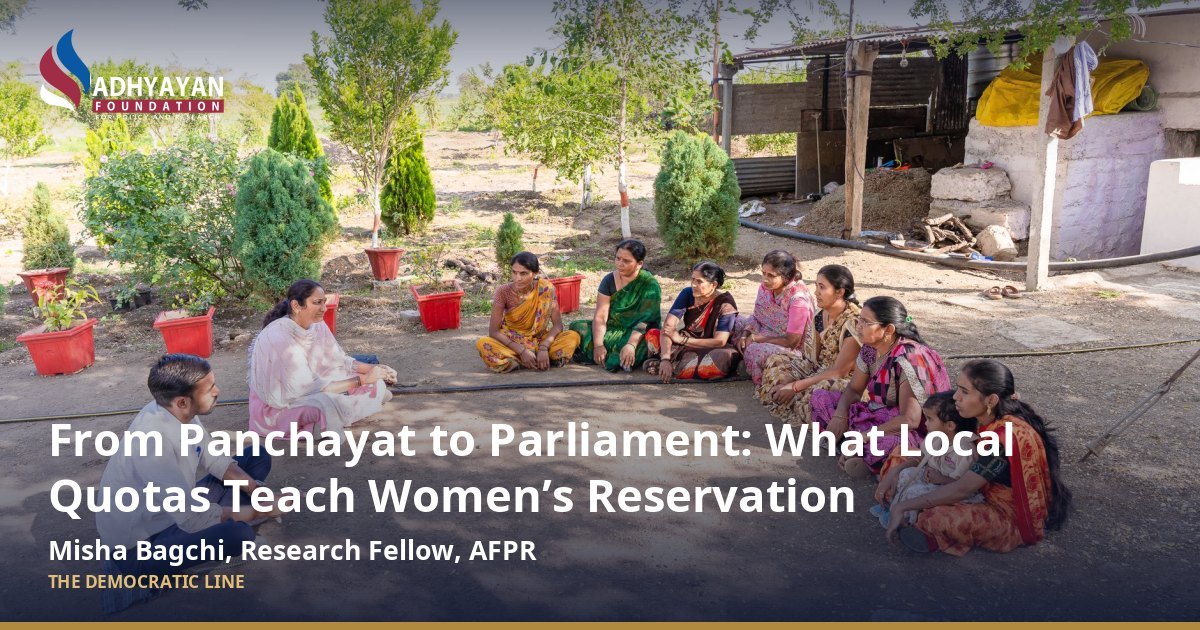
By the most basic measure, the local experiment has worked. IndiaSpend reported in April 2026 that more than 1.5 million women now hold elected posts in panchayati raj institutions. Women hold more than half of panchayati raj seats in 18 States, and only two jurisdictions, Dadra and Nagar Haveli and Daman and Diu, and Ladakh, are below 33 per cent. In Himachal Pradesh women hold 50.13 per cent of panchayat seats, and in Karnataka nearly 53 per cent. That women hold more than the constitutional minimum in so many States shows that the legal floor has become a norm, and in some places a ceiling that has been raised by State law.
Contrast this with the top of the system. In the 18th Lok Sabha women number 75 of 544 members, or 13.79 per cent, according to figures from the Ministry of Statistics and Programme Implementation cited in the same report. In 1957 the figure was 22 of 489, or 5.5 per cent. India stands 149th in the Inter-Parliamentary Union’s 2026 ranking of women’s share of national legislatures, against a global average of 27.5 per cent. Himachal Pradesh, where half of the panchayat members are women, has one woman among its 68 MLAs, and in Karnataka the share of women MLAs is 4.5 per cent. A pipeline that fills at the bottom and runs nearly dry at the top is not what a reader of the constitutional text would have predicted. It is an important finding, and it means that a quota at the top does not simply replicate the logic of the quota at the bottom.
The evidence on what women leaders do
Do women in office behave differently from men, and does it matter? The best-known evidence comes from a randomised natural experiment in West Bengal and Rajasthan. In both States studied, Article 243D’s requirement was implemented by randomly reserving certain village council head posts for women, which allowed researchers to compare reserved and unreserved councils fairly. Raghabendra Chattopadhyay and Esther Duflo’s paper, published in Econometrica in 2004, studied 265 village councils in Birbhum in West Bengal and in Udaipur in Rajasthan, with data collected between 2000 and 2002. According to the summary maintained by the Abdul Latif Jameel Poverty Action Lab, women-led councils in West Bengal built about nine more drinking-water facilities on average and improved road conditions by 18 per cent, while in Rajasthan they built about 2.6 more drinking-water facilities, though road conditions there were 8 per cent worse. The pattern suggests that women leaders invested more in goods, such as drinking water, that matter to women in the village. It also shows that the effects differ by State, which cautions against any simple claim that women govern better.
A second study, by Lori Beaman, Chattopadhyay, Duflo, Rohini Pande and Petia Topalova, published in the Quarterly Journal of Economics in 2009 (volume 124, issue 4, pages 1497 to 1540), asked what happens to attitudes. The authors found that villagers who had never had a woman leader preferred male leaders and, shown identical performance, rated hypothetical women leaders as less effective. Exposure to a woman leader did not change the preference for men, but it weakened stereotypes about gender roles and removed the penalty male villagers applied in rating women leaders’ effectiveness. Villagers rated women as less effective at first exposure but not at second. And after ten years of the quota, women were more likely to run for and to win open seats in villages that had been continuously required to elect a woman as chief councillor.
These two findings are the strongest argument for reservation, and they should be stated fairly. The first shows that quotas can change policy outcomes in ways that the affected group values. The second shows that they can change the politics around them, by making it normal for women to stand and for voters to judge them by results. A conservative reader will note that this is an argument about institutions shaping habits, and that is exactly how the framers of a durable constitutional order expect reforms to work: by changing incentives and expectations over time.
The limits: proxy rule and the one-term trap
The evidence does not support a triumphalist reading. The IndiaSpend report records a long-standing concern that many elected women are treated as figureheads, with husbands or other male relatives and community members performing the functions of the office. A resource-centre specialist quoted there says decisions are often taken or influenced by male family members. The report also describes what a 2026 study calls a one-term trap that arises from rotational reservation: because the reserved seat moves to another constituency at the next election, the woman who held it generally cannot contest it again, and the experience she has acquired is lost. A 2018 survey of 32 women-led panchayats in Tamil Nadu found that about 30 per cent of the women would like to contest again even in an unreserved seat and 15 per cent would like to enter party politics. Those are modest numbers, but they show that a substantial minority is ready to move up, and that the system gives them no clear path.
Two lessons follow, and they matter for the design of the new reservation. The first concerns rotation. Rotation is designed to spread the benefit across constituencies and to prevent a seat from becoming the permanent property of one person. But it makes it hard for any individual to build a career, and the Beaman findings suggest the benefits of exposure are cumulative: the shift in open-seat contests appeared after a decade of continuous reservation. A rotation schedule that moves a reserved seat every five years may therefore trade away the very learning that makes a quota effective. Article 334A(3) provides that seats reserved for women rotate after each subsequent delimitation, as Parliament may by law determine, so the length and design of the cycle will be set by Parliament and the delimitation orders. A design that rotates less often, or that guarantees a woman who has held a seat a chance to contest a successor seat, would answer the problem better.
The second lesson concerns proxy representation. Reservation guarantees that a woman holds the seat. It does not guarantee that she exercises the powers of the seat. The remedies lie in the machinery around the office: training that actually reaches elected women, a system in which the records and the accounts are accessible to the member herself, and a political culture that penalises those who run a proxy. The state can do something about this. Parties can do more, because a party that selects candidates decides whether a woman is placed as a figurehead or as a leader.
Why the pipeline matters more than the quota
The gap between the base and the top suggests that a reservation in Parliament and the Assemblies cannot, on its own, create a supply of experienced candidates. The 1.5 million women who now hold local office are a large pool, but the ladder between a gram panchayat and a legislative seat is long and steep. Candidates for Parliament and Assemblies are chosen by parties, financed by networks and elected in constituencies far larger than a village. The quota will create seats, and the parties must create candidates. A party that has not prepared women for higher office will fill its reserved constituencies with the relatives of existing leaders, and the country will have exchanged the sarpanch’s husband for the legislator’s son’s wife.
This is not a reason to oppose the reservation. It is a reason to accompany it with measures that the framers of the 106th Amendment did not need to put in the Constitution but that the parties and the institutions can supply. Parties can commit to promoting women who have served well in local bodies, and voters can ask them to do so. The Election Commission can publish constituency-wise data on candidates by sex in a form that allows the public to see which parties are fielding women in winnable seats. State governments and Parliament can fund and publish independent evaluations of training for elected women.
The objection from equality
A fair account must also state the case against quotas. Critics argue that reserving seats treats citizens as members of a category rather than as individuals, that it can reduce the quality of competition for the seat, and that rotation removes the accountability that comes from the prospect of re-election. Some add that quotas rest on a premise that women, as a group, share interests, when in fact women are divided by class, caste and region. These are serious points and the Constitution’s authors weighed similar ones when they decided on the reservation of seats for Scheduled Castes and Scheduled Tribes.
The local evidence gives a partial answer to the first two. The competition for the reserved seats is real, and the Beaman study found that after sustained exposure women were more likely to win open seats, which is hard to reconcile with the claim that quotas simply install weaker candidates. It does not answer the third point so easily. Rotation does weaken accountability to the voter, and a woman who knows she cannot stand again has less reason to answer to the village. The fourth point, about divisions among women, is correct, and the fact that outcomes differed between West Bengal and Rajasthan is a reminder that no category speaks with one voice. These arguments do not defeat the case for reservation, but they do point to design choices: longer terms for reserved seats, a more careful rotation, and an honest recognition that a quota guarantees presence and not any particular policy.
What the new reservation should take from the old
Six lessons stand out.
First, the legal floor becomes a social norm. In 18 States women hold more than half of panchayat seats, so the original third has been overtaken. The national reservation should be expected to have similar effects on expectations, and its design should leave room for States and parties to go beyond it.
Second, exposure works slowly. The best evidence of changed behaviour comes after a decade or more of continuous reservation, and the national fifteen-year term, extendable, is therefore the minimum period over which an effect can reasonably be judged.
Third, rotation should be handled with care. The cycle should be long enough for a member to learn the work and to build a record that voters can judge, and Parliament should consider a mechanism that allows a woman who has served well to contest again.
Fourth, proxy rule is a risk at every level and should be treated as one. Training, access to records and the choices of parties are more useful here than further constitutional text.
Fifth, the pipeline is the real constraint. A third of the seats is a number that the Constitution can fix, but a third of capable candidates is something the parties must produce.
Sixth, outcomes must be measured. The most reliable findings about local reservation came from studies that compared reserved and unreserved councils. If the national reservation is to be evaluated with similar rigour, data on candidates, winners and the exercise of office will need to be collected and published from the start.
Conclusion
What does three decades of local reservation show about effective representation? It shows that a legal quota can put women into office in large numbers, can change what local governments build, and can, over time, change what voters think women can do. It also shows that the gap between holding an office and exercising it does not close by itself, that rotation can interrupt the learning on which effectiveness depends, and that a wide base does not automatically produce a broad top. The Constitution has already taken the decision to reserve a third of seats in the Lok Sabha and the Assemblies once the census and delimitation are complete. The task now is to make that reservation work as the best of the local experience suggests it can, so that the women who enter the Houses of the Republic are able to make real use of what they have been given.
Frequently asked questions
What does the Constitution require for women in panchayats?
Article 243D requires at least one-third of directly elected panchayat seats, including those for SC and ST women, and at least one-third of chairperson offices at each level, to be reserved for women, with rotation. Article 243T makes parallel provision for municipalities.
When will the women’s reservation in Parliament take effect?
The 106th Amendment reserves one-third of Lok Sabha, State Assembly and Delhi Assembly seats for women, but under Article 334A it takes effect only after the census and the delimitation that follows. It runs for fifteen years, which may be extended, and does not cover the Rajya Sabha.
What does the evidence say about women leaders in panchayats?
Chattopadhyay and Duflo, studying 265 councils, found women-led councils in West Bengal built about nine more drinking-water facilities, while in Rajasthan they built about 2.6 more. Beaman and colleagues found exposure weakened stereotypes, and after ten years women were more likely to win open seats.
What are the limits of local reservation?
Elected women are sometimes treated as figureheads while male relatives act for them, and rotation can end a member’s career after one term. Women hold 75 of 544 seats (13.79 per cent) in the 18th Lok Sabha, so the base is wide but the top is thin.
Further reading from AFPR: Understanding Quota within Quota: A New Approach to Social Equity in India
Notes and References
1. Constitution of India, Article 243D (reservation of seats in Panchayats; inserted by the Constitution (Seventy-third Amendment) Act, 1992), text as reproduced at constitutionofindia.net. https://www.constitutionofindia.net/articles/article-243d-reservation-of-seats/
2. Constitution of India, Article 243T (reservation of seats in Municipalities; inserted by the Constitution (Seventy-fourth Amendment) Act, 1992), text as reproduced at constitutionofindia.net. https://www.constitutionofindia.net/articles/article-243t-reservation-of-seats/
3. The Constitution (One Hundred and Sixth Amendment) Act, 2023, Gazette of India, 28 September 2023 (Articles 239AA, 330A, 332A and 334A). https://egazette.gov.in/WriteReadData/2023/249053.pdf ; on its commencement on 16 April 2026 and the defeat of the Constitution (131st Amendment) Bill, 2026: LiveLaw, https://www.livelaw.in/amp/top-stories/lok-sabha-rejects-constitution-131st-bill-2026-on-delimitation-530736
4. “From local bodies to Parliament: five charts show how fewer women climb the political ladder”, Scroll.in (IndiaSpend), 17 April 2026. https://scroll.in/article/1092160/from-local-bodies-to-parliament-five-charts-show-how-fewer-women-climb-the-political-ladder
5. Raghabendra Chattopadhyay and Esther Duflo, “Women as Policy Makers: Evidence from a Randomized Policy Experiment in India”, Econometrica, 2004, as summarised by the Abdul Latif Jameel Poverty Action Lab, “Influencing the Provision of Social Services through Mandated Female Representation in Policymaking in India”. https://www.povertyactionlab.org/evaluation/influencing-provision-social-services-through-mandated-female-representation (figures taken from the J-PAL summary; the paper itself was not opened).
6. Lori Beaman, Raghabendra Chattopadhyay, Esther Duflo, Rohini Pande and Petia Topalova, “Powerful Women: Does Exposure Reduce Bias?”, Quarterly Journal of Economics, vol. 124, no. 4 (November 2009), pp. 1497-1540; NBER Working Paper 14198, July 2008. https://www.nber.org/papers/w14198
7. Press Trust of India, “Census to be held in 2 phases between April 2026-Feb 2027: Govt tells Parliament”, The Tribune, 3 December 2025. https://www.tribuneindia.com/news/top-headlines/census-to-be-held-in-2-phases-between-april-2026-feb-2027-govt-tells-parliament