A republic that wishes to govern with restraint must first know whom it governs. Public power, used sparingly, should be aimed accurately, and accuracy depends on counting. India is now partway through its sixteenth census. The houselisting phase was scheduled between April and September 2026, and the population enumeration is scheduled for February 2027 with a reference moment of 00:00 hours on 1 March 2027 [1][2]. Two groups sit uneasily in that machinery: women whose labour is real but does not look like a job, and persons with disabilities whose conditions the law recognises more widely than the form can record.
The argument of this essay is simple. Where women’s work and disability in the census are thinly counted, the damage is not mainly moral or symbolic. It is administrative and fiscal. Denominators decide where money goes, which entitlements can be audited, how reservations are sized and whether a promise made in statute can be checked against reality. A thin count turns each into guesswork, the opposite of the rules-based, institutional governance that a conservative reading of the Constitution prefers. The remedy is neither a bigger census nor a cheaper one, but a better-designed one, with sample surveys and registries as partners rather than rivals.
The 2027 questionnaire details below come from press reports of the Ministry of Home Affairs notification of 14 August 2026, not from the gazette text, and some are contested.
What the Census 2027 schedule asks
The legal and logistical facts first. The Registrar General and Census Commissioner told the press on 30 March 2026 that houselisting would run state by state in 30-day windows from April to September 2026, that population enumeration was planned for February 2027, and that the reference date would be 00:00 hours on 1 March 2027, with 1 October 2026 for Ladakh and the snow-bound areas of Jammu and Kashmir, Himachal Pradesh and Uttarakhand [2]. Caste enumeration was announced for the population phase, following the Cabinet Committee on Political Affairs decision of 30 April 2025 [1][2]. Self-enumeration is new: a household may fill in its details online in 16 languages and receive an identification number that the enumerator later confirms in the field [1][2]. I found no official statement, as of 29 October 2026, declaring the houselisting phase complete, and so I do not assert that it is.
On 14 August 2026 the Ministry of Home Affairs notified the population-phase questions under section 8(1) of the Census Act, 1948, over the signature of the Registrar General [3]. Press listings of the notified schedule count forty items [4]. Those that matter here are: sex (item 3), which one summary reports as offering male, female and third gender [5]; disability (item 13); a block on work that asks whether the person worked at any time in the last year, the category of economic activity, occupation, industry, class of worker, and, for “marginal, semi-marginal and non-worker” persons, a question on non-economic activity and one on seeking or being available for work [4]; and three fertility questions addressed to women [4]. The numbering differs across press summaries, and I have not seen the gazette text itself, so the reader should treat the item numbers as indicative.
Two features deserve attention. First, the work block refers to a “semi-marginal” category, absent from the Census 2011 concepts I reviewed [4][16]; I could not find its definition in any source I opened. Second, the disability item, according to reports of the notified form, groups conditions into nine categories: visual, hearing, speech, locomotor, intellectual, mental illness, acid attack, chronic neurological disease and blood disorder [6]. That list rests on a report of a statement by disability organisations, and on a commentary, rather than on a gazette page I could open [6][23]. It should be read as reported, not as confirmed.
Counting women’s work: what the census measures and what it does not
Work statistics are a matter of definition before they are a matter of arithmetic. In the Census 2011 convention, a main worker is a person who worked for the major part of the year preceding enumeration, that is six months or more, while a marginal worker worked for less than that [16]. Work itself means participation in an economically productive activity, with or without pay, and includes unpaid help on a farm or in a family enterprise [16]. The definition thus already reaches beyond wage employment. Yet the outcome in 2011 was a female work participation rate of 25.51 per cent against 53.26 per cent for men, with a rural female rate of 30.0 per cent and an urban female rate of 15.4 per cent [15].
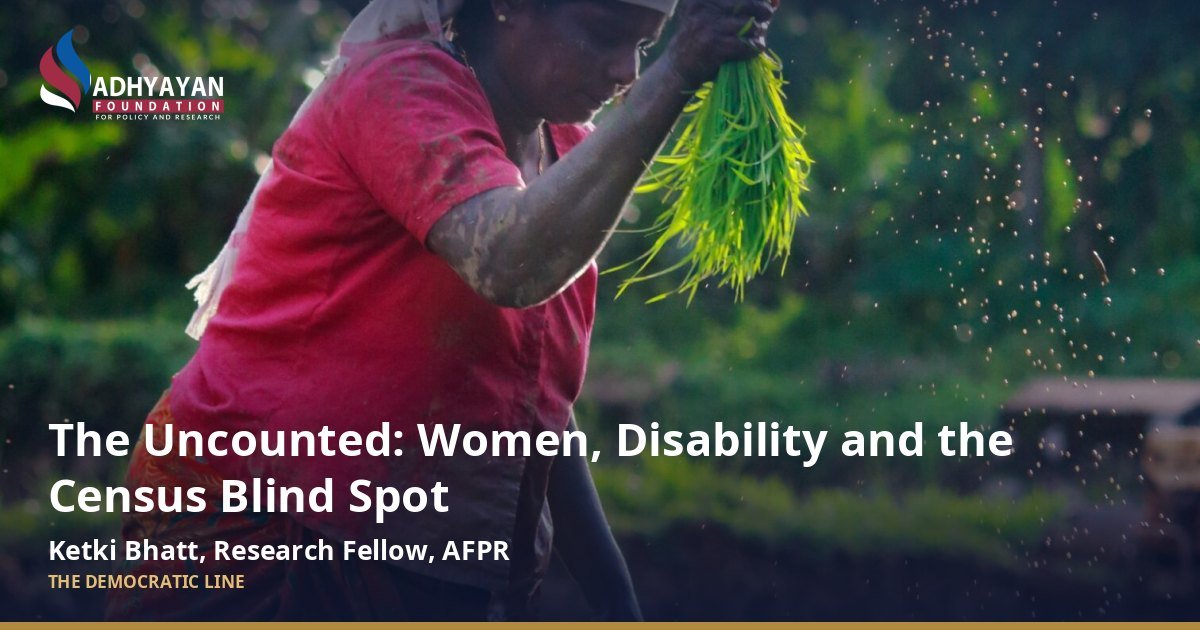
Those numbers are not an error; they measure something, but what they measure depends heavily on the question put and on who answers it. A census generally records the account of one household respondent on behalf of everyone present, and a woman who works in the field, tends livestock and helps in a household enterprise may be recorded as a housewife. A single-pass design is poorly suited to intermittent, seasonal and mixed activity, which is how much rural women’s work is organised.
Sample surveys give a different picture. The Periodic Labour Force Survey annual report for 2025, released on 27 March 2026, puts the labour force participation rate for persons aged 15 and above at 40.0 per cent for women and 79.1 per cent for men on the usual status measure, with a rural female rate of 45.9 per cent [14]. The same release says 64.2 per cent of employed women were self-employed in 2025 [14]. These are not strictly comparable with the census figures, since the age base, reference period and definitions differ, and the years are fourteen apart. But the dedicated labour survey, which probes repeatedly, records women’s participation well above the 2011 census level.
Time-use evidence shows the other side of the ledger. The Time Use Survey of 2024, conducted by the Ministry of Statistics and Programme Implementation across January to December 2024 on a 24-hour reference period, found that 81.5 per cent of women aged six and above took part in unpaid domestic services for household members, against 27.1 per cent of men, and 34.0 per cent of women in unpaid caregiving against 17.9 per cent of men [13]. Among participants, women spent 289 minutes a day on unpaid domestic services against 88 for men [13]. Participation in employment and related activities was 20.7 per cent for women and 60.8 per cent for men [13]. Whether a census, which asks about “work” in the economic sense, can or should capture this is the real question.
International standards give the practical frame. The 19th International Conference of Labour Statisticians in 2013 narrowed “employment” to work done for pay or profit and moved own-use production, such as subsistence farming for the household’s own consumption, into a separately measured category of work [17]. The reform was meant to make unpaid forms visible, not to discard them. The 2027 questions, as listed, still frame the matter in terms of main, marginal and non-workers [4]. National offices may reasonably choose their own definitions; but when a definition leaves a large category of activity in the residual bin, every downstream figure inherits the choice.
The courts have already noticed. In Kirti v. Oriental Insurance Co. Ltd., decided on 5 January 2021 and reported at (2021) 2 SCC 166, the Supreme Court held that the work of a homemaker has economic value, and that notional income must be fixed for compensation, with the concurring opinion drawing on the Time Use in India 2019 survey [22]. The case concerned accident compensation, not statistics, but it shows the legal system beginning to price what the statistical system leaves out.
Counting disability in the census: the 2.21 per cent and what lies behind it
Census 2011 recorded 26.8 million persons with disabilities, a prevalence of 2.21 per cent, with 2.40 per cent among males and 2.01 per cent among females [9]. The question was asked of all persons, enumerators were instructed to speak to the disabled person as well as the respondent, and the categories were chosen to match the Persons with Disabilities Act, 1995 and the National Trust Act, 1999 [9]. The census reported eight groupings: movement, hearing, seeing, “any other”, multiple, speech, mental retardation (the term then used) and mental illness [9].
The National Sample Survey Office’s 76th round, which surveyed July to December 2018 and was released on 23 November 2019, estimated prevalence at 2.2 per cent overall, 2.3 per cent in rural areas, 2.0 per cent in urban areas, 2.4 per cent among males and 1.9 per cent among females [10]. The NSS figure is almost identical to the census figure, which cuts against any lazy narrative that the sample survey exposes a much larger population.
The real contrast lies elsewhere. The World Health Organization’s global report on health equity for persons with disabilities, published on 2 December 2022, estimated that about 1.3 billion people, roughly 16 per cent of the world’s population, experience significant disability [18]. That estimate rests on functional measurement rather than on a list of statutory categories, and the comparison is not like for like. But a gap of this order, between two or three per cent and sixteen per cent, is too large to be explained by demography. It reflects what the questions ask. The Washington Group short set, recommended for censuses and supported by the United Nations for the 2020 round, asks about difficulty in six functional domains (seeing, hearing, walking, remembering or concentrating, self-care and communication) and counts a person if they report “a lot of difficulty” or inability in at least one [19]. Such a design does not depend on a respondent’s willingness to label a family member.
The Rights of Persons with Disabilities Act, 2016, passed by the Rajya Sabha on 14 December 2016 and the Lok Sabha on 16 December 2016, raised the number of recognised disabilities from seven to 21 and added, among others, specific learning disabilities, speech and language disability, acid attack survivors and three blood disorders [12]. It came into force on 19 April 2017 [11]. Statutory benefits turn on “benchmark disability” of forty per cent or more, with a four per cent reservation in government employment under section 34 and five per cent in government and government-aided higher education under section 32 [11]. Census 2027 is the first since that Act [7].
According to the reports cited above, the notified schedule uses nine categories against the Act’s 21 [6][23]. National Platform for the Rights of the Disabled, a coalition endorsed by 405 signatories according to a report of 19 August 2026, argued that autism, specific learning disabilities, dwarfism, leprosy-cured persons and multiple disabilities including deafblindness are not distinctly provided for, and that grouping thalassaemia, haemophilia and sickle-cell disease into one “blood disorder” head renders them invisible [6]. The same report notes that a Union minister had earlier said the census would capture all 21 categories; the Department of Empowerment of Persons with Disabilities was not quoted in the report on any reply [6]. A radio report of the minister’s remarks of 18 March 2026 is consistent with that assurance [8]. An October 2026 consultation by the National Centre for Promotion of Employment for Disabled People added concerns about accessible self-enumeration, enumerator training and reaching people with high support needs and leprosy colonies [7].
A nine-head schedule may yet be mapped to 21 conditions in tabulation, through enumerator instructions or follow-up fields; I have not seen the manual. The question is open, and the ministry can close it by publishing the mapping.
What policy misses when these groups are thinly counted
The key question is what is lost, and the answer can be given under four heads.
The first is budgeting. Gender-responsive budgeting and disability-related allocations are only as good as the population they are scaled against. If the number of women engaged in unpaid or irregular work is understated, programmes that support women’s enterprise, skills and childcare will be sized for the labour force as recorded, not the labour force as it exists. If the population with disabilities is placed at two per cent when functional measures suggest several times that, schemes for aids and appliances, rehabilitation and inclusive education are rationed by an artificial ceiling. A conservative who prizes fiscal prudence should dislike this: money goes to an imagined population or is withheld from the real one.
The second is scheme design and targeting. Benefits that need to reach persons with disabilities are administered through certification and the Unique Disability Identity card, and the ministry’s own replies show a scheme architecture of aids and appliances, rehabilitation, scholarships and skills training [11]. For example, the National Action Plan for Skill Development trained 1.42 lakh persons with disabilities, of whom about 28,000 were placed in wage or self-employment, according to a Lok Sabha reply of December 2024 [11]. Without a census benchmark by district and by type of disability, one cannot say whether those numbers are large or small relative to need. The same is true of schemes for women: a programme evaluated on a base of “women workers” cannot be tested against the women who work without being so recorded.
The third is reservations. The four per cent job quota and five per cent higher-education quota in the 2016 Act turn on benchmark disability and statutory categories [11]. Where an official count does not distinguish the categories, the apportionment of vacancies rests on administrative convention rather than demographic evidence. With caste now to be enumerated, unmeasured disability categories will look more anomalous still.
The fourth is accessibility, where the Supreme Court has spoken with unusual clarity. In Rajive Raturi v. Union of India, decided on 8 November 2024 (2024 INSC 858; reported also as 2024 LiveLaw (SC) 875), a bench led by Chief Justice D.Y. Chandrachud held Rule 15 of the Rights of Persons with Disabilities Rules, 2017 ultra vires the Act because it presented recommendatory guidelines as rules, and directed the Union to frame mandatory accessibility standards in consultation with stakeholders within three months [20][21]. The Court observed that “a ceiling without a floor is hardly a sturdy structure” [20]. The same judgment records a finding of a NALSAR-CDS report that many states do not officially recognise all the statutory categories, leading to underreporting, and notes that a large number of states and union territories had not responded to the Court’s inquiries [20]. I found no SCC citation for this decision and give the neutral citation. The relevance here is direct: a mandatory standard is hard to enforce, and harder to cost, if the population it protects is not measured.
The strongest objection: the census is the wrong tool
The best counter-argument runs as follows. A census is a blunt, once-a-decade exercise run by a very large, temporary and lightly trained workforce, with a limited number of questions and a household respondent who may not know, or may not wish to say, who has a disability or what each woman does. Dedicated instruments do these jobs better. The Periodic Labour Force Survey, with trained investigators and repeated probing, measures female participation more reliably; the Time Use Survey’s 24-hour diary is the right tool for unpaid work; a Washington Group survey or a registry built on the Unique Disability Identity card will give better prevalence than a one-line census item. Loading the census with detail risks fatigue, error and lower quality on its core task, a clean headcount on which delimitation and fiscal transfers depend. Prudence, on this view, counsels simplicity. And self-reported disability is shaped by stigma, whatever the wording.
This is a serious argument and partly correct. The sample surveys are superior for the intensity and nature of work and for functioning, and they should not be displaced. The Washington Group short set is itself commended for censuses precisely because it identifies most persons with disabilities with the fewest questions [19]. And the NSS figure of 2.2 per cent, close to the census’s 2.21 per cent, shows that a sample survey using a similar category-based approach does not solve the problem by itself [10].
But the argument proves less than it seems to. First, the census is the only instrument that produces counts for every village, ward and block. A sample of a few lakh households cannot yield reliable estimates for a district, still less for a minority category of disability whose national prevalence is a fraction of one per cent. The census is the sampling frame and the benchmark against which the surveys are weighted. If it undercounts a group, the surveys inherit the bias. Second, the problem is not primarily the number of questions but their design. A functional screener of six short questions, followed by a category-specific follow-up for those who screen in, adds minutes to a few households, not to all. Third, the registry route depends on prior certification, and certification itself reaches only those who already have contact with the system; a registry cannot count the person the system has never met. Fourth, the 2027 schedule is the first to include self-enumeration and a mobile data-collection app [1][2], which lower the cost of adding conditional questions and cross-checks. The objection from simplicity carries weight against a poor extension, but not against a disciplined one.
Reforms that would stand scrutiny
None of what follows needs a change of law or an expansion of the state. These are measures of design and publication, and several can still be made before the February 2027 enumeration.
One: publish the mapping. The Registrar General should state, in a manual or a public note, how the disability item will be coded against the 21 conditions of the Act, so that tabulations can be compared with the statutory schedule. If the nine heads are indeed all that the form carries, a publicly available follow-up or tabulation rule that separates, for instance, autism, specific learning disability, dwarfism, and the three blood disorders would answer the groups’ main complaint at modest cost.
Two: add a short functional screen. A six-question screener of the Washington Group type, administered to everyone or at least to a defined subset, would allow India to report on both the legal definition and the international functional definition [19]. The two figures can sit side by side. This is how the gap between a recorded two per cent and a global estimate of sixteen per cent can be examined with evidence rather than inference.
Three: make the work questions probe. The enumerator instruction should require that the question on work in the last year be put to each adult directly, and not only to the household head, with explicit cues for family farm work, livestock, household enterprise and home-based production. The Census 2011 definition already includes unpaid help in family enterprises [16]; the issue is whether the interview elicits it. Publishing the definition and the coding of the “semi-marginal” category would also let researchers compare 2027 with 2011.
Four: tabulate across. Release district-level tables that cross sex, disability type, age, education and work status. Policy needs the female wage worker with a locomotor disability, not two separate marginal totals.
Five: link, do not replace. Use the census as the frame for the Periodic Labour Force Survey and the next Time Use Survey, reconcile it with the Unique Disability Identity registry at district level, and run a small post-enumeration check on women’s work and disability so that the undercount is measured rather than guessed.
Six: make the process accessible. Self-enumeration portals and apps should meet accessibility standards, and enumerators should be trained to speak to persons with disabilities directly, as disability organisations have asked [7].
Conclusion
The question was what policy misses when these groups are thinly counted. The answer is not sentiment but substance: a denominator, a benchmark and an audit trail. Without them, budgets are scaled to the wrong populations, schemes cannot be tested against need, reservations rest on convention, and accessibility mandates, which the Supreme Court has now insisted must be binding, cannot be costed or monitored. A state that wishes to do fewer things better needs to know precisely whom those things are for.
The strongest objection, that the census is the wrong instrument and that surveys and registries do the job better, is half right, and the right half argues for a division of labour rather than for silence. The census provides the frame; the surveys supply depth; the registries supply continuity. A thin census count weakens all three.
The required changes are modest. India has adopted a digital, self-enumerating, caste-inclusive census at a stated outlay of about Rs 11,718 crore [1][2]. Against that scale, a disability coding map, a short functional screen, a sharper instruction on women’s work and cross-tabulated district tables are small steps, and they respect the principle that the state’s first duty is to know its citizens accurately. Whether they are taken before the enumerators set out in February is for the Registrar General and the Ministry of Home Affairs to decide.
Frequently asked questions
How many disability categories does Census 2027 use?
According to press reports of the notified schedule, nine categories: visual, hearing, speech, locomotor, intellectual, mental illness, acid attack, chronic neurological disease and blood disorder. The Rights of Persons with Disabilities Act, 2016 recognises 21 conditions, and the article notes the gazette text was not opened.
What disability prevalence did Census 2011 record?
Census 2011 recorded 26.8 million persons with disabilities, a prevalence of 2.21 per cent. The NSS 76th round (2018) estimated 2.2 per cent, while the WHO’s 2022 report estimated about 16 per cent worldwide, on a functional measure that is not like for like.
Why are women’s work and unpaid labour undercounted?
A census generally records one household respondent’s account, and a woman who works in the field or a family enterprise may be recorded as a housewife. The Time Use Survey 2024 found 81.5 per cent of women took part in unpaid domestic services against 27.1 per cent of men.
What reforms does the article propose?
It proposes publishing how the nine heads map to the 21 statutory conditions, adding a short Washington Group functional screen, probing questions on women’s work, cross-tabulating district tables, linking the census with surveys and registries, and making self-enumeration accessible.
Further reading from AFPR: Breaking the Binary: Legal and Social Recognition of Non-Binary and Transgender Rights in India
Notes and References
All items were opened and read for this essay unless stated otherwise. Dates are those printed on or reported by the page; where a page gave no date, that is said.
[1] Press Information Bureau (PIB Research), “Census 2027: India’s First Digital Enumeration Exercise”, 25 April 2026. https://static.pib.gov.in/WriteReadData/specificdocs/documents/2026/apr/doc2026425856601.pdf (opened).
[2] Press Information Bureau, “Registrar General and Census Commissioner of India addresses Press Conference on Census-2027, in New Delhi today”, press conference of 30 March 2026. https://www.pib.gov.in/PressReleasePage.aspx?PRID=2246847®=48&lang=2 (opened).
[3] Down To Earth, “Census 2027 to Include Caste Question for First Time in Independent India, Says MHA Notification”, reporting the Ministry of Home Affairs notification of 14 August 2026. https://www.downtoearth.org.in/governance/census-2027-to-include-question-related-to-caste-a-first-in-independent-india (opened; the gazette PDF itself was not opened).
[4] Business Today, “Census 2027: here is the full list of 40 questions you may be asked”, 17 August 2026. https://www.businesstoday.in/india/story/census-2027-here-is-the-full-list-of-40-questions-you-may-be-asked-549540-2026-08-17 (opened).
[5] Barristery, “Census 2027: Complete List of 40 Questions, Key Changes and What’s New”, August 2026. https://www.barristery.in/2026/08/census-2027-questions.html (opened; secondary blog, used only for the report that sex options include third gender; its question numbering differs from [4] and is not relied on).
[6] Deccan Chronicle, “Rights Groups Seek All 21 Disabilities in Census 2027”, 19 August 2026. https://www.deccanchronicle.com/nation/rights-groups-seek-all-21-disabilities-in-census-2027-1980576 (opened).
[7] ThePrint, “Disability groups want Census 2027 to avoid leaving India’s ‘missing millions’ behind”, 17 October 2026. https://theprint.in/feature/disability-census-2027-avoid-leaving-indias-missing-millions/3074537/ (opened).
[8] GS Times, “Census 2027 to recognise all 21 disability categories”, 18 March 2026, citing All India Radio on remarks by the Union Minister of State for Social Justice and Empowerment. https://www.gstimes.in/census-2027-to-recognise-all-21-disability-categories/ (opened; secondary aggregator).
[9] Office of the Registrar General and Census Commissioner, India, presentation to the UN Expert Group Meeting on disability measurement, 12-14 July 2017. https://unstats.un.org/unsd/demographic-social/meetings/2017/new-york–disability-egm/Session%204/India.pdf (opened).
[10] Press Information Bureau (Ministry of Statistics and Programme Implementation), “NSS report no. 583: Persons with Disabilities in India, NSS 76th round (July-December 2018)”, 23 November 2019. https://pib.gov.in/PressReleasePage.aspx?PRID=1593253 (opened).
[11] Press Information Bureau (Ministry of Social Justice and Empowerment), reply in the Lok Sabha on empowerment of disabled persons, 10 December 2024. https://www.pib.gov.in/PressReleasePage.aspx?PRID=2082717®=48&lang=2 (opened).
[12] Press Information Bureau, “Rights of Persons with Disabilities Bill – 2016 Passed by Parliament”, December 2016 (page date not printed in the extract opened). https://www.pib.gov.in/newsite/printrelease.aspx?relid=155592®=48&lang=2 (opened).
[13] Ministry of Statistics and Programme Implementation, Press Release on Time Use Survey 2024, 25 February 2025. https://mospi.gov.in/sites/default/files/press_release/PR_TUS_25022025.pdf (opened).
[14] Ministry of Statistics and Programme Implementation, Press Note, Periodic Labour Force Survey Annual Report 2025, 27 March 2026. https://www.mospi.gov.in/uploads/latestReleases/latest_release_1774607827733_3e8964a9-268b-4cc9-ad65-cfc8a9e32f08_Press_note_AR_PLFS_2025_23032025_V2.1_26032026_final.pdf (opened).
[15] Ministry of Statistics and Programme Implementation, Women and Men in India 2014, Chapter 4 “Participation in Economy” (Census 2011 data, Office of the Registrar General). https://www.mospi.gov.in/sites/default/files/reports_and_publication/cso_social_statices_division/Chapter_4_2014.pdf (opened).
[16] Indian Economic Service (Government of India), Arthapedia, “Worker (Census Definition)”, undated. https://ies.gov.in/arthapedia/concept/worker-census-definition (opened; secondary government reference page).
[17] International Labour Organization, page on statistics of work, employment and labour underutilization (19th International Conference of Labour Statisticians, October 2013), undated. https://www.ilo.org/global/statistics-and-databases/statistics-overview-and-topics/WCMS_470295/lang–en/index.htm (opened).
[18] World Health Organization, “Global report on health equity for persons with disabilities”, 2 December 2022. https://www.who.int/publications/i/item/9789240063600 (opened).
[19] Washington Group on Disability Statistics, primer on the Short Set of Questions, undated. https://www.washingtongroup-disability.com/fileadmin/uploads/wg/Documents/primer.pdf (opened).
[20] Supreme Court of India, Rajive Raturi v. Union of India, W.P. (C) No. 243 of 2005, judgment of 8 November 2024, 2024 INSC 858. https://api.sci.gov.in/supremecourt/2005/9321/9321_2005_1_1503_56986_Judgement_08-Nov-2024.pdf (opened; no SCC citation found in the text).
[21] LiveLaw, “Supreme Court Directs Union To Frame Mandatory Rules Under Rights Of Persons With Disabilities Act For Accessibility Of Public Spaces”, November 2024 (reported as 2024 LiveLaw (SC) 875). https://www.livelaw.in/top-stories/supreme-court-directs-union-to-frame-mandatory-rules-under-rights-of-persons-with-disabilities-act-for-accessibility-of-public-spaces-274704 (opened).
[22] Kirti v. Oriental Insurance Co. Ltd., Civil Appeal Nos. 19-20 of 2021, decided 5 January 2021, (2021) 2 SCC 166. Bench of N.V. Ramana, S. Abdul Nazeer and Surya Kant JJ. Report: LiveLaw, https://www.livelaw.in/amp/top-stories/supreme-court-homemakers-house-hold-work-economic-value-motor-vehicles-compensation-167981 ; concurrence on the Time Use in India 2019 survey: SCC Online blog, https://www.scconline.com/blog/post/2021/01/06/conception-that-housemakers-do-not-add-economic-value-to-the-household-is-a-problematic-idea-future-prospect-must-be-granted-in-case-of-motor-accident-of-a-non-earning-victim-sc/ ; the (2021) 2 SCC 166 citation as cited by the Delhi High Court, https://delhihighcourt.nic.in/app/showFileJudgment/59727042026MACA3572018_201428.pdf
[23] Civilsdaily, “Counting out the disabled citizens”, 25 August 2026. https://www.civilsdaily.com/news/counting-out-the-disabled-citizens/ (opened; opinion piece).