In the Indian political dictionary, the bandh, a forced general strike or blockade, has long been used as the loudest expression of political disagreement. From local highway blockades to state-wide shutdowns, political outfits routinely halt commercial life to show their strength or air their grievances. Beneath the politics lies an economic reality: the cost of a bandh falls unevenly on the Indian economy.
The Cost of a Bandh and of Coercion
The Constitution guarantees freedom of speech and peaceful assembly, but repeated disruption of daily public life raises questions about the limits of protest and the rights of other citizens. When local commerce is shut down, the State does not pay the price. The people who pay are the daily-wage workers who lose their income, the supply chains that break, and an economy that loses investment.
A bandh’s costs extend beyond lost transactions to wages, damaged goods, delayed production, higher logistics costs and public expenditure. The key question is not only how much activity is disrupted, but who bears the cost.
The Micro-Economic Haemorrhage: Punishing the Poor
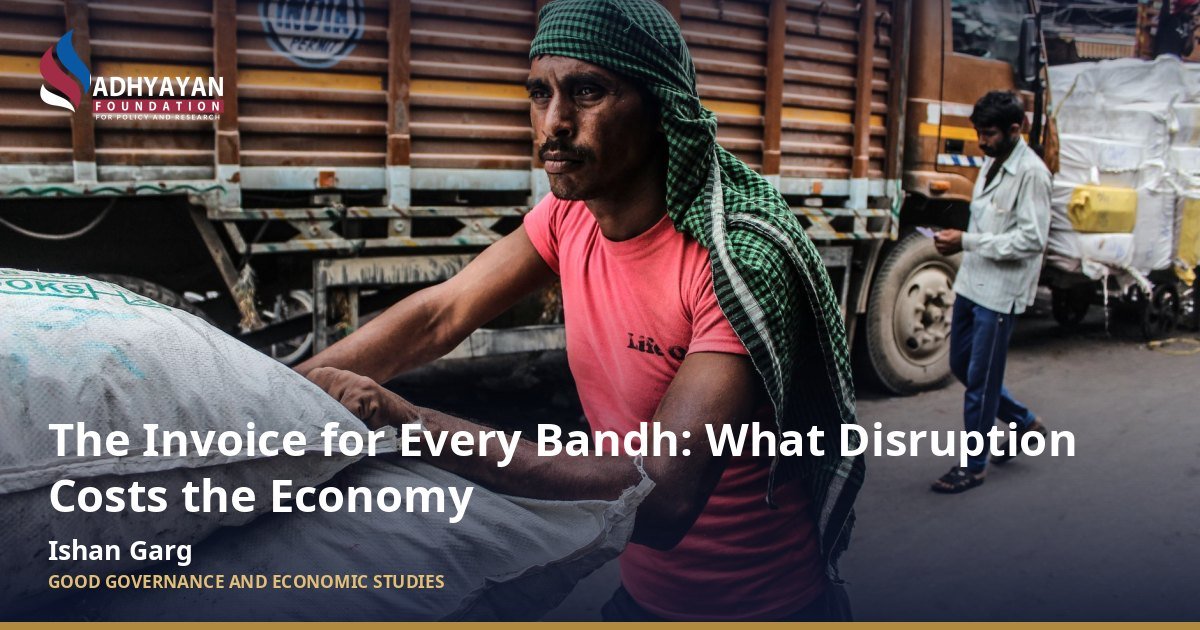
The most immediate victims of a bandh are not large corporations but the most vulnerable participants in the informal economy. According to Table 14 (page A-176) of the Additional Tables of the Annual Report of the Periodic Labour Force Survey 2022-23, published by the Ministry of Statistics and Programme Implementation (MoSPI), casual labour accounted for 21.8 per cent of workers across rural and urban India under the usual-status measure (principal plus subsidiary status), covering workers of all ages.
For these citizens, a forced shutdown is not merely an inconvenience. It is the loss of a day’s livelihood, with no social safety net or paid leave to absorb the shock. Blockades of national and state highways can also disrupt agricultural supply chains. Perishable goods such as milk, vegetables and poultry depend on timely transport to wholesale markets (mandis) and retail outlets. Delays can reduce the quality and market value of produce and raise costs for traders and consumers. The size of the loss depends on the duration of the blockade, the nature of the goods and the availability of alternative routes.
The Macro-Economic Impact: Lost Revenue and Deterred Capital
Beyond the informal sector, bandhs and blockades impose costs on businesses, public services and government finances. A suspension of commercial activity interrupts production schedules, reduces sales and delays the movement of raw materials and finished goods.
The Bharat Bandh of 2 April 2018 gives a documented example from Uttar Pradesh. The shutdown, called in protest against the Supreme Court’s March 2018 judgment on the Scheduled Castes and Scheduled Tribes (Prevention of Atrocities) Act, was accompanied by violence, road blockades and disruption in several parts of the state. In Agra, the Uttar Pradesh State Road Transport Corporation (UPSRTC) reported a loss of Rs 25.60 lakh from disrupted bus operations and damaged buses. The figure was based on details sent by the corporation’s regional office to the district administration and confirmed by the Additional District Magistrate, as reported by The Times of India. Officials said the statewide loss to UPSRTC was not known, so the Agra figure is a floor, not a total.
More troubling is a political culture that permits frequent, arbitrary shutdowns. It makes the business environment less predictable, and private capital, domestic and foreign, relies on predictability. When manufacturing hubs or logistics corridors can be disrupted at will by non-state actors, firms face greater uncertainty in long-term investment decisions. Just-in-time supply chains need reliable logistics; chronic disruption forces industries to hold larger inventories, which locks up working capital and lowers efficiency.
The Legal Framework: Strike versus Bandh
The Indian judiciary has repeatedly recognised the economic and social costs of forced disruption, and it draws a sharp line between a voluntary strike (hartal) and a forced shutdown.
The leading authority is Communist Party of India (M) v Bharat Kumar (1997), in which the Supreme Court, by its judgment of 12 November 1997, upheld the Kerala High Court’s conclusion that there is no right to call or enforce a bandh that interferes with the fundamental freedoms of other citizens. The Court endorsed the distinction between a bandh and a general strike or hartal, and stressed that the fundamental rights of the public as a whole cannot be subordinated to the claims of an individual or a section of society.
More recently, in Amit Sahni v Commissioner of Police (2020), the Supreme Court addressed the prolonged blockade of public roads during protests and held that “public ways and public spaces cannot be occupied in such a manner and that too indefinitely”. The Court affirmed that opposition is protected, but that protesters’ rights must be balanced against those of commuters and the wider public.
The decision should be read in its context. It concerned prolonged occupation and obstruction of public spaces; it did not impose a blanket prohibition on demonstrations or on temporary protest. Its wider significance is the principle that the exercise of one set of rights cannot indefinitely extinguish the rights of others.
The Counter-Argument: Disruption as Democratic Leverage
The strongest argument against curbing blockades and bandhs lies in the history of civil disobedience and the realities of democratic engagement in a highly unequal society.
In a vast democracy, institutions can remain unresponsive to marginalised communities. When petitions and peaceful appeals fail, economic disruption may be their only non-violent leverage. Strikes, blockades and hartals were also used by India’s independence movement to compel the colonial government to negotiate. Critics argue that prohibiting blockades puts economic efficiency and middle-class convenience ahead of the democratic rights of farmers, labourers and minorities who may have few other ways to move a government. On this view, temporary losses to output are an acceptable price for keeping the state responsive to its most marginalised citizens.
The argument deserves serious consideration. The right to protest should not be reduced to economic convenience, nor should the cost of dissent alone decide the legitimacy of a demonstration. Peaceful collective action has played a vital role in widening democratic participation, especially for groups whose voices might otherwise go unheard.
Response: Coercion Is Not Constitutionalism
Opposition is indispensable in a republic, but equating a coercive bandh with historical civil disobedience misreads the Constitution. Civil disobedience means peacefully breaking a law and accepting the penalty in order to expose an injustice. A bandh, by contrast, uses coercion to restrict the freedoms of those who do not take part. Democratic leverage rests on persuasion and voluntary solidarity, not on force. When a shutdown relies on highway blockades, damage to public transport or threats against shopkeepers, it ceases to be democratic protest and becomes coercion by a crowd.
The distinction, therefore, is not between economic activity and democratic rights, as if one must always prevail over the other. It is between voluntary collective action and coercive enforcement. Citizens must remain free to support a strike, join a demonstration, refuse to work or express solidarity. They must equally remain free to disagree, run their businesses, travel to work and reach essential services without pressure.
When the burden of protest falls on people who have little influence over the dispute and little capacity to absorb the loss, the claim that disruption is an acceptable democratic price is hard to defend. The legitimacy of a demand cannot by itself justify the means used to advance it.
Conclusion
India’s economic progress and constitutional order depend on a shared commitment to the rule of law. The cost of each bandh shows in lost wages, disrupted production, delayed agricultural deliveries, higher business expenses and, at times, damage to public infrastructure. The right to peaceful protest is a pillar of the Republic under Article 19, but it does not confer a power to compel unwilling citizens to take part or to obstruct public spaces indefinitely.
The answer is not to weaken the right to disagree but to protect the conditions in which dissent can coexist with the freedoms of others. Political organisations must be able to mobilise, demonstrate and call for voluntary strikes; citizens must be free to join or decline without fear. The State, in turn, must protect peaceful assembly while preventing intimidation and coercive disruption.
A democracy should not have to choose between the right to protest and the right to earn a livelihood. The test of constitutionalism is whether it can protect both. The cost of a bandh should not be imposed by force on those least able to bear it.
Frequently asked questions
Who bears the cost of a bandh?
Mainly daily-wage workers who lose a day’s income, along with supply chains and traders. Casual labour accounted for 21.8 per cent of workers in the Periodic Labour Force Survey 2022-23.
What did the Supreme Court decide in Communist Party of India (M) v Bharat Kumar?
On 12 November 1997 the Court upheld the Kerala High Court’s conclusion that there is no right to call or enforce a bandh that interferes with the fundamental freedoms of other citizens. It endorsed the distinction between a bandh and a hartal.
What did the 2018 Bharat Bandh cost the UPSRTC in Agra?
The Uttar Pradesh State Road Transport Corporation reported a loss of Rs 25.60 lakh in Agra from disrupted bus operations and damaged buses. The statewide loss was not known, so the figure is a floor, not a total.
Does the article argue against the right to protest?
No. It says the right to peaceful protest is a pillar of the Republic under Article 19, but it does not confer a power to compel unwilling citizens to take part or to obstruct public spaces indefinitely. The line it draws is between voluntary collective action and coercion.
Further reading from AFPR: The Grammar of Dissent: Why the Constitution Sends Protest to Institutions, Not the Street
References
Ministry of Statistics and Programme Implementation (MoSPI), Additional Tables of the Annual Report, Periodic Labour Force Survey (PLFS), July 2022-June 2023, National Sample Survey Office, December 2023, Table 14, “Percentage distribution of workers in usual status (ps+ss) by broad status in employment for each social group”, all-India, rural plus urban, person category, p. A-176.
Lavania, D., “UPSRTC suffered Rs 25.60 lakh loss in Bharat Bandh violence”, The Times of India (Agra), 11 April 2018.
Tripathi, A., “Bharat Bandh victims to be compensated, UP govt tells HC”, The Times of India, 12 April 2018.
Communist Party of India (Marxist) v Bharat Kumar and Others, Civil Appeal Nos 7728-7729 of 1997, Supreme Court of India, 12 November 1997, (1998) 1 SCC 201; AIR 1998 SC 184.
Amit Sahni v Commissioner of Police and Others, Civil Appeal No 3282 of 2020, Supreme Court of India, 7 October 2020, 2020 INSC 579.
Constitution of India 1950, art 19(1)(a), (b), (d) and (g), read with art 19(2), (3), (5) and (6).