Fifty weeks, fifty letters. How Chief Minister Yogi Adityanath turned the humble paati into a working instrument of compassionate, accountable governance.
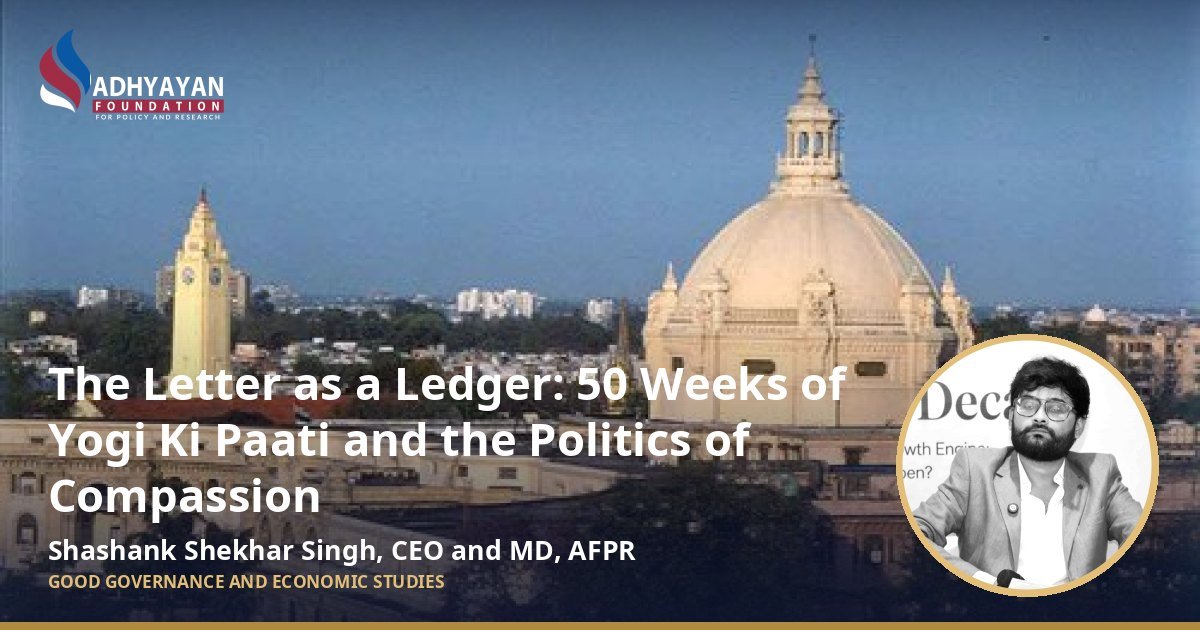
In an age of thirty-second reels, trending hashtags and press notes that nobody reads past the headline, the Chief Minister of India’s most populous state has chosen the oldest medium of all: the letter. Every week for fifty weeks, Yogi Adityanath has written a paati to the people of Uttar Pradesh. On 16 November 2026 that habit became a milestone. The fiftieth letter was published, a coffee table book compiling all fifty editions, prepared by the state’s Information Department, was released at the Chief Minister’s official residence in Lucknow, and an exhibition on the Samvad Yatra, the journey of dialogue, was inaugurated alongside it.[1][2]
It would be easy to dismiss this as a communications exercise. That would be a misreading. Read closely, Yogi Ki Paati is something rarer in Indian public life: a head of government putting his priorities, his reasoning and his commitments in writing, every week, addressed to the very people who will hold him to them. If one had to name the two hallmarks of this administration that the series reveals most clearly, they would be compassion and communication, and the argument of this essay is that in Uttar Pradesh the two have become inseparable.
Why a Chief Minister writes letters
The fiftieth letter opens with the question the Chief Minister imagines his readers have been asking all year: why does a Chief Minister write letters at all? His answer is the most revealing passage of the series. The real duty of governance, he writes, is not merely to frame schemes and count achievements, but to reach the last person in society, whose expectations and pain often never reach the system.[3]
He goes further. Uttar Pradesh, he writes, is not merely an administrative unit but a family, and in a family one does not issue orders; one converses with a sense of belonging. The relationship between the Chief Minister and the state’s 25 crore people, in his telling, should never be confined to formal notifications.[3]
That is a statement of governance philosophy, not sentiment. It treats communication not as the last step of policy (announce, publicise, move on) but as part of policy itself. The letter closes with an invitation rather than an announcement: the Chief Minister wants the paati to carry not only his own thoughts but the expectations and suggestions of the people. Their voice, he writes, is the real strength of the paati.[3]
A letter for every Uttar Pradesh
What strikes anyone who reads the series end to end is its range. This is not one message repeated fifty ways. The letters have spoken to very different citizens, in very different registers:
- To children, in February, warning against deadly Chinese manjha during kite season and against the growing grip of mobile phones, and urging them towards sport and real interests.[4]
- To families and readers, on the eve of Ambedkar Jayanti, asking every household to keep good books at home, read them and pass the habit to their children, because that is how Babasaheb’s dream is realised.[5]
- To young innovators, on National Technology Day, calling on youth to embrace technology and innovation in building a self-reliant Uttar Pradesh.[6]
- To every road user, voicing concern over road accidents and appealing for safer behaviour on the state’s roads.[6]
- To the youth again, on Bhagat Singh’s birth anniversary, asking them to draw courage from his life and to make books their friends.[7]
- To the devotee and the citizen alike, ahead of Ayodhya’s tenth Deepotsav, presenting the festival as a celebration of sacrifice, dignity and cultural confidence before the world.[8]
- To the whole state, on the government’s ninth anniversary, timed to Chaitra Navratri, drawing a parallel between the nine forms of Maa Durga and nine years of governance.[9]
Child safety, constitutional values, technology, road safety, patriotism, culture and development: the spread is deliberate. A government that speaks only on its anniversaries speaks to voters. A government that speaks about manjha in kite season and helmets on highways is speaking to families. That difference is the whole point.
Back to Vantangiya, where the idea was born
The fiftieth letter returns to the place where, by the Chief Minister’s own account, the idea of the paati took root: the Vantangiya villages of Gorakhpur.[3]
He recalls his first visit there. Communities such as the Kol, Gond, Musahar, Tharu and Buksa were living in pitiable conditions, cut off for years from the most basic facilities, and the sight moved him deeply.[3] The Vantangiya story is one of historic invisibility. Settled in the forests to plant and tend trees under the colonial taungya system, these families were neglected through some 120 years of British rule and seven decades after Independence. They had no revenue villages, no secure citizenship entitlements, and their children had no schools.[2]
At the book release the Chief Minister shared an episode that says more than any statistic. When a school for Vantangiya children was started in a forest department shed, whitewashed and run with the help of a temple trust, the then government and the forest department filed a case against him. The Centre had amended the Forest Rights Act in 2007–08, but the law was not effectively implemented in Uttar Pradesh until 2017.[2][10]
What changed after 2017 is a matter of official record. The state government granted revenue village status to 54 Vantangiya settlements, bringing thousands of families into the formal administrative map and, with it, roads, electricity, housing, schooling, rations and the full range of citizen entitlements.[2][10] A community the state once treated as encroachers became, on paper and in practice, citizens. The Chief Minister’s own summary at the launch was simple: thousands of families once denied basic facilities now have all of them, and they have citizenship.[11]
This is why the Vantangiya letter matters. It is not a victory lap. It is a reminder of what invisibility costs, and an explanation of why a Chief Minister feels the need to keep talking directly to people whose pain, in his words, does not always reach the system.
Beyond Vantangiya: the last-mile communities
The same approach, the government has said, now extends to other communities among the most deprived in the state: the Musahar, Tharu, Chero, Gond and Kol. They are being covered under the Mukhyamantri Awas Yojana for pucca houses, alongside other state schemes.[2][10]
The record on children tells the same story of the last mile. Before 2017, the government notes, Basic Shiksha Parishad schools were on the verge of closure, dilapidated and short of teachers, and 60 to 70 per cent of children, girls especially, walked to school barefoot. Under Operation Kayakalp, 96 per cent of these schools have been provided basic facilities with public participation, and about 1.6 crore children now receive money for uniforms, bags, books, shoes and socks directly in their parents’ accounts through DBT. Atal Residential Schools serve the children of workers and Mukhyamantri Composite Schools have been set up for quality education.[2] In Purvanchal, where encephalitis once struck thousands of children every year between July and November and claimed hundreds of young lives in hospitals that lacked power, fans and life-saving equipment, the government reports that encephalitis deaths have been brought to an end.[2][10]
The Chief Minister also made a point that every policy practitioner will recognise: schemes fail not only in design but in awareness. Eligible families routinely miss out on an Ayushman card, a ration card or a destitute women’s pension simply because nobody told them.[2] Repeating information about government schemes, again and again, is therefore not publicity. It is delivery. Yogi Ki Paati is, in this sense, a last-mile instrument: it takes the scheme out of the government order and into the household conversation.
The letter as a ledger of accountability
There is a sharper argument to be made here, and it deserves to be made plainly.
A letter is a public record. Speeches are delivered and forgotten; press releases are drafted by departments. A signed letter from the Chief Minister, published every week and now compiled into a book, is a document. It can be quoted back, checked against outcomes and held up when promises slip. A leader who commits his reasoning to paper fifty times in a year is voluntarily creating a ledger against which he can be measured.
A letter explains the why, not just the what. Most government communication tells citizens what has been done. The paati tells them why something matters: why Chinese manjha is dangerous, why reading at home is a civic act, why a forest settlement deserves revenue status. Explaining the reasoning behind policy is the foundation of democratic consent.
A letter invites a reply. The fiftieth letter explicitly asks for people’s suggestions and expectations to find a place in the conversation. That turns broadcast into dialogue, and dialogue is where feedback loops, and therefore course correction, begin.
A letter removes the filter. In a state of 25 crore people, the distance between Lucknow and a Musahar hamlet is measured not in kilometres but in layers of intermediaries. A direct letter collapses those layers.
Compassion as a method, not a mood
The deeper lesson of Yogi Ki Paati is that compassion in governance is not a soft virtue. It is a method. The Vantangiya revenue villages did not begin with a cabinet note; they began with a visit, a shed turned into a classroom, and a public servant who saw something he could not unsee. The policy followed the encounter.
This is how good public policy is so often made: from observation to empathy, from empathy to design, from design to delivery, and then back to communication, so that the people a policy was made for actually know it exists. The weekly letter closes that loop. Compassion without communication stays private feeling; communication without compassion becomes propaganda. Joined together, they become governance that people can recognise as their own.
Innovation in government is usually imagined as dashboards, portals and apps, and Uttar Pradesh has no shortage of those. Yet the state’s most interesting innovation of the past year may be a letter, and it works precisely because it feels human. In choosing the language of family over the language of the file, the Chief Minister has made accessibility itself a policy commitment.
The road ahead
Fifty letters are a beginning, not a conclusion. The real test of the paati will be whether the voices it invites begin to shape its pages: whether a Tharu farmer’s suggestion, a schoolgirl’s complaint or a street vendor’s idea finds its way back into a future letter. The fiftieth edition signals that intent clearly.
In closing that letter, the Chief Minister asks that this partnership of ideas become a bridge of trust that brings government and society closer, and that together the people resolve to build an Uttar Pradesh foremost in prosperity and finest in values.[3] In a political culture that often prefers the megaphone, it is worth appreciating a leader who has chosen the pen, and who has kept writing, week after week, to the last person in the queue.
Frequently asked questions
What is Yogi Ki Paati?
It is a weekly letter written by Uttar Pradesh Chief Minister Yogi Adityanath to the people of the state, sharing his thoughts, the government’s priorities and information about public welfare schemes. It completed 50 weeks on 16 November 2026.
What did the 50th Yogi Ki Paati say?
It explained why the Chief Minister writes the letters, tracing the idea to his first visit to a Vantangiya village in Gorakhpur, described Uttar Pradesh as a family of 25 crore people, and invited citizens to share their expectations and suggestions.
What has the Vantangiya community received since 2017?
According to the state government, 54 Vantangiya settlements were granted revenue village status, giving thousands of families access to basic facilities, citizenship rights and government schemes.
Which other communities are covered by the same approach?
The government says the Musahar, Tharu, Chero, Gond and Kol communities are being given pucca houses under the Mukhyamantri Awas Yojana and are being linked to other state schemes.
Further reading from AFPR: The UP Turnaround: Evaluating Uttar Pradesh’s Growth Trajectory
Notes
1. “50 weeks of Yogi Ki Pati: 25 crore residents are my family, says CM Yogi”, Aaj Tak, 16 November 2026. https://www.aajtak.in/uttar-pradesh/story/cm-yogi-adityanath-fifty-weeks-yogi-ki-pati-uttar-pradesh-dialogue-progress-ntc-acwi-utrath-rpti-2697437-2026-11-16
2. Chief Minister’s remarks at the release of the Yogi Ki Paati coffee table book, Lucknow, as reported by Amar Ujala, 16 November 2026. https://www.amarujala.com/lucknow/up-cm-yogi-makes-a-major-revelation-says-a-case-was-filed-against-him-under-the-then-government-for-building-2026-11-16
3. Yogi Ki Paati, 50th edition, “Atmiya Samvad ki Swarnim Yatra”, Information and Public Relations Department, Government of Uttar Pradesh, 16 November 2026 (text as displayed at the Samvad Yatra exhibition, Lucknow).
4. “Yogi Adityanath’s special message to students”, India TV, February 2026. https://www.indiatvnews.com/uttar-pradesh/yogi-adityanath-s-special-message-to-students-reduce-screentime-devote-time-to-sports-and-valued-interests-2026-02-09-1029444
5. “Adopting Babasaheb’s thoughts will build harmonious, empowered, prosperous state: CM Yogi”, IANS, 13 April 2026. https://ianslive.in/educate-organise-and-struggle-only-then-will-babasahebs-dream-be-realised-cm-yogi-on-ambedkar-jayanti–20260413092941
6. “On National Technology Day CM Yogi addressed state youth with letter”, Zee News, May 2026. https://zeenews.india.com/hindi/india/up-uttarakhand/lucknow/on-national-technology-day-cm-yogi-addressed-state-youth-with-letterdeep-tech-capital-youth-message/3212530
7. “CM Yogi on why he writes Paati to the public”, India TV Hindi, 16 November 2026. https://www.indiatv.in/uttar-pradesh/up-cm-yogi-adityanath-answers-why-he-write-letter-paati-to-public-says-uttar-pradesh-state-is-a-family-2026-11-16-1254628
8. “Ayodhya’s Deepotsav showcasing values of sacrifice, dignity and dedication on global stage: CM Yogi”, IANS, 2 November 2026. https://hiindia.com/ayodhyas-deepotsav-showcasing-values-of-sacrifice-dignity-and-dedication-on-global-stage-cm-yogi/
9. “Yogi Adityanath and nine years of transformation in Uttar Pradesh”, Organiser, 28 March 2026. https://organiser.org/2026/03/28/346122/bharat/yogi-adityanath-and-nine-years-of-transformation-in-uttar-pradesh-a-story-of-governance-and-growth/amp/
10. “CM Yogi releases coffee table book based on Yogi Ki Paati”, REVOI, 16 November 2026. https://hindi.revoi.in
11. “From Vantangiya to the Musahar community, CM Yogi recounts stories of struggle in Yogi Ki Paati”, KNews, 16 November 2026. https://knewsindia.in/big-breaking-2/from-the-vantangiya-to-the-musahar-community-cm-yogi-recounts-stories-of-struggle-in-yogi-ki-paati/