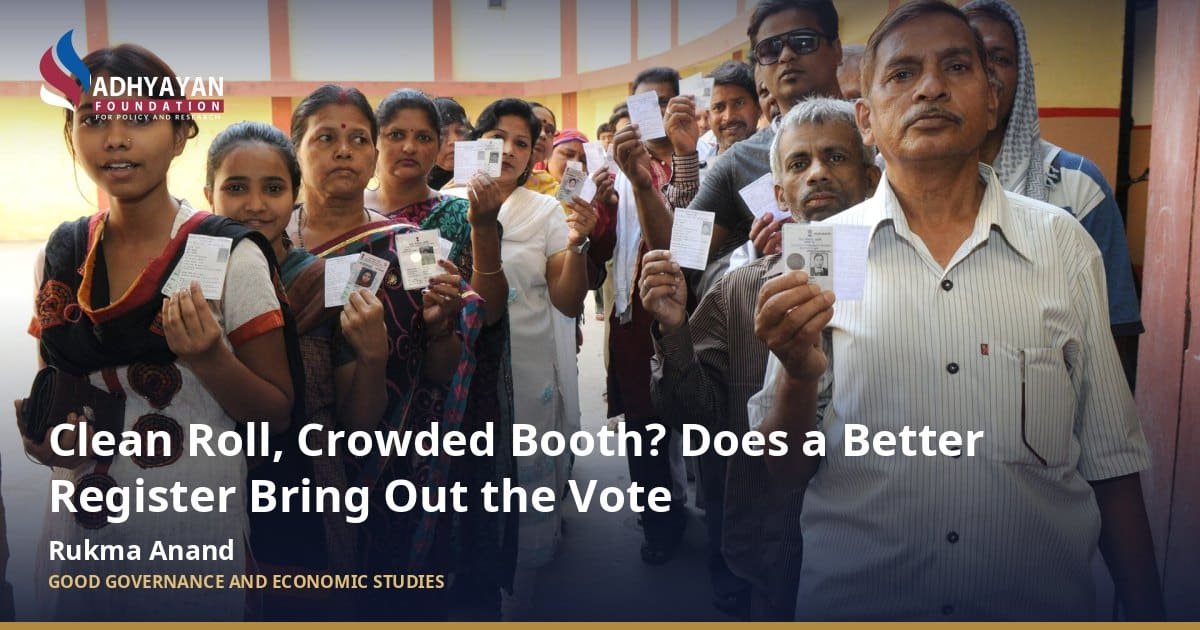
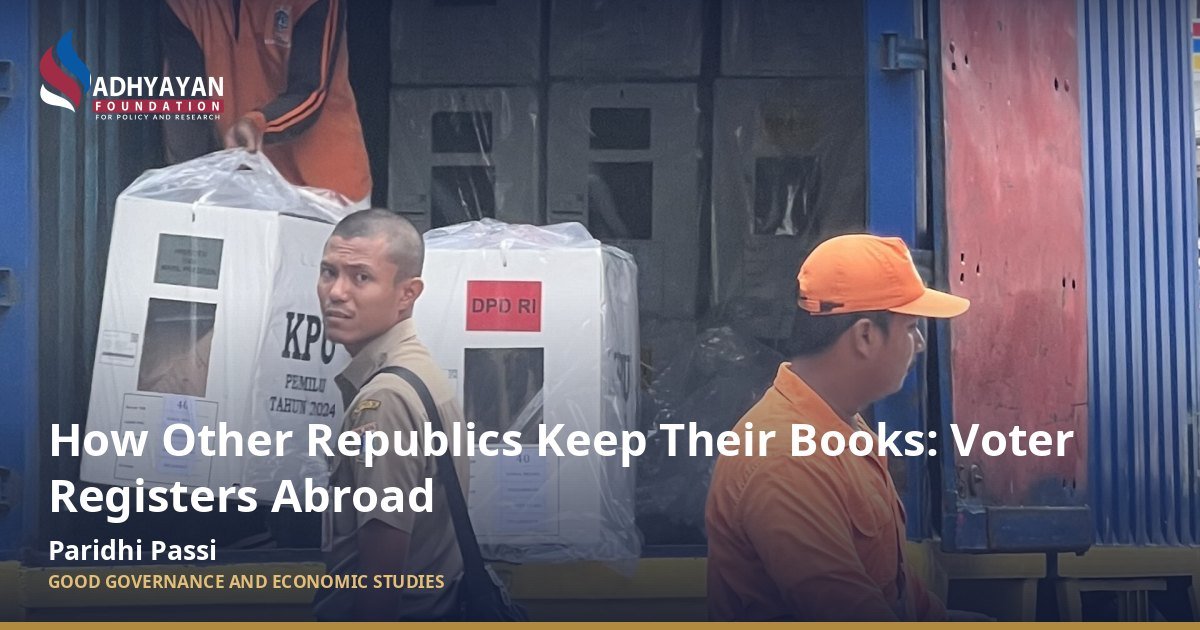
A democracy is only as legitimate as its voter list, and that list is only as good as the process that produces it. In June 2025 the Election Commission of India began a Special Intensive Revision, or SIR, of Bihar’s electoral rolls. According to the Commission’s figures, about 65 lakh names were taken off the draft roll, 21.53 lakh were later added through Form 6 applications, and the final roll ended up about 47 lakh names smaller than the one before the exercise. In May 2026 the Supreme Court upheld the SIR under Article 324 of the Constitution and Section 21(3) of the Representation of the People Act, 1950.
There was never much doubt that the Commission had the power to do this. The real question is whether intensive revision is a good way to keep a roll accurate. A country that has to run large clean-up drives to fix its rolls has a design problem, and comparing the voter registration systems of India, Germany, Australia and the United Kingdom makes that problem easier to see.
Who Bears the Burden in Voter Registration Systems?
Registration systems differ mainly on one point: who has to make sure an eligible person is on the roll, the citizen or the state? Countries that leave it to the individual tend to end up with lower registration. The United States is the clearest case among its peers; the Institute for Responsive Government notes that it registered 73% of eligible voters in the 2020 presidential election. Germany, which registers people automatically, is above 90%. The Australian Electoral Commission, or AEC, reports that Australia, which uses direct enrolment, stood at 97.6% in September 2025.
The SIR sits nearer the individual-burden end. Voters had to respond to enumerators within a short window and produce documents, a few months before a state election. People who could not be found were marked for deletion. The Commission’s own breakdown of the 65 lakh draft deletions, as reported by The Wire, was about 22 lakh dead, 36 lakh shifted or not found, and 7 lakh duplicates. Treating those 36 lakh as something the voter had to explain, rather than something the state had to explain, was a choice, and a questionable one.
Germany: When the Roll Maintains Itself
Germany has no separate voter registration process. Residents must register with their local municipality when they move, and that population register is used to build the electoral roll. People are added at 18 and their addresses change when they move, so there is no revision drive and no need to ask voters for documents. The roll stays accurate because the register behind it is kept up for other purposes anyway.
The starting assumption is different from India’s. In Germany a person is on the roll unless something changes. In the SIR a name had to be confirmed or it could be removed. Some of the 36 lakh names removed as shifted or not found were probably out of date. Still, “not found” says as much about how hard the state looked as it does about the voter. When an eligible person cannot be found, that is a failure of the system, and in the SIR it tended to become the voter’s problem.
Australia: The State Does the Paperwork
Australia is a useful comparison because it is also large, has a lot of internal movement and has a federal structure. The AEC uses data from licensing authorities, the tax office, births, deaths and marriages registries and education departments to add or update people on the roll without an application. Enrolment is still compulsory, but the state does most of the work.
A parliamentary committee report from 2012 records the AEC’s estimate that about 90% of eligible Australians were enrolled at the end of 2011. By September 2025 the figure was 97.6%. The roll is maintained continuously instead of being rebuilt before an election, and that is the main contrast with the SIR.
The United Kingdom: A Warning
The UK is the cautionary case. In 2014 it replaced household registration with Individual Electoral Registration, where each person applies, helped by data-matching and online tools. The Electoral Commission’s 2023 report, on the December 2022 registers, found them 86% complete and 88% accurate, with up to eight million people missing or wrongly registered (James, 2023). The Commission concluded that “there is little evidence to suggest that levels of accuracy and completeness are likely to significantly improve without major changes to the current electoral registration system.”
The lesson is that technology only goes so far when the model stays the same. The UK added data-matching and online registration and still has a large gap. Digitising the SIR, adding Aadhaar checks or training enumerators better is unlikely to fix the underlying problem, for the same reason.
The Counter-Argument, and Why It Is Not Enough
The strongest objection to copying Germany or Australia is that India’s data is not good enough. Research by James and Garnett across countries finds that automatic registration improves completeness and accuracy, but it depends on reliable population data. On 8 September 2025 the Supreme Court told the Commission to accept Aadhaar as a twelfth identity document in the SIR, but said it is not proof of citizenship. Automatic registration built on weak records could put ineligible people on the roll, which is also a problem for electoral integrity.
That concern is fair, but it does not make the SIR a permanent answer. It means the priority should be building records that can support continuous maintenance. If the Commission has to run an SIR every cycle because those records do not exist, the drive is covering for a gap. The people who pay for that gap are mostly migrant workers, the rural poor and others for whom collecting documents at short notice is hardest.
The Point India Needs to Reckon With
Article 326 guarantees universal adult suffrage, and Article 324 gives the Commission the power to carry it out. In the 1978 Mohinder Singh Gill case, the Supreme Court described Article 324 as a “reservoir of power” to act where the statute is silent. In Bihar that power was used to remove 65 lakh names from the draft roll, about 36 lakh of them as shifted or not found, and in October 2025 the Court asked the Commission to explain a further 3.66 lakh names left out of the final roll, as The Tribune reported. The power exists. Whether this is the right tool for the job is another matter.
Three changes would help. Electoral registration should be linked to existing government databases, with safeguards. Constituency-level grievance mechanisms should be set up so that wrongful deletions can be fixed without going to the Supreme Court. And detailed deletion and addition figures should be published after each revision, so that claims about accuracy can be checked.
The SIR was lawful, and the judgment was correct. But defending repeated intensive revision as housekeeping, when 36 lakh names in one state’s draft roll were removed as shifted or not found, does not show that the accuracy problem is solved. It leaves the cost of that problem with the voters.
Frequently asked questions
How does Germany keep its voter roll accurate?
Residents must register with their local municipality when they move, and that population register is used to build the electoral roll, so there is no separate revision drive.
How does Australia maintain its electoral roll?
The Australian Electoral Commission uses data from licensing authorities, the tax office, births, deaths and marriages registries and education departments to add or update people without an application. It reported 97.6% enrolment in September 2025.
What does the UK example show?
The Electoral Commission found the December 2022 registers 86% complete and 88% accurate, even after data-matching and online registration were added, so technology alone did not close the gap.
What does the article say about the Bihar SIR?
It says the SIR was lawful and the Supreme Court judgment correct, but that about 36 lakh of the 65 lakh draft deletions were shifted or not found, a cost that fell on voters.
Further reading from AFPR: Counting the Counters: SIR Across the States, Phase by Phase
References
All India Radio. (2025a, September 8). Supreme Court allows Aadhaar as 12th identity document for Bihar voter list revision.
All India Radio. (2025b, September 30). Election Commission releases final voter list with 7.42 crore names for Bihar Assembly Elections.
All India Radio. (2026, May 27). Supreme Court upholds legality of ECI’s special intensive revision of electoral rolls.
Australian Electoral Commission. (2025, October 23). Enrolment statistics.
Electoral Commission. (2023). 2023 report: Electoral registers in the UK.
Electoral Reform Society. (2026, February 12). Briefing on automatic voter registration.
James, T. S. (2023). Register every voter. Unlock Democracy and University of East Anglia.
James, T. S., & Garnett, H. A. (2024). The determinants of electoral registration quality: A cross-national analysis. Representation, 60(2), 279-302. https://doi.org/10.1080/00344893.2023.2207194
Joint Standing Committee on Electoral Matters. (2012). Chapter 2: The issues. Parliament of Australia.
Mohinder Singh Gill v. Chief Election Commissioner, (1978) 1 S.C.C. 405 (India).
Sellers, J. S. (2024, March 15). Comparative voter registration: Lessons from abroad for improving access and accuracy in the United States. Institute for Responsive Government.
The Tribune. (2025, October 7). Furnish details of 3.66 lakh excluded voters, SC tells EC.
The Tribune. (2025). Bihar voter count drops to 7.42 cr; 65 lakh deleted, 21 lakh added during SIR.
The Wire. (2025). Bihar SIR: Electoral roll shrinks by 6%, net 47 lakh voters excluded from EC’s final voter list.