
By Shashank Shekhar Singh, CEO and MD, AFPR
The framers knew satyagraha from the inside, and still chose courts, legislatures and the ballot. Seventy-five years of jurisprudence has kept faith with that choice.
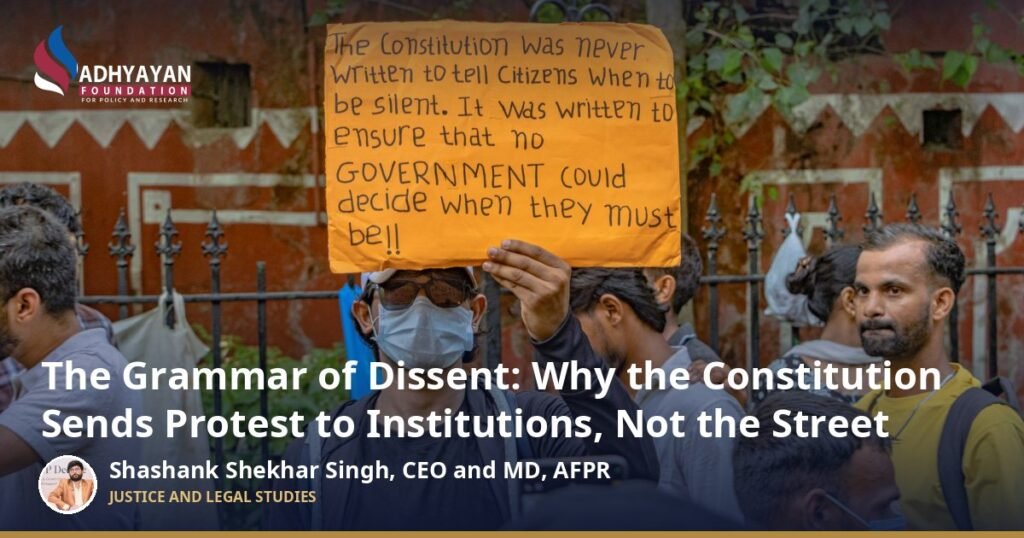
Every few years, India relearns an old lesson in the open air. This October, crowds gathered in Delhi and other cities demanding the removal of the Chief Election Commissioner over the Special Intensive Revision of electoral rolls.[1] Within days the Supreme Court was asked to direct the police to allow protests at Jantar Mantar, and a bench led by the Chief Justice remarked that protests held without permission could be unlawful.[2] The same Court had already issued notice on petitions challenging the Commission's conduct.[1] The grievance, in other words, was before the highest constitutional forum in the land even as it was being carried through the streets.
That coincidence is the subject of this essay. The right to protest in India is protected by the Constitution. It does not protect the idea that the street may stand in for the courtroom, the legislature or the Election Commission. The distinction is not a modern convenience of governments. It was drawn, deliberately and in full knowledge of what mass agitation can achieve, by the men and women who had led the largest civil disobedience movement in history.
The framers who knew satyagraha
The members of the Constituent Assembly were not theorists of protest; many were its practitioners. When draft Article 13, which became Article 19, came before the House on 1 December 1948, the debate turned on how much liberty a new and fragile republic could afford.
Damodar Swarup Seth wanted the "freedom to assemble peaceably and without arms" guaranteed, and warned that the restrictions attached to it would make the guarantee "virtually ineffectual".[3] Hukam Singh objected that the power to legislate "in the interest of public order" left the freedoms "so precarious and entirely left at the mercy of the legislature", and that the Assembly was "certainly making these freedoms illusory".[4] H. V. Kamath reminded the House that the Congress had once put "its seal of approval on this Satyagraha movement against the Arms Act".[5]
The Assembly heard them and still kept the limits. K. M. Munshi persuaded it to drop "sedition", a word "of doubtful and varying import", in favour of speech that "undermines the security of, or tends to overthrow, the State".[6] The text that emerged guaranteed every citizen the right "to assemble peaceably and without arms", while Article 19(3) allowed reasonable restrictions on it in the interests of public order.[7] When the revised article returned on 17 October 1949, the House rejected Thakur Das Bhargava's proposal to require "any reasonable law" in place of "any law", and added contempt of court as a further ground of restriction.[8]
The framers, then, were not naïve about the State. They feared executive overreach as much as any critic does today. Their answer was not to license the street but to bind the State to law and to subject that law to judicial review.
Ambedkar's verdict
The settlement was given its sharpest form on 25 November 1949, the day before the Constitution was adopted. Dr B. R. Ambedkar told the Assembly that if Indians wished to keep democracy in fact and not merely in form, they must "hold fast to constitutional methods of achieving our social and economic objectives".[9] That meant giving up the bloody methods of revolution, and also the methods of civil disobedience, non-cooperation and satyagraha. Those methods had been justified when no constitutional road was open. Where constitutional methods were available, he argued, they had no justification at all. "These methods are nothing but the Grammar of Anarchy and the sooner they are abandoned the better for us."[9]
The passage is often quoted and rarely read for what it says. Ambedkar was not condemning the freedom struggle. He was saying that its tools belonged to a world without a vote, a court or a Parliament, and that a people who had won all three should use them. The obligation he described runs both ways. The citizen must use constitutional means; the State must keep those means open, fair and quick enough to deserve the citizen's trust.
What the courts built on that foundation
The Supreme Court has spent seventy-five years giving that settlement legal shape, and its rulings point in one consistent direction.
In Romesh Thappar v State of Madras (1950), the Court declared that freedom of speech and of the press "lay at the foundation of all democratic organisations", and insisted that a line be drawn between minor breaches of the peace and serious threats to the security of the State.[10] Parliament responded the next year: the First Amendment of 1951 added "public order" to the grounds for restricting speech in Article 19(2), and the Sixteenth Amendment of 1963 added "the sovereignty and integrity of India" to the grounds in Articles 19(2) to 19(4).[11]
In Kameshwar Prasad v State of Bihar (1962), a Constitution Bench held that a demonstration is "a form of speech or of expression", and may take the form of an assembly protected by Article 19(1)(b). It struck down a service rule banning every kind of demonstration by government servants, because the rule did not separate the peaceful from the disorderly. The same judgment was clear about the limit: stone-throwing by a crowd is "a violent and disorderly demonstration" outside the protection of the Constitution, and there is no fundamental right to strike.[12]
In Himat Lal K. Shah v Commissioner of Police, Ahmedabad (1972), Chief Justice Sikri held that the State may regulate the use of streets, but only by rules made "in aid of the right of assembly". A rule giving a police officer unguided power to refuse permission was struck down as "arbitrary".[13]
The Court then drew the line from the other side. In Communist Party of India (M) v Bharat Kumar (1997), it affirmed the Kerala High Court's ruling that an enforced bandh is unconstitutional, because "the fundamental rights of the people as a whole cannot be subservient to the claim of fundamental right" of an individual or a section.[14] A call for a hartal is speech. A bandh that shuts shops, roads and livelihoods by fear is coercion.
The modern cases complete the picture. In re Ramlila Maidan Incident (2012) arose from the police operation of the night of 4–5 June 2011 to clear an assembly at the Ramlila Maidan. The Court held that these rights may be restricted only "by or under the authority of law", never by executive power without it, and that the State has a positive duty to protect those who assemble. In the same breath it affirmed that the right to hold meetings in public places "is subject to control of the appropriate authority" as to time and place.[15] In Mazdoor Kisan Shakti Sangathan v Union of India (2018), concerning demonstrations at Jantar Mantar, it stated plainly that "the right to protest is, thus, recognised as a fundamental right", and equally that such rights "are not untrammeled and unlimited in their scope".[16] And in Amit Sahni v Commissioner of Police (2020), the Shaheen Bagh case, a three-judge bench held: "Democracy and dissent go hand in hand, but then the demonstrations expressing dissent have to be in designated places alone." Public ways and public spaces, it added, "cannot be occupied in such a manner and that too indefinitely".[17]
What, then, is the right to protest?
Read together, these rulings yield a clear doctrine.
First, peaceful protest is a fundamental right, rooted in Articles 19(1)(a) and 19(1)(b). The State must respect it and protect those who exercise it.
Second, the right is to assemble "peaceably and without arms". Violence, intimidation and coercion are not degraded forms of protest; they fall outside the right altogether.
Third, the State may regulate time, place and manner, but only by law, with guided discretion and subject to judicial review. Arbitrary refusals fail; so do indefinite occupations of public roads.
Fourth, one citizen's protest cannot extinguish another citizen's rights. The commuter, the trader, the patient and the student also have fundamental rights, and the Constitution does not rank them below the demonstrator's.
India is not alone in this design. Article 21 of the International Covenant on Civil and Political Rights, to which India is a party, recognises the right of peaceful assembly but allows restrictions imposed in conformity with law and necessary in a democratic society in the interests of national security, public safety or public order.[18] The Indian position is the mainstream democratic position, not an authoritarian exception.
Why the street cannot replace the institution
The case for institutions over agitation is sometimes dismissed as a defence of whoever holds power. It is the opposite. Institutions are the only arenas in which the weak and the strong meet on rules neither can change mid-game.
A court requires evidence. A legislature requires a majority and a public record. The Election Commission is answerable to statute and, as this month shows, to the Supreme Court. The street requires none of these. It rewards whoever can mobilise the largest crowd, block the most important road or sustain disruption the longest. That is not a democratic test. It is a test of organisational muscle, and it favours the well-funded, the well-networked and the most willing to escalate.
For a republic that is barely seventy-five years old, governing more than a billion people across deep lines of language, region, caste and faith, the risk is sharper still. Older democracies built their institutions over centuries before mass politics arrived. India built hers in a single generation, and their authority rests heavily on public confidence. Every time a dispute that belongs in a courtroom or a counting hall is settled instead by who can hold a road hostage, that confidence is drawn down. Those who wish India ill, at home or abroad, understand this better than anyone. The unity and integrity of the nation are not abstractions in Article 19(3); they were written there because the framers had just lived through Partition.
None of this asks citizens to be silent. It asks them to be constitutional. Petition the courts, which have shown they will hear urgent matters within days. Lobby legislators. Organise, campaign and vote. Demonstrate, peacefully and in the places and at the times the law sets. The right to protest is the right to persuade, not the right to compel.
Ambedkar's warning was addressed to his own generation of nationalists, who had every moral claim to the methods of the freedom struggle and were asked to lay them down anyway. That request has lost none of its force. A free people that keeps its grievances inside its institutions strengthens both. A people that carries them to the street, as a habit rather than a last resort, weakens the very institutions it will one day need to protect its own rights.
Frequently asked questions
Is the right to protest a fundamental right in India?
Yes. Peaceful protest is protected by Article 19(1)(a), freedom of speech and expression, and Article 19(1)(b), the right to assemble peaceably and without arms. In Mazdoor Kisan Shakti Sangathan v Union of India (2018), the Supreme Court said the right to protest is recognised as a fundamental right.
Can the State restrict protests?
Yes, but only by law. Article 19(3) allows reasonable restrictions in the interests of the sovereignty and integrity of India or public order. The Supreme Court has held that the police may regulate the time, place and manner of assemblies, but cannot use unguided, arbitrary power to refuse permission (Himat Lal K. Shah, 1972; Ramlila Maidan, 2012).
Can protesters block public roads indefinitely?
No. In Amit Sahni v Commissioner of Police (2020), the Shaheen Bagh case, the Supreme Court held that demonstrations must be held in designated places and that public ways cannot be occupied indefinitely.
What did Dr Ambedkar mean by the "grammar of anarchy"?
In his speech of 25 November 1949, Ambedkar argued that once constitutional methods are available, civil disobedience, non-cooperation and satyagraha lose their justification, and called them "the Grammar of Anarchy".
Further reading from AFPR: Petition, Not Placard: Why the Street Cannot Stand In for the Supreme Court, the Election Commission and the Constitution · Gender Neutrality vs Gender Justice: Rethinking Equality in Law
Notes
1. "Supreme Court to list plea seeking permission for peaceful protests in Delhi", The Pioneer, 5 October 2026 (petition: Priya Mishra v Union of India, Diary No. 62121/2026; notice issued on petitions concerning the Chief Election Commissioner). https://dailypioneer.com/news/supreme-court-plea-peaceful-protests-jantar-mantar-delhi-police
2. Report on the Supreme Court hearing on restrictions before the 10 October protest at Jantar Mantar, Kerala Kaumudi, 10 October 2026. https://keralakaumudi.com/en/india/general/supreme-court-protests-without-permission-legal-action-1813164
3. Constituent Assembly Debates (CAD), Vol. VII, 1 December 1948, Damodar Swarup Seth, paras 7.64.11 and 7.64.13. https://www.constitutionofindia.net/debates/01-dec-1948
4. CAD, Vol. VII, 1 December 1948, Hukam Singh, paras 7.64.176 and 7.64.179.
5. CAD, Vol. VII, 1 December 1948, H. V. Kamath, para 7.64.76.
6. CAD, Vol. VII, 1 December 1948, K. M. Munshi, para 7.64.164.
7. Constitution of India, Articles 19(1)(b) and 19(3). https://www.constitutionofindia.net/articles/article-19/
8. CAD, Vol. X, 17 October 1949, paras 10.154.91–10.154.137 (T. T. Krishnamachari's contempt-of-court amendment adopted; Thakur Das Bhargava's "reasonable law" amendment negatived). https://www.constitutionofindia.net/debates/17-oct-1949/
9. Dr B. R. Ambedkar, CAD, Vol. XI, 25 November 1949; text as reproduced in Dr. Babasaheb Ambedkar: Writings and Speeches, Vol. 6 (Dr. Ambedkar Foundation, Ministry of Social Justice and Empowerment, Government of India). https://mea.gov.in/Images/CPV/Volume6.pdf
10. Romesh Thappar v State of Madras, AIR 1950 SC 124, (1950) SCR 594, decided 26 May 1950.
11. Constitution (First Amendment) Act, 1951; Constitution (Sixteenth Amendment) Act, 1963.
12. Kameshwar Prasad v State of Bihar, AIR 1962 SC 1166, 1962 Supp (3) SCR 369, decided 22 February 1962.
13. Himat Lal K. Shah v Commissioner of Police, Ahmedabad, (1973) 1 SCC 227, AIR 1973 SC 87, decided 15 September 1972.
14. Communist Party of India (M) v Bharat Kumar, (1998) 1 SCC 201, decided 12 November 1997.
15. In re Ramlila Maidan Incident v Home Secretary, Union of India, (2012) 5 SCC 1, decided 23 February 2012, paras 22, 25 and 44.
16. Mazdoor Kisan Shakti Sangathan v Union of India, AIR 2018 SC 3476, decided 23 July 2018, paras 54–55.
17. Amit Sahni v Commissioner of Police, AIR 2020 SC 4704, decided 7 October 2020, para 17.
18. International Covenant on Civil and Political Rights (1966), Article 21. https://www.ohchr.org/en/instruments-mechanisms/instruments/international-covenant-civil-and-political-rights